
7 Regional Dhams of Himachal Pradesh: How Every District Feasts Differently
The first time you sit at a real Dham, you do not understand the shape of what is happening. The plate is a leaf. The seat is the floor. The man pouring dal is barefoot, in a dhoti and vest, and he has been awake since four. Around you, somewhere between fifty and five hundred other people are sitting in two long parallel rows, none of them looking at their phones, and the rice has not stopped arriving.
You are eating a feast that is about a thousand years old, prepared by a caste of hereditary cooks whose families have been doing exactly this since a king came back from Kashmir.
And here is what no English-language travel article has ever properly admitted: this feast you are eating, this particular Dham, is not what they would have served you fifty kilometres to the east. Or fifty kilometres to the south. The Government of Himachal Pradesh says it in plain, almost embarrassed prose on its tourism portal: a Mandi Dham is much different from a Chamba, Kangra, Bilaspur, Shimla, Sirmaur or Kullu Dham. That is seven distinct feasts. Most of the writing about Himachali food covers four of them, at most. The other three almost never make it into English.
So that is the project here. Seven Dhams. Seven districts. One feast per Boti, none of them quite the same.
What is a Dham, exactly
A Dham is the communal meal of Himachal Pradesh. It is served at weddings, at temple festivals, at thread ceremonies, at funeral feasts, at the launch of a new shop, at retirement parties, at the inauguration of a new piece of agricultural land. It is, by any reasonable measure, the most important non-religious institution in the state, and it is not optional. If your daughter is getting married, there will be a Dham. If your village deity is being processed through town for Shivratri, there will be a Dham. If you are a Boti, you may be cooking it for twenty thousand people at JP Naddas sons wedding, which actually happened, in Bilaspur, in 2024.
The rules are surprisingly strict. Traditional Dham contains no onion, no garlic, no ginger, no tomato. It uses lentils, yoghurt, ghee or mustard oil, buttermilk, rice, garam masala, a few specific dry spices, and that is it. Vegetables are rare. Meat is almost never served, even at a Hindu wedding in a meat-eating valley like Kullu, because Dham started life as prasad, sacred temple food, and the rules of satvik cooking carry over.
The dishes come out in odd numbers. Five, seven, nine, eleven. Eleven dishes means a serious host. The first thing on your leaf is steaming rice, and you make a small crater in the middle with your right hand because the dishes are about to arrive sequentially and the crater stops them from running into each other on the leaf. Rice will land on your plate three times during the meal. Dessert may come first, or it may come last, depending on where you are.
The origin story everyone tells, and which appears in Whetstone Magazine and is gestured at in the Himachal Pradesh Tourism portal, is that about a thousand years ago a descendant of King Jaisthambh of Chamba travelled to Kashmir, was served a Wazwan, the multi-course Kashmiri feast prepared by the hereditary Waza chefs, and returned to Chamba determined to commission a vegetarian version of the same thing. He gave the brief to the Brahmin cooks of the Chamba court, and over the following generations they refined it into what we now call a Dham, with their own caste, the Botis, performing the same hereditary role that the Wazas perform in Srinagar.
That is the legend. The truth probably has more rough edges than that. But the geographical link to the Wazwan is not invented. A Dham is, at its bones, what happens when you take the structural logic of Wazwan and run it through a Hindu vegetarian kitchen at five thousand feet.
- Age of tradition
- ~1,000 years (Chamba court origin)
- Number of regional Dhams
- 7 (HP Govt official)
- Number of dishes
- 5, 7, 9 or 11 (odd numbers only)
- Cooking start
- 4 AM, sometimes the night before
- Banned ingredients
- Onion, garlic, ginger, tomato, most vegetables
- Serving format
- Pattal leaf plates, Painth floor seating
- Who cooks
- Boti chefs - hereditary Brahmin caste
- Where to eat (no invite)
- Naina Devi langar (Bilaspur), Himachali Rasoi (Shimla), Mandi Shivratri Feb 16-22 2026
The seven Dhams, district by district
This is where the assumption that there is one Himachali Dham falls apart. The basic vocabulary is shared. Every district uses madra. Every district uses khatta. Every district uses some form of rice-and-dal as a structural backbone. But the proportions, the cooking fats, the order of service, the signature dish, and the texture of the day all change district to district, and a Boti in Pathiar will tell you, with a slight frown, that what Mandi Botis make is not really the same kind of cooking at all.
Chambyali Dham (Chamba) — the origin point
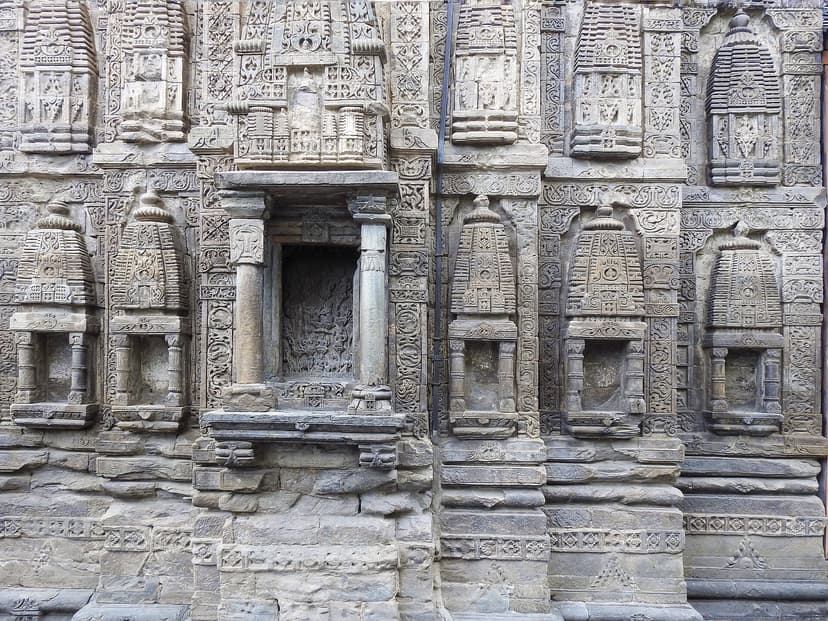
Chamba is where the tradition starts. The valley of the Ravi, the seventeenth-century Bhuri Singh Museum, the old wooden Chamba palace. Lakshmi Narayan temple is the centre of the old town and the architectural anchor of Chambyali Dham, because the feast came out of that temple circle in the first place.
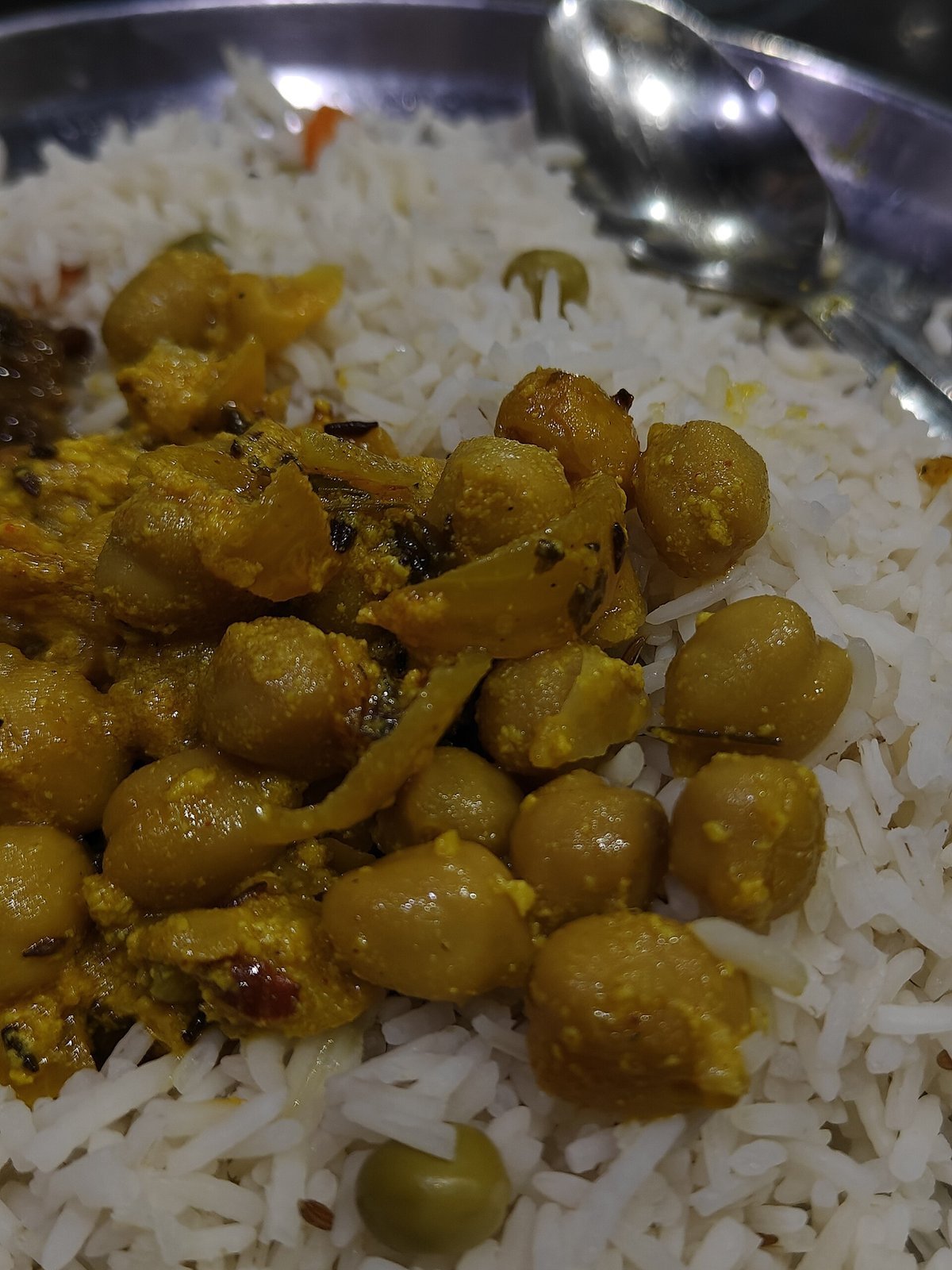
Chambyali Dham opens with rice and moong daal. The middle of the meal is a Madrah of chickpeas, slow-cooked in yoghurt and pahadi ghee with a long bay-leaf-and-cardamom temper. Mash daal, black gram with the skin on, comes next, then a Khutta of jaggery and tamarind which is the lower-acid cousin of Mandyali Khatta. Mittha, sweet rice cooked with raisins and dry fruits, closes the meal. A wedding-grade Chambyali Dham also includes moti sevian, thick sweet vermicelli, and on some occasions kathauti, small wooden bowls, appear alongside the pattal, which is a Chamba-specific touch.
The feeling of a Chambyali Dham, if you have to put one word on it, is ghee-rich. Mustard oil shows up rarely; the cooking fat of the upper belt is desi ghee from local cows, and on a cold November wedding day in Chamba, with a wood fire crackling somewhere behind the Rasialu, that ghee is half the point.
Kangri Dham (Kangra) — the most commercially visible
Kangra is where the Boti tradition is most alive as a working profession today. The valley itself runs broad and green from Pathankot up to the foothills of the Dhauladhar, and the Boti families clustered around Palampur, Kangra town, Pathiar, and Dharamshala still take more bookings than the families anywhere else in the state. If you Google "Boti Himachal" the result that comes back is almost always Sanjay Mishra of Pathiar, who runs Sanjay Mishra Kangri Dham & Catering (9816457888) and was profiled by The Better India as one of the few Botis who came back to the village after a near-extinction generation.
Kangri Dham is the ten-or-eleven-dish Dham. The District Kangra page lists Chana Madra, Mahani, Teliya Mah, chane ki dal, boondi-ka-meetha and rice as the core, with cholia, kadhi, rajma and a paneer dish appearing in fuller versions. The signature trick of Kangra is the Dhuni. A piece of burning coal is placed inside the dal, hot mustard oil is poured over it, the lid is slammed shut, and the smoke flavours the dish from the inside out. It is the same Adivasi technique that turns up in tribal cooking across central India, and it is unmistakable on the tongue.
The cooking fat in Kangra is mustard oil, not ghee. The Kangri palate is mild but full, not as spicy as Mandi, not as ghee-saturated as Chamba. Wikipedia, for what it is worth, calls Kangri Dham the best of the regional variants. I would not pick that fight in Mandi.
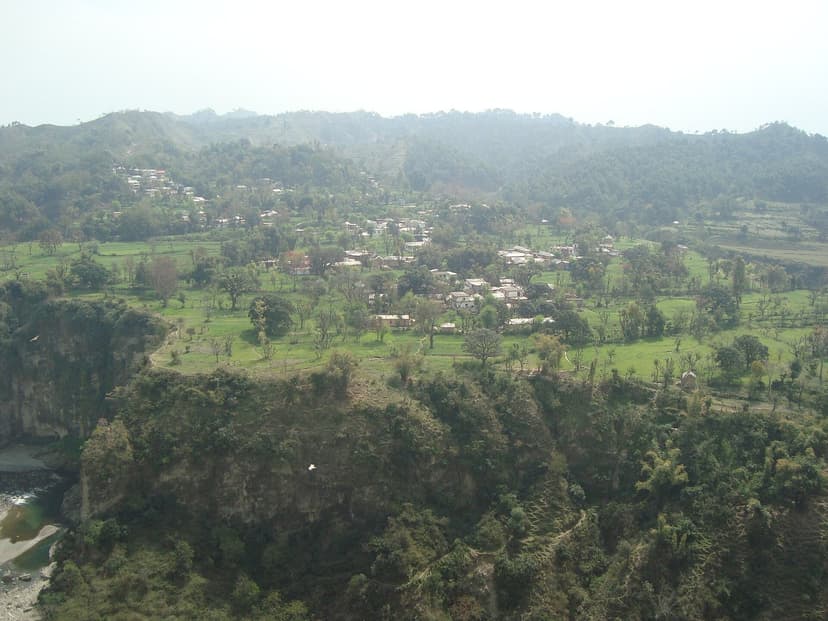
Mandyali Dham (Mandi) — the one most Himachalis call the gold standard
Ask a Reddit thread of Himachalis which Dham is the best and they will tell you Mandyali, and they will be slightly aggressive about it. The case is not without basis. Mandyali Dham has two structural features that the other repertoires do not. First, the meal opens with the dessert. Boondi-ka-meetha, deep-fried gram-flour pearls in a thin sugar syrup, arrives on your leaf before anything savoury. The Ayurvedic explanation is that sweet first opens the appetite and primes the digestion. The practical explanation is that nobody refuses dessert, so you cannot pretend you are too full to eat.
Second, Mandi has Sepu Vadi. This is the dish that no other regional Dham makes. A paste of soaked urad and moong dal is ground, cut into small flat pieces, deep-fried, and then folded into a thin palak gravy with a hand-flat temper of cumin and asafoetida. The vadi is the size of a thumb-tip and it absorbs gravy like a sponge. It is the single dish I would tell a first-time visitor to Himachal to eat before they leave.
The cooking fat in Mandi is mustard oil. The flavour profile is tangier than Kangra, spicier than Chamba, slightly aggressive. ETV Bharat Hindi reported in 2025 that Mandyali Dham is the Prime Ministers reported favourite among the regional Dhams, which is the kind of small political detail that does the rounds at every Mandi wedding.
The single best week of the year to eat a Mandyali Dham is the International Shivratri Fair, which runs Feb 16 to 22 in 2026, and this year is the 500th edition, with 216 palanquin deities arriving in Mandi from across the district. The District Mandi page lists the venue maps; if you can be in Mandi that week, every visiting deity arrives with a small Boti team feeding the entourage, and on at least three days of the fair the Paddal ground turns into the largest open-air pattal-and-Madra operation in the state.
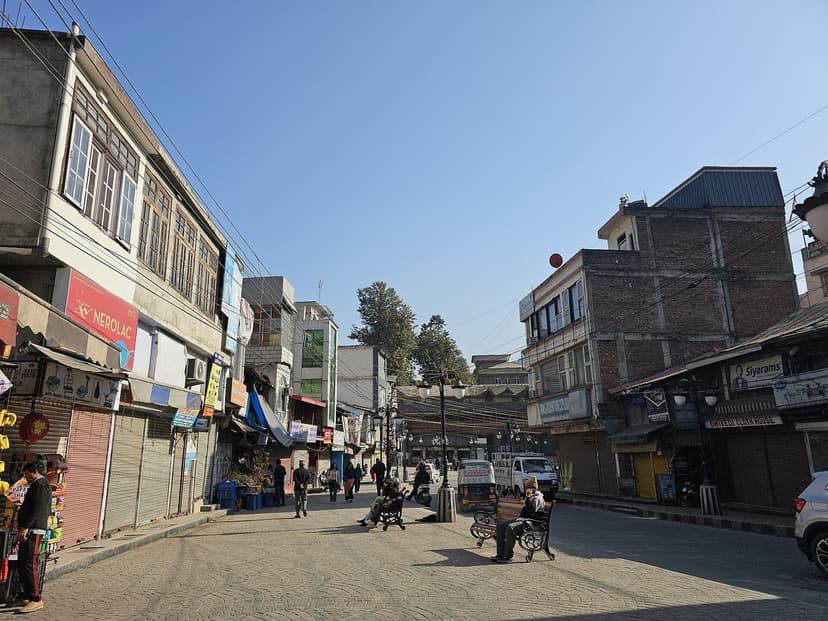
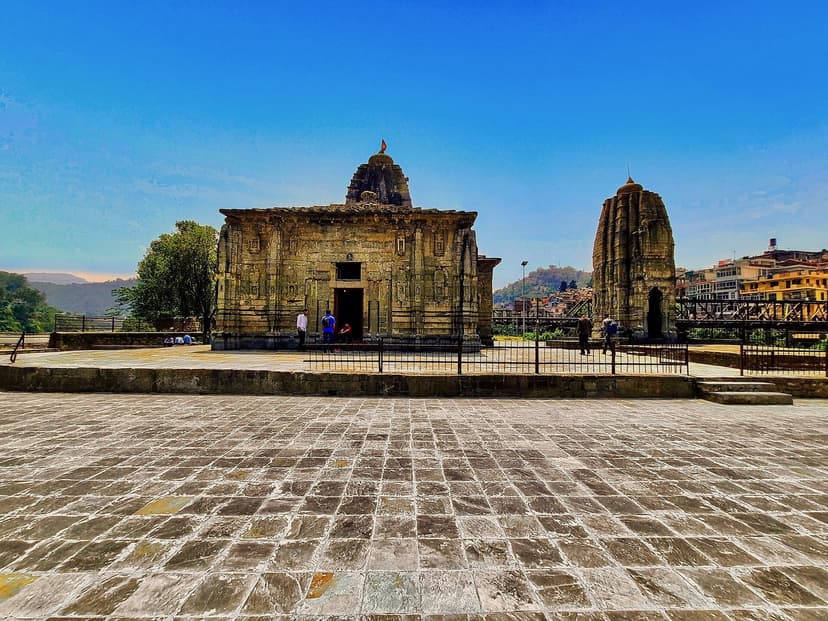
Kullvi Dham (Kullu) — the one with the worlds priciest mushroom
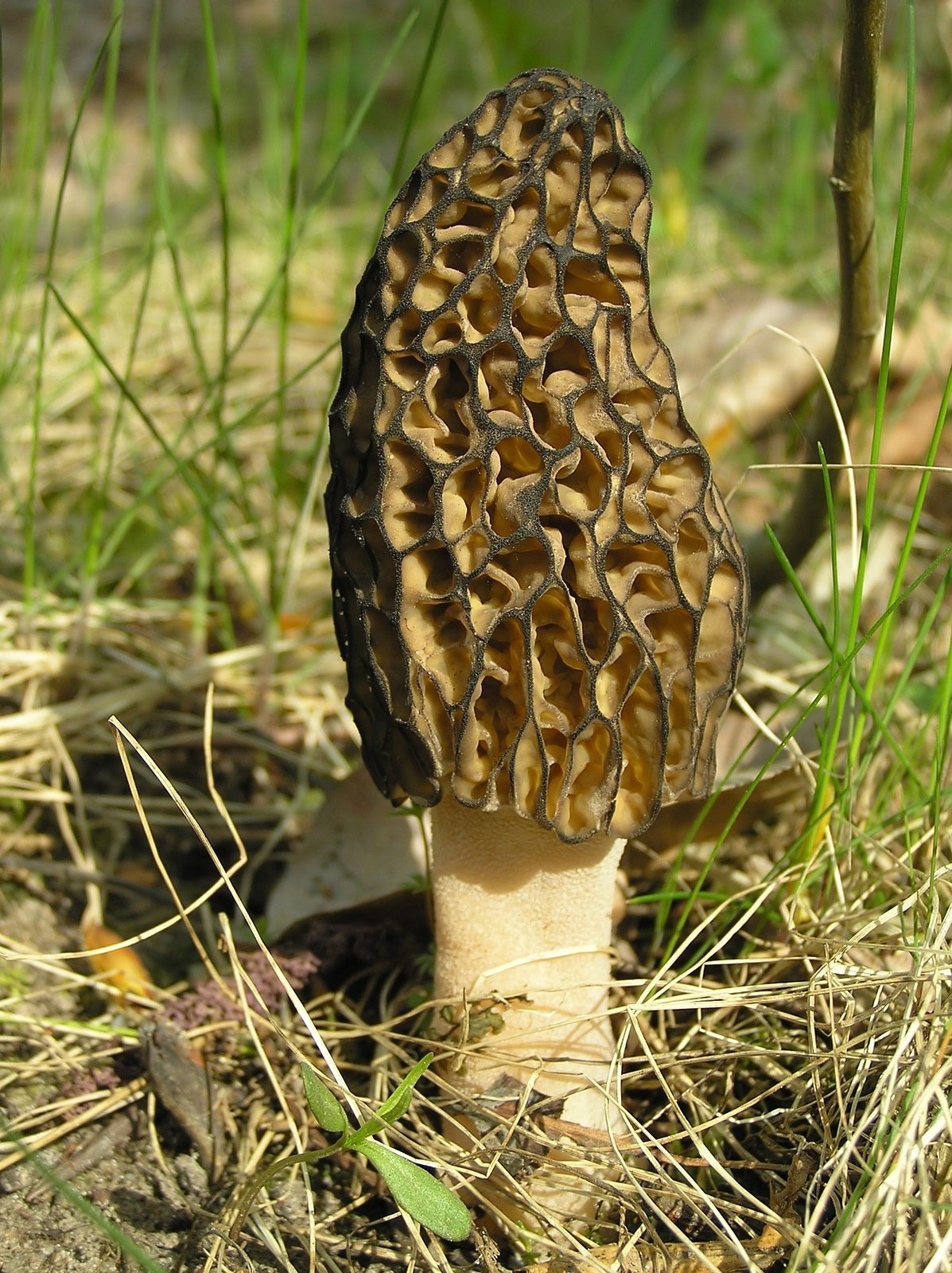
Kullu is my own valley, and the Dham at a Kullu wedding tastes of pahadi ghee from the start. Cooking fat here moves back to ghee, like in Chamba. The signature dish is Gucchi Madra. Gucchi is the wild morel mushroom, Morchella esculenta, foraged from oak and pine forests in the slopes above the valley floor after the post-monsoon lightning storms. The honey-comb cap, the hollow stem, the smoky earth aroma when it has been dried in the sun for weeks. You cook it in yoghurt and ghee with cardamom and cloves, and you have something that no other vegetarian Indian curry quite resembles.
The price of Gucchi has fallen since China started farming it commercially. The Tribune tracked a Kullu wholesaler at Rs 4,500 to Rs 5,000 per kilo recently, wholesale, at collector level, which is a long way down from the Rs 30,000 figure that travel articles still quote. The fully-dried premium grade still sells at Rs 25,000 to Rs 40,000 a kilo at retail, per Pahadi Amrut, but it is no longer untouchable. What it still cannot be is farmed like a button mushroom. Nobody has succeeded in farming it in India; every kilo on the market still comes off a forest floor somewhere.
The other Kullu signatures are Teliya Mash, black gram cooked in mustard oil with a generous fry, and the standard Madra base done with chickpea or kidney bean. Kullvi Dham gets served at Kullu Dussehra (Oct 20 to 26, 2026) and at every Hindu wedding in the valley.
The most photographed Kullvi Dham of recent years was the one at Karan Deols wedding reception in Dashal village near Manali in 2022. Sunny Deol commissioned a full Kullvi Dham for the villagers, Gucchi Madra featured, naturally, and danced the Kullvi at the reception. Bollywood on a leaf plate.
Bilaspuri (Kehluri) Dham — the one you probably havent heard of
Bilaspur is where the Dham starts getting under-documented. There are perhaps three English-language paragraphs in the entire searchable web on Bilaspuri Dham (locally called Kehluri Dham, after the old name of the district). The Hindi sources are better, and they are unanimous: Bilaspuri Dham is ghee-heavy and built around Dhule Maha ki Daal, husked urad dal cooked in pure desi ghee with very little else. Five to seven dishes total. No onion, no tomato, classic satvik rules.
The dish that gives Bilaspur its claim to fame is the Dhule Maah preparation. Husked black gram, dry-roasted, pressure-cooked, then finished with ghee and asafoetida so generously that the dal smells of ghee from across the courtyard. The Tribune covered the Vijaypur Dham at the wedding of Girish Nadda, JP Naddas son, in February 2020. The reception drew Chief Minister Jai Ram Thakur and the Governor; the Bilaspuri Boti team fed thousands of guests.
The most accessible Bilaspuri pattal meal you can have without an invitation is at the Naina Devi temple langar. The temple trust runs a 500-capacity langar serving kadhi, dal, rice and roti free of cost to pilgrims, three meals a day; during Navratri the complex expands into full Boti-supervised Dhams on toor-leaf pattal. The hero photograph in our Boti Chefs piece was shot at exactly that temple, by exactly that langar, on a pattal.
Shimla Dham — the urban hybrid
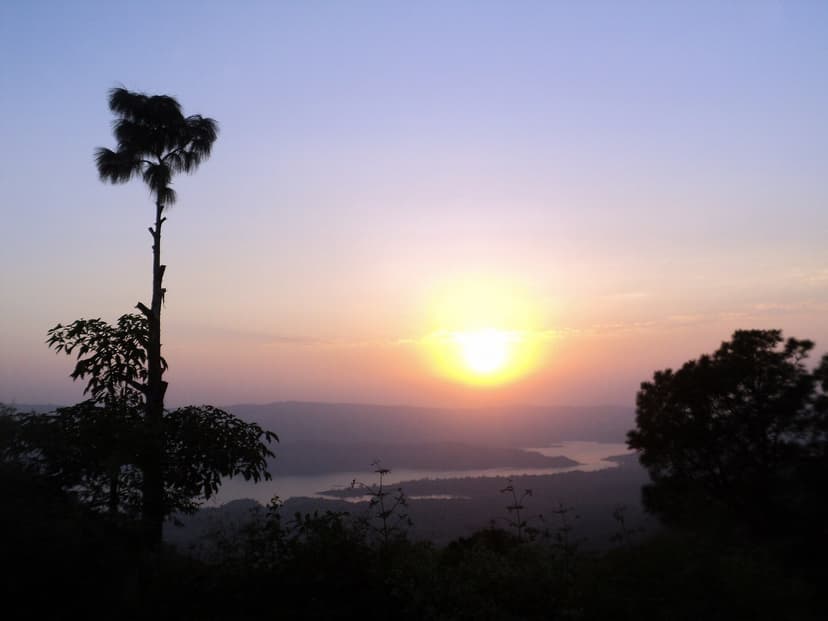
Shimla is a district built on a colonial hill station, and its Dham reflects that. The repertoire is more eclectic than the rural belts. Chole Madra, Jimikand (elephant yam) Madra, Maah and Channa dals, paneer in some weddings, and a Khatta of gur and imli to close. The cooking fat is mixed, ghee and mustard oil both appear depending on the cook. In the upper Shimla hills, particularly around Rampur, Kotgarh and Narkanda, you also start seeing meat dishes appear alongside the Dham at non-temple occasions, which is technically a violation of the satvik rule and which the elders will tell you, with a small shrug, is how it goes nowadays.
The city-side Shimla version is best accessed at Himachali Rasoi at 54 Middle Bazar, just off Mall Road. Himanshu Sud, a software engineer who left tech to revive Himachali food, trained with Botis in Kangra for a year before opening the place. The Kangri Dham thali there is Rs 240 to Rs 400 depending on day and version, and it is the closest thing to a real Boti meal that you can order from a menu without booking a year in advance.
Sirmauri Dham (Sirmaur) — the Punjab-shaped cousin
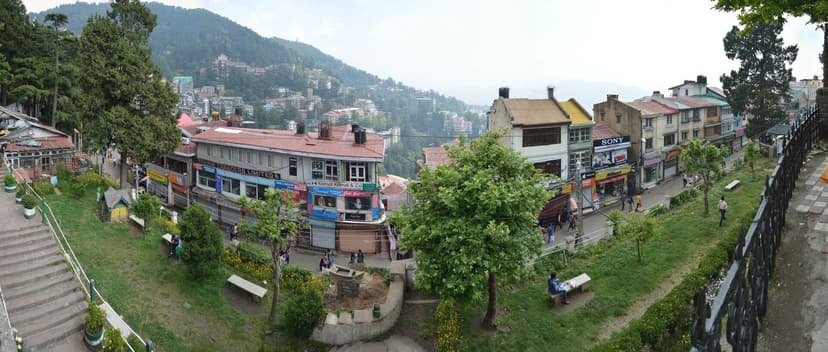
Sirmaur is the southernmost district, sharing a long border with Haryana and a culturally porous one with Punjab. The Dham reflects that. Patande, thin lentil-and-rice pancakes that look like a half-cousin of a dosa, appear on the leaf alongside rice. The sweets are different too: Jalebi and Halwa show up where other regions would have Mittha or Boondi-ka-Meetha. The cooking is simpler, lower on the Madra-Khatta-Mash trinity, higher on Punjab-style dal-and-roti structure with Pahari accents.
The single best week to eat Sirmauri Dham is during the Renuka Fair in November (Nov 20 to 24, 2026) at the lake of the same name in the south of the district. The fair pulls deity palanquins from across Sirmaur and the food stalls turn Sirmauri Dham out at scale. Off-fair, your best bet is a village wedding invite, because the documented restaurant Dhams for this district are thin to non-existent.
Upper belt, lower belt — ghee versus mustard oil
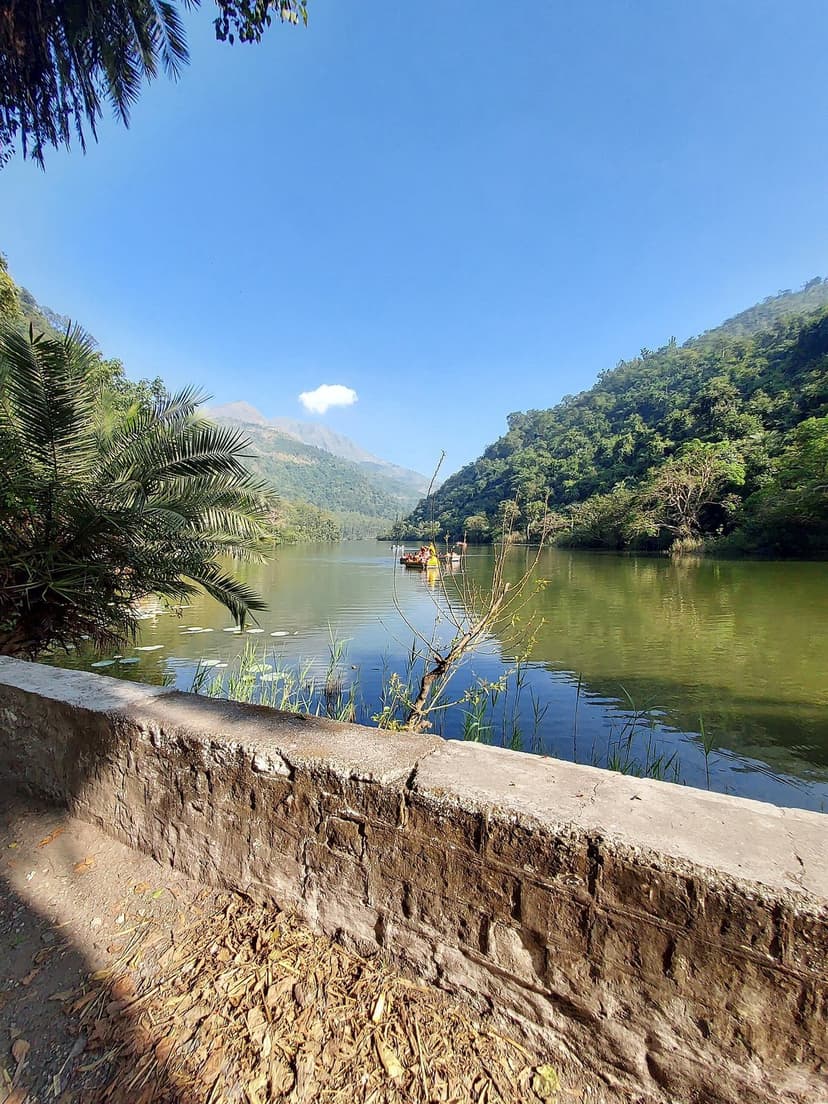
The thing that nobody quite states out loud, but which becomes obvious once you have eaten Dham in five different districts, is that there are really two belts in Himachal that cook a Dham, and the dividing line is the cooking fat. Above a certain altitude, roughly Chamba, upper Kullu, upper Shimla, the Bharmour belt, the cooking fat is pahadi ghee from local cattle. Below it, Kangra, Mandi, Bilaspur, lower Shimla, Sirmaur, the cooking fat is mustard oil, with ghee saved for special preparations.
Pahadi ghee tastes of the grass the cow was eating that month. Mustard oil cuts and tangs and bites. Lower-belt Dhams tend to be sharper, brighter, more aggressive on the tongue; upper-belt Dhams are heavier, richer, slower to finish. Both are real. People in each belt will tell you the other is doing it wrong.
| Upper belt (ghee) | Lower belt (mustard oil) | |
|---|---|---|
| Districts | Chamba, upper Kullu, upper Shimla, Bharmour | Kangra, Mandi, Bilaspur, lower Shimla, Sirmaur |
| Cooking fat | Pahadi desi ghee from local cattle | Mustard oil for everything except Madra |
| Flavour profile | Rich, slow-finishing, heavier on tongue | Sharper, tangier, more aggressive temper |
| Signature dishes | Rajma Madra, Gucchi Madra, Mash daal, Mittha | Sepu Vadi, Chana Madra, Khatta, Boondi-ka-Meetha |
| Meat alongside Dham | Occasionally at non-temple weddings | Almost never - strict satvik rules hold |
| Dessert position | Last, as Mittha or Meetha Bhat | First in Mandi (Boondi-ka-Meetha), last elsewhere |
Want a Himachali sanity-check on your food-trail through HP? Email us your draft itinerary. We will tell you which Boti is taking bookings this season, which Dham you can crash without an invite, and where the food at the restaurant is honest.
The ritual ecosystem — Rasialu, Char, Charoti, Pattal, Painth
You can describe what is happening on the leaf in front of you with English words. The trouble is that the apparatus behind it has names that English does not even try to translate. Five matter.
Rasialu is the temporary kitchen. Bamboo frame, steel-sheet roof, built specifically for the Dham, taken down again the day after. The kitchen is outdoors, never inside the house, because the volume of food being cooked, the wood fires, and the smoke would fill an indoor room past tolerance. A Rasialu for a 300-guest wedding is the size of a tractor shed and has its own ridge line.
Char is the fire trench. Six feet long, two feet wide, dug into the ground. Wood, pine, deodar, oak, whatever the village has, burns the length of the trench, and the brass cooking vessels sit on iron grills laid across the gap. The trench is doing the work of a six-burner stove without any actual stoves.
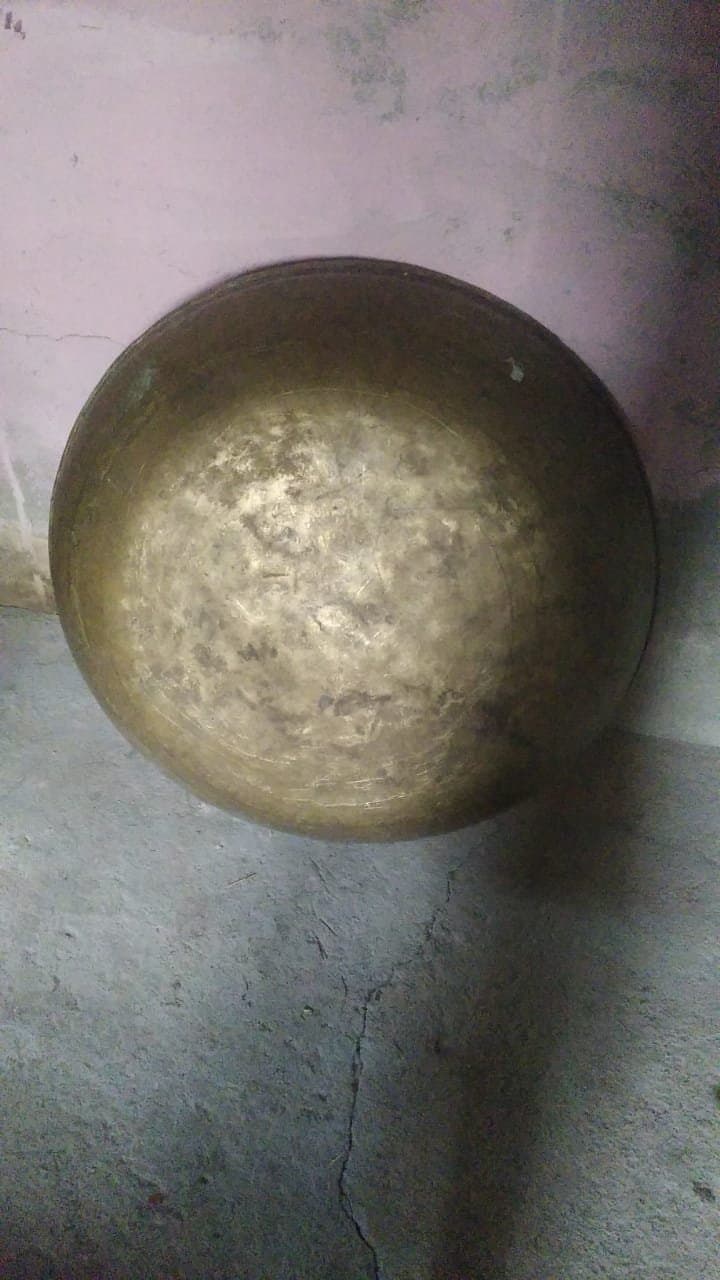
Charoti (also Batloi, also Batohi, depending on which valley you are in) is the brass cooking vessel. Wide base, narrow mouth. The shape keeps heat circulating inside; the brass conducts evenly. The vessels in a Botis kitchen are typically older than the Boti. They are lent between families, returned within the week, replaced when the bottom finally goes. Architectural Digest India ran a piece in 2023 on Charotis older than 100 years that are still in regular use at Boti kitchens in Kangra; the writer counted seven such vessels in one shed in Pathiar.
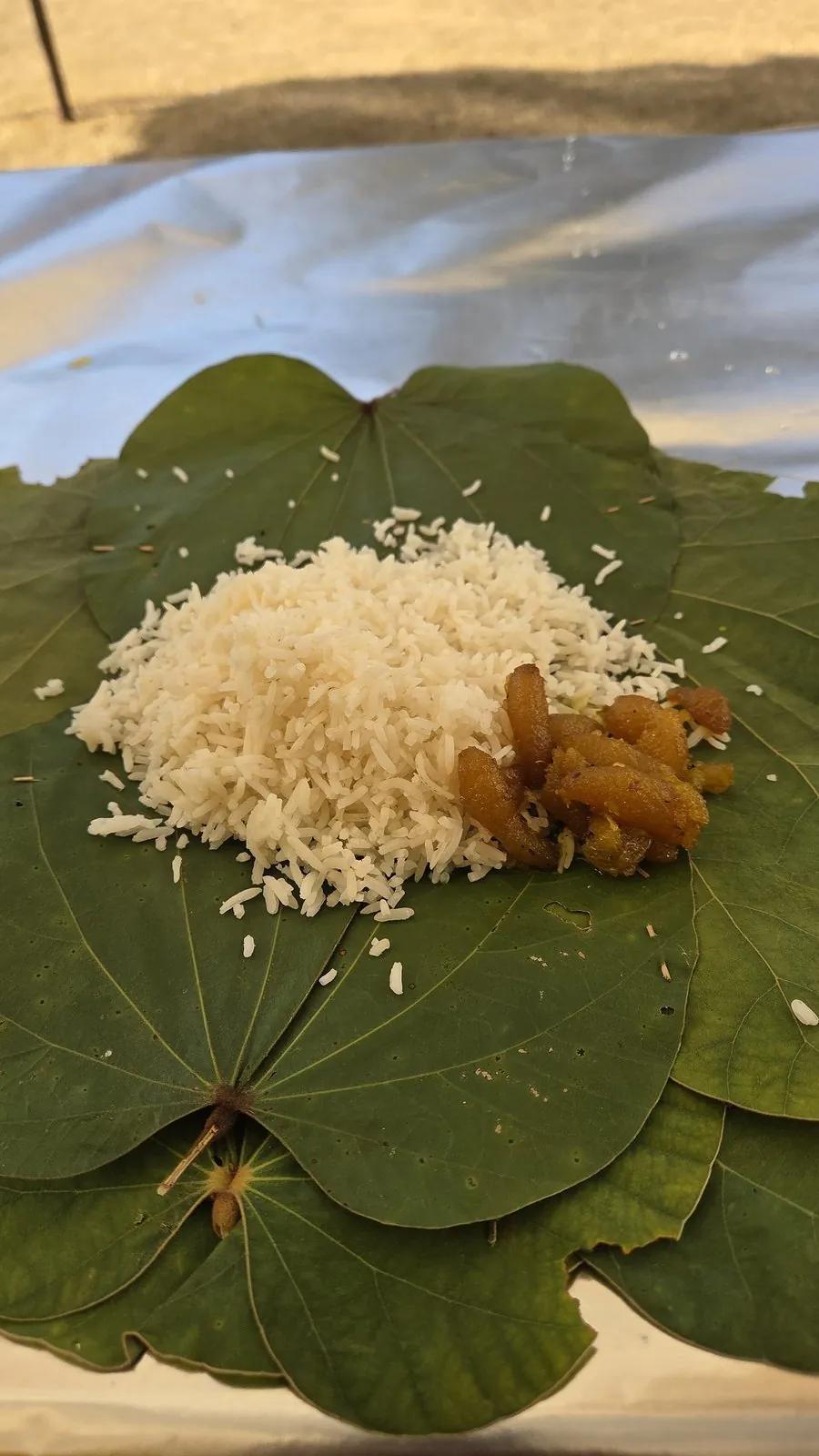
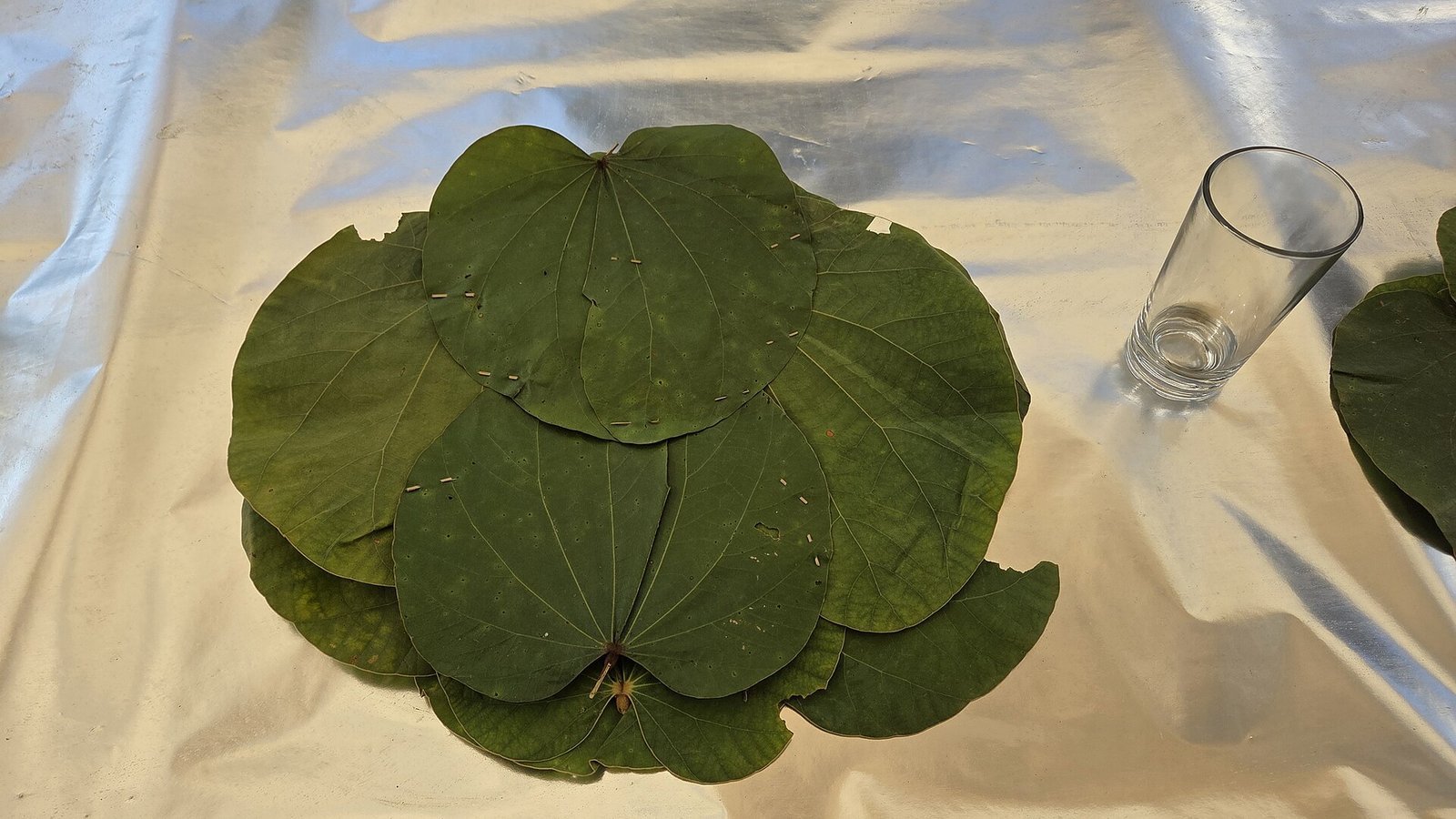
Pattal (or Pattlu in Kangri) is the leaf plate. Sal leaves in Mandi and lower Kangra, Tor leaves in some Kangra villages, Banyan in Sirmaur. Multiple leaves are stitched together with thin bamboo slivers, and the resulting circular plate is roughly twelve inches across. Each guest gets a fresh leaf; nobody washes anything; the used leaves go into the cattle feed or onto a compost heap. Zero-waste before the word existed.
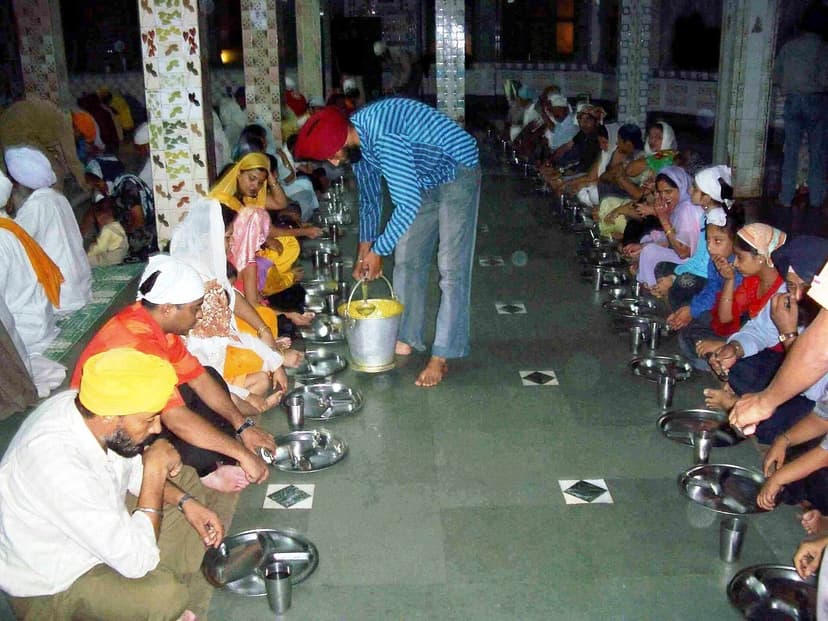
Painth is the floor seating. Long rugs laid out in two parallel rows, sometimes four rows for a larger wedding, sometimes a single long row in a narrow village courtyard. Guests sit cross-legged, leaf plate in front. The servers walk down the corridor between rows with their Charotis and ladle the dishes onto the leaves in sequence. The Sikh Gurdwara langar at Manikaran uses exactly the same physical layout, which is why we used a Manikaran shot when we wrote up the Boti piece, same architecture of eating, different volunteers serving.
The sixth term, the one that does not sit easily with the others, is Dhuni. The smoking technique. Mustard oil poured over a burning coal placed inside the cooking vessel, lid slammed shut. Adivasi origin, central India, but adopted into Kangri Boti practice and now a Kangra signature. You can taste the Dhuni on a chana dal across a banquet hall.
The Botis themselves (and where to read more)
The full piece on Botis, who they are, why they nearly disappeared, what a working week looks like for Sanjay Mishra in Pathiar, is a sister article, so I will keep this short. Three things are worth knowing here.
First, the Botis are a hereditary Brahmin caste. Skills pass father to son, no written recipes existed for centuries, and the lineage in Pathiar can be traced back at least 200 years on JustDial records and substantially longer on family memory. The Hindi reporting from Prabhasakshi describes the morning ritual: bath first, dhoti and vest, no leather, no shoes, no shirt, then the cooking begins barefoot.
Second, the tradition nearly ended. Sanjay Mishra told The Better India that there was a generation in Pathiar when the Botis were almost extinct. The young men did not want the profession. The families that kept it had to convince their own kids that this was a thing worth doing.
There was a time when Botis were almost extinct. Now we have again taken up this profession.
Third, the demand has come back. Sanjay cooks for politicians, cricketers, and at least one Bollywood family. The Hindi-language press has rediscovered Boti profiles as a regular beat. The booking lead time for a top Boti at peak season is up to a year, which is a number Nitika Kuthiala of Pahadi Pattal in Noida likes to quote when she does her Himachal pop-ups. The crisis is over, at least for now. The next question is whether the kids will take it on.
The celebrity Dham, the temple Dham, and the 500th Shivratri
Three Dhams that you can point to on a map without an invitation.
The first is the Sunny Deol one, which happened in June 2022 in Dashal village near Manali. Karan Deols wedding reception. The Statesman covered it; BollywoodShaadis did a photo piece. Full Kullvi Dham, Gucchi Madra on the leaf, Sunny Deol dancing the Kullvi at his own sons reception. The whole village was there. The point of the story is not that a film star ate on a leaf, which is the bit the English press cared about. The point is that even Sunny Deol sits on the floor for a Dham; the egalitarianism of the Painth has held.
The second is the temple Dham at Naina Devi. The Naina Devi langar is a daily 500-capacity pattal meal at the Shaktipeeth on the ridge above Govind Sagar. The food is langar-grade, kadhi, dal, rice, not full Boti Dham, but the leaf plate is the same toor pattal, and during Navratri the complex hosts proper Boti-supervised feasts at scale. The temple page spells out the timings; you do not need to be a Hindu pilgrim to eat there, you just need to be there.
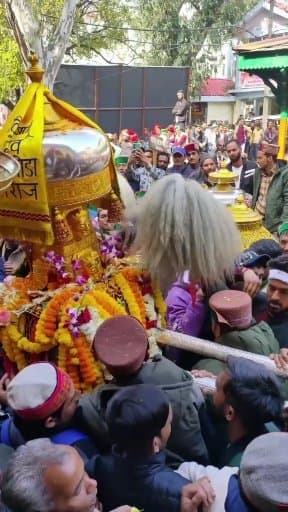
The third is the Mandi Shivratri Fair. Feb 16 to 22, 2026. Five hundredth edition. 216 deities arriving on palanquins from across the district, each travelling with a small Boti team, each cooking the Mandyali Dham at its source. The District Mandi page lists the venue and traffic plan; if you are going to time one HP food-trip this decade, that is the week.
Where to eat a Dham (in 2026, by district)
The honest table. There are very few sit-down restaurants serving a real Boti Dham. Most Dhams that you can eat without a relationship are temple langars, festival feasts, or homestay-arranged. Restaurant Dhams exist but they are usually a thali approximation; the real thing still mostly happens at occasions.
| Category | Cost (INR) | Note |
|---|---|---|
| Naina Devi temple langar, Bilaspur | Free | 500-capacity, daily 3 meals, pattal leaf plates, langar-grade dal-kadhi-rice |
| Himachali Rasoi, 54 Middle Bazar, Shimla | Rs 240-400/thali | Kangri and Mandyali Dham thalis - Himanshu Sud trained with Pathiar Botis for a year |
| Sharma Dhaba, near Bus Stand, Mandi | Rs 150-300/thali | Mandyali Dham approximation, local institution |
| Sapna Sweets, Akhara Bazaar, Kullu | Rs 200-350/thali | Kullvi Dham elements, seasonal Gucchi if you ask in May-June |
| Mame da Dhaba, Sultanpur, Chamba | Rs 200-350/thali | Chambyali Dham approximation, local favourite |
| Thakur Dhaba, opp. Hanuman Mandir, Kangra | Rs 150-250/thali | Kangri Dham staples |
| Rakkh Resort, near Palampur, Kangra | Rs 4,500-7,500 per guest | Books a Boti for a guest Dham; one of the cleanest paid-access points |
| Village wedding or Mandi Shivratri | Free with invitation or fair access | The real thing, no compromise, Feb 16-22 2026 for the 500th Shivratri |
If the restaurant has tables, it is not a traditional Dham. The whole point of the Painth is the floor; the whole point of the pattal is no steel. A four-table thali with a Madra-and-rice combo is fine to eat, but call it what it is, a thali, not a Dham. You have not had the real thing until you have sat on a rug.
The Dham Trail — a four-day food route across HP
If you are going to do this properly, the trail goes south to north and tracks the cooking fat: mustard-oil lower belt first, ghee upper belt last. Four days, three districts, two private cooks worth booking ahead, one fair if you can time it.
- Day 1 - Bilaspur and Naina Devi
Start at Mata Shri Naina Devi temple. Daily 500-capacity pattal langar serves kadhi, dal, rice on toor leaves. Drive south to Bilaspur town, ask for Bilaspuri Dham at a local dhaba near Sadar Bazaar - Dhule Maha ki Daal is the test dish. Night in Bilaspur. - Day 2 - Mandi (the gold standard)
Drive Bilaspur to Mandi via NH154 (roughly 90 km, 3 hours). Lunch: Sharma Dhaba, near the Mandi bus stand, Mandyali Dham approximation. Walk Mandi old town - 81 temples, Bhutnath Mandir, the Beas confluence, Panchvaktra. If your trip lands Feb 16 to 22, this is the 500th Mandi Shivratri Fair and you will eat a Boti-cooked Mandyali at the Paddal ground. - Day 3 - Kangra and a booked Boti Dham
Mandi to Kangra via NH154 and NH503, about 6 hours including a stop. The point of this day is to call Rakkh Resort or your homestay 48 hours ahead and book a Boti-cooked Dham for the evening. Sanjay Mishra in Pathiar (9816457888) takes private bookings but needs 7 days lead time. The Dhuni-smoked chana madra at a real Kangri Dham is what the whole trail is for. - Day 4 - Kullu and Gucchi if you can find it
Kangra to Kullu via Mandi, about 7 hours including breaks. Sapna Sweets on Akhara Bazaar serves Kullvi-style food daily; in May-June ask for Gucchi Madra and if its in season you eat the worlds priciest mushroom on the cheapest plate in HP. Kullu Dussehra (Oct 20-26 2026) is the other peak Kullvi Dham week. Drive back to Manali, end at Dashal village where Sunny Deol fed the locals in 2022.
Want us to call ahead and check which Boti is taking bookings in the week of your visit? Email Refuje the dates. We will tell you who has openings, who needs a 7-day deposit, and which Mandi Shivratri venue serves the cleanest pattal.
The map
What is changing
Three things, in different directions.
The first is that plastic plates are slowly turning up at urban weddings, replacing the sal pattal because nobody in Kangra-town has time to source three hundred fresh leaves on a Tuesday. Prabhasakshi ran a sceptical piece on this, increasing prosperity, commercial thinking, the Dham losing its leaves. The temple Dhams resist it. The village weddings resist it. The urban catered ones, less so.
The second is that the Boti profession is recovering from a near-extinction window in the 1990s and 2000s. Sanjay Mishras case is one of several. 30 Stades and The Better India have run several profiles in the last three years. The demand is real and the families that kept the recipes are now training their own next generation. Whether this will hold against urbanisation is the question for the 2030s.
The third is the academic re-discovery. Himachali Dham was published as a peer-reviewed case study in ScienceDirect in 2017, and the IIPA in Delhi covers the sustainability angle as a case in their food-heritage modules. None of this matters to the Botis in Pathiar, they were already doing it, but it matters for whether a UNESCO Intangible Cultural Heritage application has a chance the next time the Indian government files one. The Mandi Shivratri Fair and the Kullu Dussehra are both UNESCO-tentative-listing candidates; the Dham could ride alongside.
Frequently asked questions
What is a Himachali Dham?
Dham is the communal feast of Himachal Pradesh - a multi-course vegetarian meal prepared by hereditary Boti chefs and served at weddings, temple festivals, religious ceremonies and other major occasions. It is served on leaf plates (Pattal) to guests sitting cross-legged on the floor in rows (Painth). The tradition is approximately 1,000 years old, traced to the Chamba court, and is structurally inspired by the Kashmiri Wazwan.
How is each districts Dham different?
The HP government states A Mandi Dham is much different from a Chamba, Kangra, Bilaspur, Shimla, Sirmaur or Kullu Dham. Chamba uses Rajma Madra in pahadi ghee. Kangra uses Chana Aloo Madra in mustard oil with the Dhuni smoking technique. Mandi serves dessert first and features Sepu Vadi. Kullu features Gucchi Madra (wild morel). Bilaspur is known for Dhule Maha ki Daal in pure ghee. Shimla mixes urban influences into Chole and Jimikand Madra. Sirmaur leans Punjab-adjacent with Patande pancakes, Jalebi and Halwa.
Who are Boti chefs?
Botis are a hereditary Brahmin caste of specialist cooks who have prepared Dham feasts since the Chamba court started commissioning them. Skills pass father to son through oral tradition. They cook barefoot from 4 AM in temporary outdoor kitchens (Rasialu) using century-old brass vessels (Charoti). The tradition nearly went extinct in the 1990s but is now reviving - Sanjay Mishra in Pathiar (Kangra) is the best-known living example.
Why is Mandyali Dham considered the gold standard?
Several reasons. Mandyali Dham serves dessert first (Boondi-ka-Meetha), follows Ayurvedic dietary principles, and features the distinctive Sepu Vadi lentil dumpling found nowhere else. Its tangy mustard-oil flavour is the most assertive of the regional repertoires. Reddit threads in r/HimachalPradesh are remarkably unanimous on Mandyali being the best. The Prime Minister is reportedly a fan, according to ETV Bharat Hindi.
What is Madra?
Madra is the signature curry that appears in every Dham across HP. It is a slow-cooked yoghurt-based gravy of chickpeas, kidney beans or other lentils, cooked in ghee with about 20 spices including cardamom, cloves, cinnamon and bay leaves. The base ingredient varies by region: Chamba uses rajma, Kangra uses chana and aloo, Kullu uses Gucchi (wild morel mushrooms), Shimla uses Jimikand (elephant yam). It is the structural spine of the meal.
Can tourists experience an authentic Dham without a wedding invitation?
Yes, three ways. (1) Eat at the Naina Devi temple langar in Bilaspur - daily 500-capacity pattal meal, free, no invite required. (2) Attend a festival: Mandi Shivratri (Feb 16-22, 2026, the 500th edition), Kullu Dussehra (Oct 20-26, 2026), or Renuka Fair (Nov 20-24, 2026) all serve community Dhams at scale. (3) Book through a Refuje homestay or Rakkh Resort near Palampur, both of which arrange Boti-cooked Dhams for guests with 48 hours notice.
Why are onion, garlic and tomatoes banned in Dham?
Dham started life as temple prasad, sacred food offering. Satvik cooking principles in Hindu tradition exclude onion, garlic, ginger and tomato as tamasic ingredients. Historically these were also not the easiest crops to grow in HPs mountain terrain. The traditional permitted list is: lentils, yoghurt, ghee, buttermilk, mustard oil, garam masala, sugar or jaggery, rice. Modern wedding Dhams sometimes bend the rules; temple Dhams almost never do.
What are Pattal leaf plates?
Pattals (also called Pattlu in Kangri Pahari) are disposable plates made from dried leaves of Sal, Banyan or Tour trees, stitched together with thin bamboo slivers. They are biodegradable, ritually clean for temple-origin food, and add a subtle earthy flavour. Each guest gets a fresh plate. Used leaves go into compost or cattle feed - zero-waste before the word was a slogan. Sal in lower Mandi, Tor in Kangra, Banyan in Sirmaur.
What is the Dhuni smoking technique?
Dhuni is the traditional smoking method most associated with Kangri Dham. Hot mustard oil is poured over a piece of burning coal placed inside the cooking vessel (usually in dal). The vessel is immediately covered, trapping the aromatic smoke. This infuses the dish with a distinct smoky flavour that is the hallmark of authentic Kangri Dham. The technique comes from Adivasi (tribal) cooking practice and cannot be replicated with liquid smoke.
Is Dham always vegetarian?
Traditional ceremonial Dham as served at festivals and temples is strictly vegetarian. However, in colder upper Himachal - particularly upper Shimla hills, parts of Kullu, the Kinnaur-Lahaul belt - wedding feasts can include meat dishes alongside the Dham. The HP government tourism portal acknowledges that non-vegetarian food is the norm in everyday Himachali cooking. It is specifically the ceremonial Dham that maintains the satvik rule.
Sources
Official / primary
- Government of Himachal Pradesh — Tourism Department, Cuisine page (the seven Dhams quote, Boti chefs).
- District Kangra Government page on Kangri Dham (menu, Pattlu leaf plates, Boti definition).
- District Mandi page — International Shivratri Fair 2026.
- Shri Naina Devi temple trust — langar facilities page.
Journalism (English)
- Whetstone Magazine — Dham Is a Heritage Food of Himachal (Wazwan-Jaisthambh origin story).
- The Better India — Sanjay Mishra of Pathiar (almost-extinct quote, Dhuni technique, walnut tip).
- The Tribune — Gucchi prices plummet (Kullu wholesale 4,500-5,000/kg).
- Architectural Digest India — Century-old brassware.
- 30 Stades — Himachali Rasoi profile.
- The Statesman — Sunny Deol Dashal Dham.
- Slurrp — Mandyali Dham underrated dishes (Sepu Vadi, Kaddu ka Khatta).
Hindi press
- ETV Bharat Hindi — PM Modi favourite Mandyali (no onion/garlic confirmation).
- ETV Bharat Hindi — Bilaspuri Dham at JP Nadda sons wedding (thousands of guests).
- Prabhasakshi (Hindi) — Boti ritual, dhoti and vest, barefoot.
Academic
- ScienceDirect 2017 — Himachali Dham: Food, Culture and Heritage (peer-reviewed).
Refuje cross-links
- The full Himachali food guide covers the 20+ everyday dishes outside of Dham.
- The Boti chefs deep-dive goes longer on Sanjay Mishra and the hereditary tradition.
- The 2026 HP festival calendar lists every Dham-eating festival week of the year.
- Best time to visit HP month-by-month.
You Might Also Like
Volunteering in Himachal Pradesh: 12 Organisations and How to Apply (2026)
Teach English in McLeod Ganj, conserve the Great Himalayan National Park, build with earth in Bir, or harvest apples in Kullu. Twelve real HP volunteer organisations with honest costs, the visa rule that gets foreigners deported, and how to apply.
How to Travel Himachal Without Wrecking It: A Quiet-Travel Manual
A non-preachy field manual for responsible travel in Himachal, by a Kullu local: how to behave, when to go, where to go instead, and the 2026 rules and bans that actually matter.
Mamleshwar Mahadev: The Eternal Flame Temple of Karsog
An eternal fire, a fist-sized wheat grain and a six-foot drum, kept in a mortar-less timber temple in the quiet Karsog valley. The honest story of Mamleshwar Mahadev: what is real, what is faith, and how to go.