
Old Goa: The 'Rome of the East' That Vanished (and How to Visit the Churches Well)
Stand on the mown grass between the Se Cathedral and the Basilica of Bom Jesus, the two churches every visitor to Old Goa photographs, and you are standing in the middle of what used to be a street. Houses lined it, and shops, and the din of one of the richest cities on earth. In the sixteenth and seventeenth centuries this was the Rome of the East, a capital of perhaps two hundred thousand people, bigger in its day than Lisbon or London, the hinge of Portugal's whole eastern empire. Almost none of it is left. A handful of enormous churches stand in open fields where a metropolis used to be, and most people who come see only the famous two, in the heat of the middle of the day, and leave. This is about the rest of it, and about seeing it well.
I write for Refuje and I do not live in Goa. This is drawn from the history of the place, from the churches' own records and the archaeologists who keep them, and from Goans and travellers on r/Goa who come back to Old Goa for the buildings rather than the beaches. I am going to stay on the stones: the architecture, the story of the city that vanished, and the plain business of visiting a set of working churches without wilting in a queue. What Old Goa asks of you is mostly time and a little quiet, which is exactly what most of its visitors do not give it.
The city that died
It helps to hold in your head how much is gone. At its height Old Goa had streets, markets, hospitals, colleges, convents and palaces, a dense working city on the south bank of the Mandovi, ringed, as one Reddit researcher traced it, by something like a twenty-one-kilometre fortification wall. What killed it was not war but water and mosquitoes. Repeated outbreaks of cholera and malaria made the low, crowded riverside unlivable, and across the seventeenth and eighteenth centuries the people simply left, upriver to the higher, healthier ground that became Panaji. By 1843 the capital had formally moved. What stayed behind was whatever was too holy or too heavy to pull down, which meant the churches. So what you visit today is not a preserved old town but the surviving skeleton of one, a few cathedrals marooned in green while a whole city drained away around them. A Goan on r/Goa caught the strangeness of it: the broad lawns between the Se Cathedral and the Basilica were once busy streets, with homes and life on either side. Cross them slowly and you can almost feel the missing city under your feet.
The broad lawns between the Se Cathedral and the Basilica were once busy streets, with homes and life on either side.
The two everyone sees
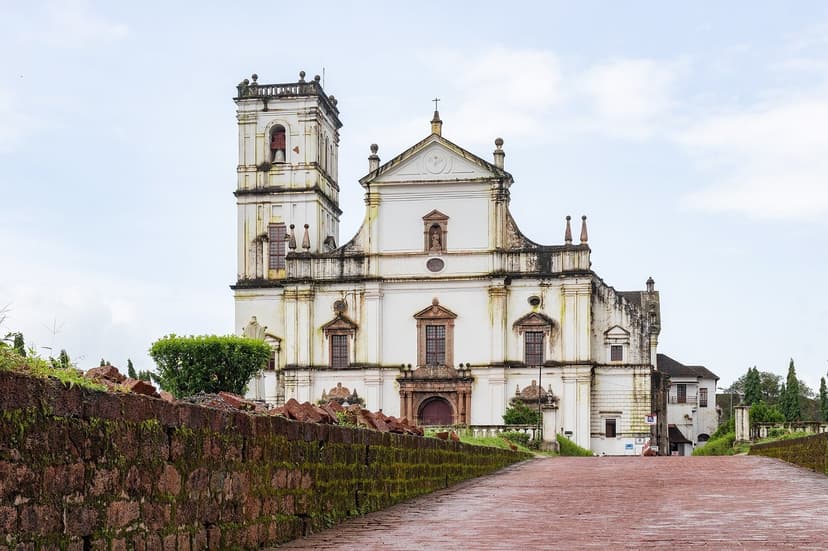
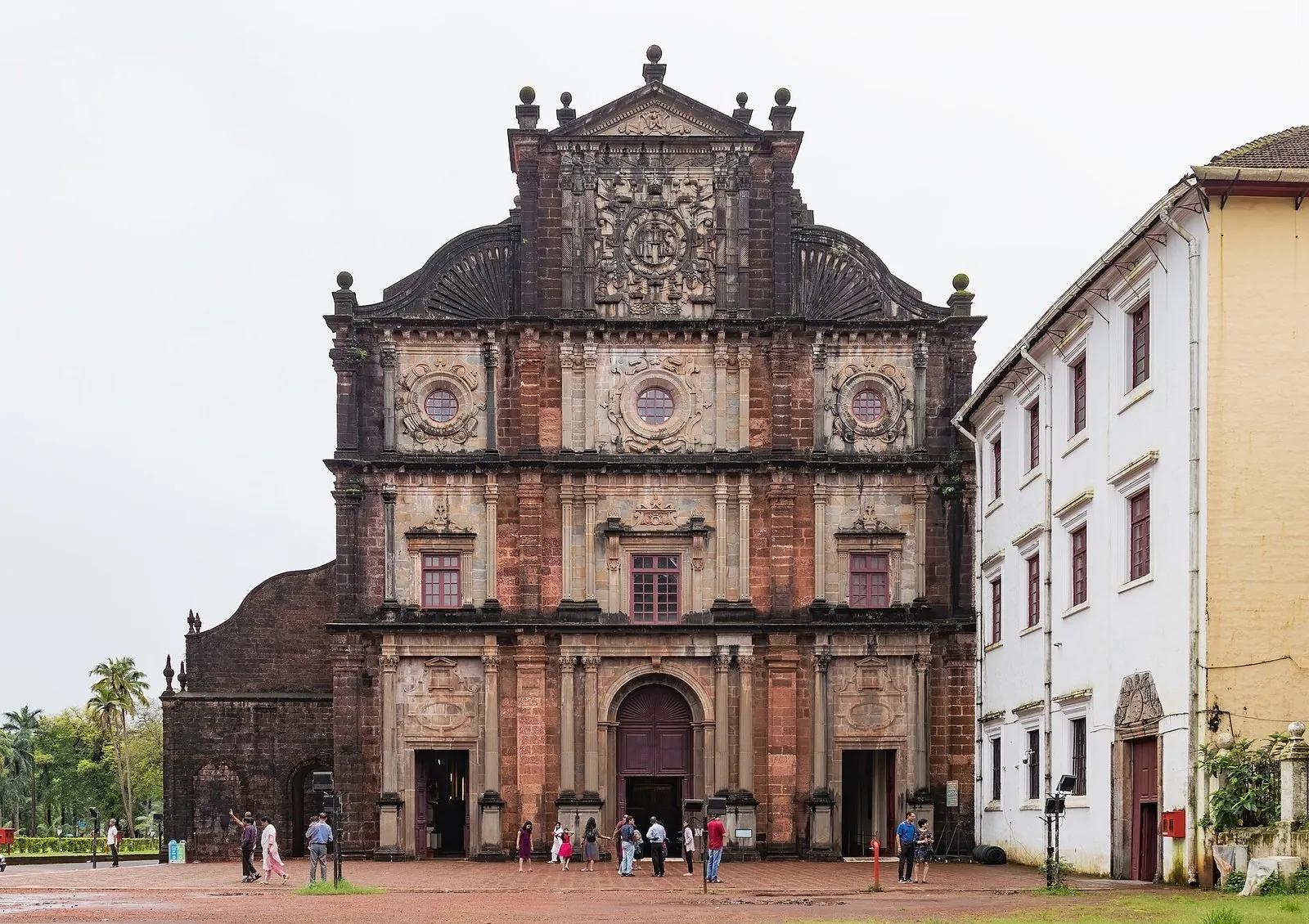
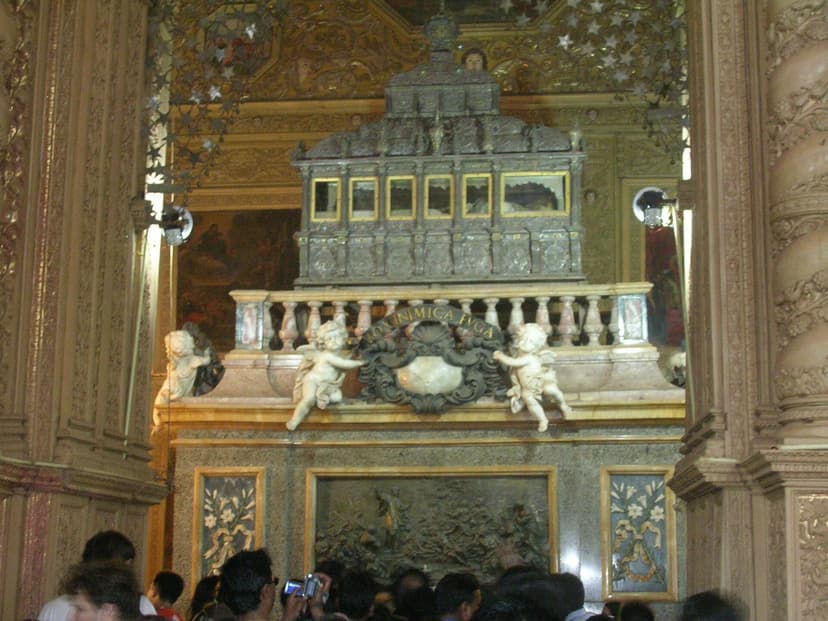
The two headline churches earn their fame. The Basilica of Bom Jesus, the one with the bare red-brown stone front, holds the relics of St Francis Xavier, the sixteenth-century Jesuit missionary called the Apostle of the Indies, in a silver casket that is among the most venerated objects in the Catholic world. His body, long revered as incorrupt, is brought down for public veneration only once a decade, at the Exposition. The last ran over the winter of 2024 and drew something like eight million pilgrims; the next is not until 2034. The rest of the time the casket rests high above a side chapel and you will not see the body, so come for the church rather than a glimpse of the saint. Across the lawns, the Se Cathedral is the giant of the group, the largest church the Portuguese ever raised in Asia, built over some eighty years to mark their capture of Goa in 1510. It lost one of its two bell towers to a collapse in 1766; the survivor holds the Golden Bell, one of the largest in Asia, whose deep note people once said carried for miles.
The ones most people miss
Here is the mistake nearly everyone makes: they do the two famous churches and go. But the best hour in Old Goa is often the next one. Right beside the Se Cathedral stands the Church of St Francis of Assisi, quieter and older in feel, its interior a dense tangle of carved and gilded woodwork and painted panels; attached to it is the Archaeological Museum, with its row of viceroys' portraits and fragments of the lost city. A short walk east, on its own low rise, is the Church of St Cajetan, modelled by Italian friars on St Peter's in Rome and almost always close to empty. And the churches do not end at Old Goa. Goa is, as one Redditor sighed, a land of churches, and the villages are thick with them: at Parra, St Anne's is known for the paintings on its ceiling; at Saligao, the neo-Gothic Mae de Deus is at its best floodlit at night; Chandor, Panjim and a dozen more have their own. One local's advice, if the buildings take hold of you, was just to get the book Churches of Goa and go looking. You could spend a very happy, very quiet week at it.
The bare-brick question
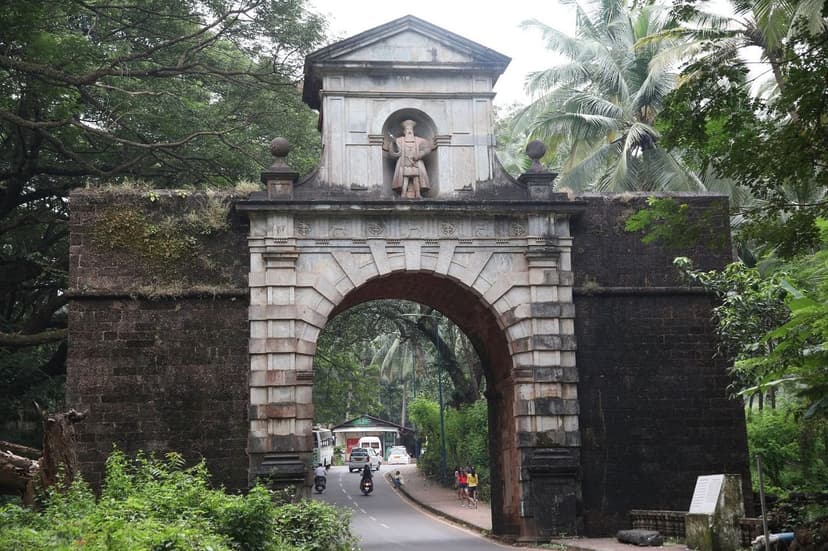
One thing is worth knowing before you photograph the Basilica, because it changes how you see it. That famous bare, medieval-looking laterite front is not how the church was built to look. For most of its life the Basilica of Bom Jesus was plastered and limewashed white, like nearly every other church in Goa; the plaster was stripped off only in the twentieth century, on the idea that exposed old stone looked more venerable and ancient. The same was done to the Viceroy's Arch. Conservationists have argued about it ever since, because the lime plaster was not decoration, it was the skin that kept the monsoon out of the soft laterite, and the naked stone now weathers year by year. There is even a fond local rumour that the Basilica simply cannot be painted, that it always comes back to its laterite colour. It can be, and it was; someone chose this look. Which is a small, useful lesson for the whole site: very little in Old Goa is quite as timeless as it appears.
How to actually visit
The good news is that Old Goa is easy. The main churches sit within a few hundred metres of each other on flat ground, entry is free, and you can see the lot properly in a half-day on foot. Two things will make or break the visit. First, go early. The regulars are unanimous that you want to be there before nine, to beat the heat and, in season, the queues; one warned that any later and you can lose the whole day to a line, and another called the November-to-December crowds, around the feast of St Francis Xavier on the third of December and Christmas, an understatement of a crush. If you can, come on a weekday morning outside that window. Second, dress for a working church, not a beach. These are active places of worship: cover your shoulders and knees, leave the ripped jeans and shorts and swimwear for elsewhere, and drop your voice if a mass or a prayer is on. Beyond that, carry water, wear something you can walk in, and give the place more time than you think you need. Old Goa rewards the slow.
Old Goa, done right. It is free, flat and walkable; give it a half-day on foot. Go EARLY, before 9, especially in season, or you can lose the day to queues and heat. Avoid the peak crush of late November to December (the St Francis Xavier feast on 3 December, Christmas, and any Exposition year). These are working churches: dress modestly, shoulders and knees covered, no ripped jeans, shorts or swimwear, and stay quiet during services. See past the famous two: the Church of St Francis of Assisi with its museum, and St Cajetan, are right there and half-empty. The casket of St Francis Xavier only comes down at the once-a-decade Exposition (next in 2034), so come for the buildings, not the body.
- What it was
- The Portuguese capital and Rome of the East, a city of around 200,000 (bigger than Lisbon or London in its day), emptied by cholera and malaria; the capital moved upriver to Panaji by 1843.
- The churches
- A UNESCO World Heritage site (the Churches and Convents of Goa, listed 1986). The headline pair: the Basilica of Bom Jesus and the Se Cathedral, the largest Portuguese-built church in Asia, with the Golden Bell.
- St Francis Xavier
- His relics, long revered as incorrupt, rest in a silver casket in the Basilica and are lowered for public veneration only at the decennial Exposition (last 2024, about 8 million pilgrims; next 2034). Otherwise the casket sits high up.
- Beyond the two
- The Church of St Francis of Assisi and the Archaeological Museum next to the Se Cathedral, the Church of St Cajetan (modelled on St Peters), the Viceroys Arch, plus village churches like St Anne at Parra and Mae de Deus at Saligao.
- How to visit
- Free, flat, walkable, about a half-day. Go early (before 9), dress modestly for working churches, and avoid the late-November-to-December crush.
| The Old Goa most people see | The Old Goa worth seeing | |
|---|---|---|
| When | Midday, off a tour bus | Early morning, before the heat and queues |
| Where | The two famous churches, then gone | Those, plus St Francis of Assisi, the museum and St Cajetan |
| How | A quick photo stop | A slow half-day on foot |
| The mindset | Tick off Bom Jesus | Feel the vanished city in the empty fields |
| What you get | A crowded selfie | One of the great heritage half-days in India |
Where the churches are
Old Goa is the grand version of a story this series keeps finding, of a Goa quieter and stranger and older than the beaches suggest. It pairs naturally with the ferry across to Divar, the island that time forgot, a few minutes away by boat; with Panjim's old Latin Quarter of Fontainhas, the lived-in descendant of this abandoned capital; and with the wider case for the Goa beyond the beaches. You can see the North Goa experiences that are currently bookable on the North Goa things-to-do page.
Common questions
Is Old Goa worth visiting?
Yes, if you have any interest in history or architecture. Old Goa is a UNESCO World Heritage site, the ghost of the once-great Portuguese capital, and its huge churches, chief among them the Basilica of Bom Jesus and the Se Cathedral, are genuinely impressive and free to enter. It is not a beach or a party spot and it is quiet, which is the point. Come for a slow, atmospheric half-day of heritage rather than entertainment and it more than delivers.
What are the main churches to see in Old Goa?
The two everyone visits are the Basilica of Bom Jesus, which holds the casket of St Francis Xavier, and the Se Cathedral, the largest Portuguese-built church in Asia, with its Golden Bell. Do not stop there: the Church of St Francis of Assisi and the adjoining Archaeological Museum are right beside the cathedral, and the Church of St Cajetan, modelled on St Peters in Rome, is a short and much quieter walk away. Goas villages hold dozens more.
Can you see St Francis Xaviers body in Old Goa?
Not usually. The relics of St Francis Xavier rest in a silver casket set high inside the Basilica of Bom Jesus, out of close view. The body is lowered and brought to the Se Cathedral for public veneration only at the Exposition, held roughly once every ten years; the last was over the winter of 2024 and the next is not expected until 2034. Outside those windows you come for the church and the casket, not a close look at the saint.
What is the best time to visit Old Goa and avoid crowds?
Go early on a weekday morning, ideally before 9am, to beat both the heat and the queues. The busiest, most crowded period by far is late November to December, around the feast of St Francis Xavier on 3 December and Christmas, and it is far heavier still in an Exposition year. The cooler, drier months of roughly November to February are pleasant to visit; just avoid the festive peak and the middle of the day.
Is there a dress code for the Old Goa churches?
Yes, in spirit. These are active places of worship, so dress modestly: cover your shoulders and knees and avoid ripped jeans, shorts and swimwear. Ordinary trousers or a t-shirt and jeans are fine, and many visitors dress up a little as a mark of respect. Keep your voice down, especially if a mass or prayer service is under way, and follow any photography or silence signs inside the churches.
How long do you need in Old Goa, and is it walkable?
A half-day is enough to see the main churches properly, and a full morning is ideal if you also want the Archaeological Museum and St Cajetan. The core monuments sit within a few hundred metres of each other on flat ground, so it is comfortably walkable; there is no need for a vehicle once you arrive. Old Goa also pairs well with a ferry across to Divar Island or a stop in Panaji, both close by.
Sources and a note on this guide
I write for Refuje and I do not live in Goa. The history of the city, its population and decline, the UNESCO listing, and the details of the Basilica, the Se Cathedral and St Francis Xavier are from Goa Tourism, Britannica, UNESCO, and church and heritage sources; the feel of visiting, the go-early and dress-modestly advice, the lesser-known churches and the note on the Basilica's stripped plaster come from Goans and travellers on r/Goa, quoted and attributed as they appear. Church timings, dress rules and exposition dates change, so confirm them locally before you go. Nothing here is a first-hand claim of mine. The facts were checked in August 2026.
- Old Goa as the Rome of the East, its peak population above Lisbon and London, the cholera and malaria that emptied it, the 1843 move of the capital to Panaji, and the 1986 UNESCO listing: Britannica, UNESCO and Goa history sources.
- Basilica of Bom Jesus and St Francis Xavier's casket, the decennial Exposition (2024, next 2034), and the Se Cathedral, its 1510 origin, lost tower and the Golden Bell: church and Goa Tourism sources.
- The vanished-city feel, the roughly 21 km fort wall, the lesser-known churches, the stripped-plaster laterite debate, and the go-early, dress-modestly and avoid-the-December-crush advice: attributed r/Goa threads, quoted inline.
A World Heritage site standing where a whole city used to be deserves a slow, respectful visit, so give it time and treat the working churches as such. If you know Old Goa better than these sources do, that is the correction this guide should carry, so tell us.
You Might Also Like
Edge City India 2026: The Practical Guide
Three weeks in Mandrem, North Goa. October 11 to November 1, 2026. Hundreds of founders, researchers, engineers, and creators living and building on a stretch of beach that is usually known for yoga retreats and quiet cafés, not hackathons. If you have applied, or you are wondering whether you...
Solo Female Travel in Goa: An Honest Safety Guide
An honest, balanced safety guide for women travelling to Goa alone: why it's comparatively safe and loved by many yet has a real, worsening harassment problem concentrated on the party beaches, where to base for a calmer trip, and the practical choices that tilt the odds in your favour.

Working Remotely from North Goa: The Honest Digital-Nomad Guide
An outsider's honest guide to working remotely from North Goa: why it isn't the beach-office of the photos, the power-and-internet problem that decides everything, where to base (Assagao, Siolim, Caranzalem), the cost, solo-female safety, and how to be a good guest rather than a coloniser.