
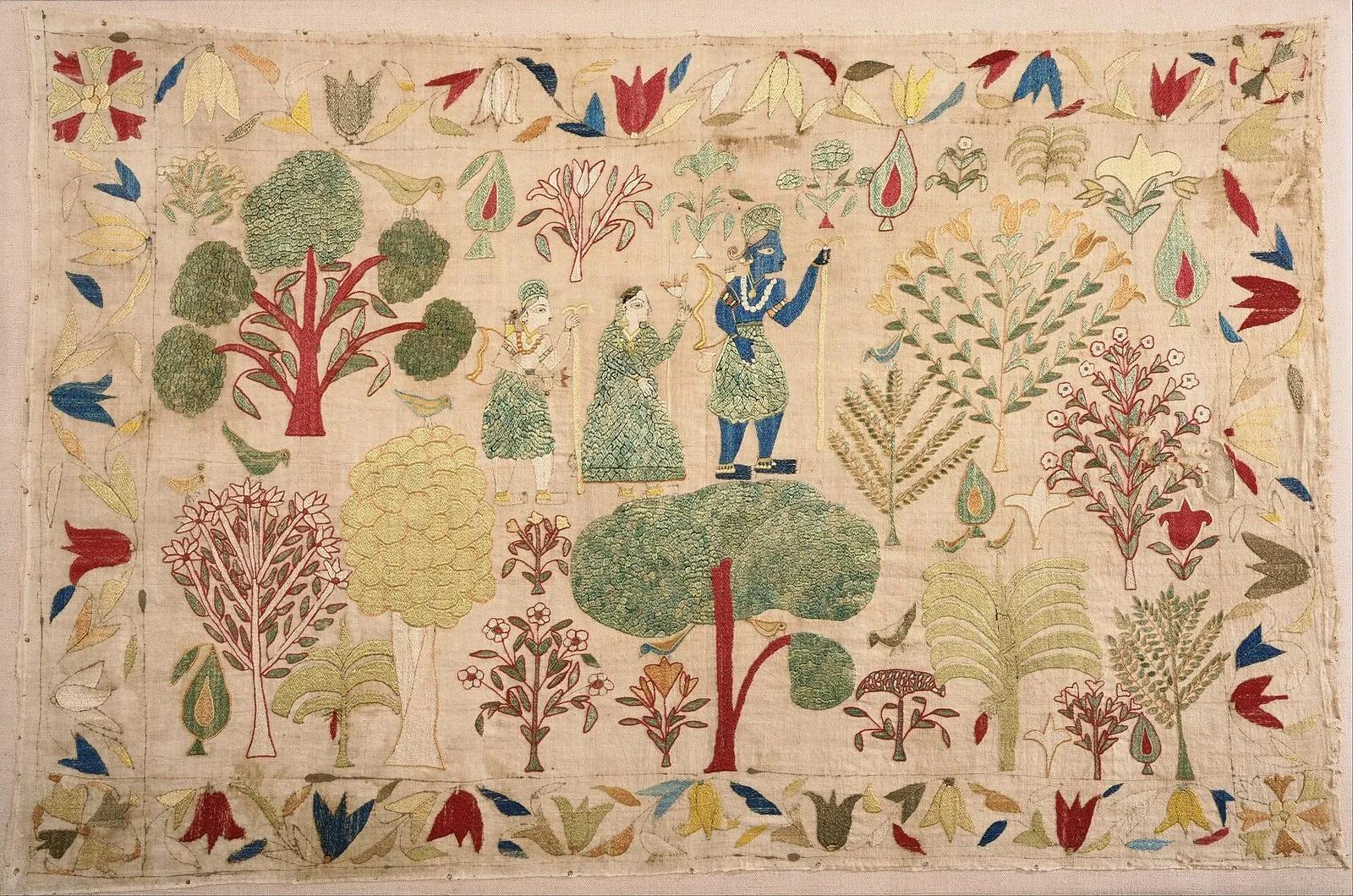
Chamba Rumal: The Embroidery With No Wrong Side
Turn the cloth over. That is the whole test. A real Chamba rumal has no wrong side: the Krishna on the front is the same Krishna on the back, stitch for stitch, colour for colour, and there is not a single knot anywhere on the fabric to tell you which face the embroiderer was looking at when she worked. Machine embroidery cannot do this. Most hand embroidery cannot do this either. I have been writing about Himachali crafts for years from my end of the state, in Kullu, and I will say it plainly: the dorukha stitch of Chamba is the single most impressive piece of textile engineering this state has produced, and almost nobody outside a museum knows it exists.
You may have read online that UNESCO declared the Chamba rumal a world heritage in 2008. That claim is repeated on dozens of websites and it is not true, and we will get to it. The real story is better anyway. It involves court painters who lost their Mughal patrons, palace women with silk from Amritsar, a widow who fed three children on thread work, and a 72-year-old who got a Padma Shri for refusing to let the whole thing die.
- What it is
- Pictorial silk embroidery on unbleached cotton, made in Chamba town since the 17th century
- The signature
- Dorukha taanka: double satin stitch, both faces identical, zero knots
- Thread
- Untwisted silk floss called pat, traditionally dyed and sourced from Amritsar
- Base cloth
- Handspun unbleached mulmul (fine muslin) or khaddar
- Legal protection
- GI tag under the GI Act 1999, application no. 79, filed 22 January 2007
- Classic motif
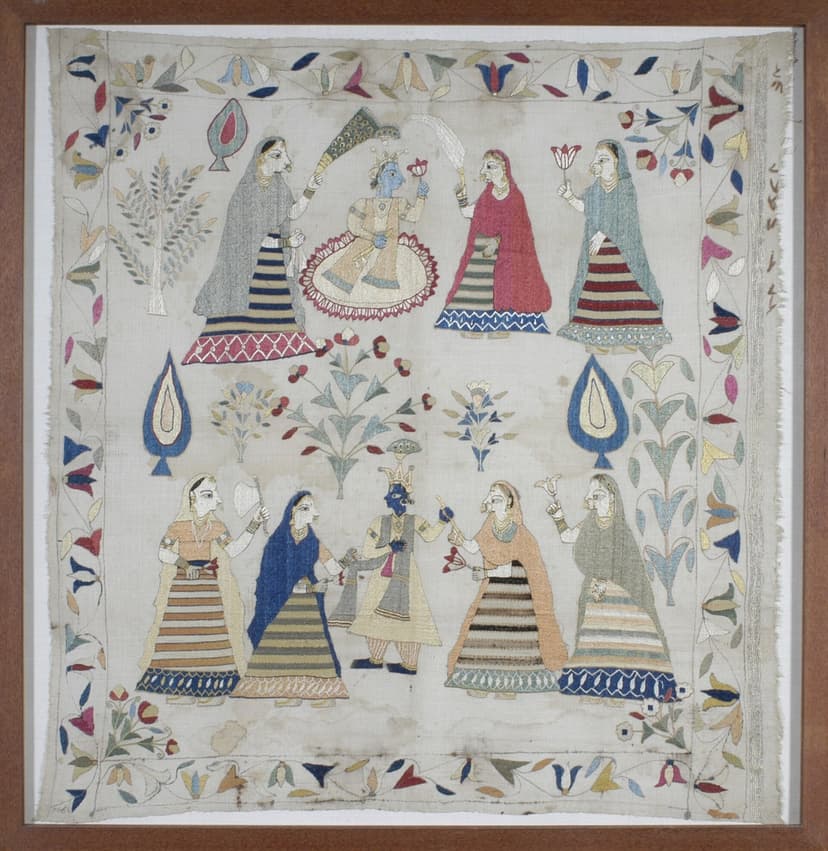
- Raasmandala: Krishna and the gopis dancing in a circle
- Where to see the best
- Bhuri Singh Museum, Chamba. Tue-Sun 10 AM-5 PM, Rs 50 Indian entry
- Price range 2026
- Rs 200 for a 2-day piece to Rs 1,00,000+ for narrative masterworks
- Working speed
- Roughly one square inch per hour on fine mulmul
Two artists, one cloth
A Chamba rumal is not one person's work. It never was. The design comes first, and it comes from a painter.
When Mughal patronage collapsed in the eighteenth century, miniature painters from the plains and from ateliers at Basohli and Guler moved up into the hill courts, and Chamba's rajas took them in. Raja Umed Singh, who ruled from 1748 to 1768, ran the most generous patronage of the lot. The painters did what court painters do: portraits, Ragamalas, Krishna cycles, the whole Pahari repertoire in mineral colour on paper. And then they did something nobody planned. They started drawing on cloth.
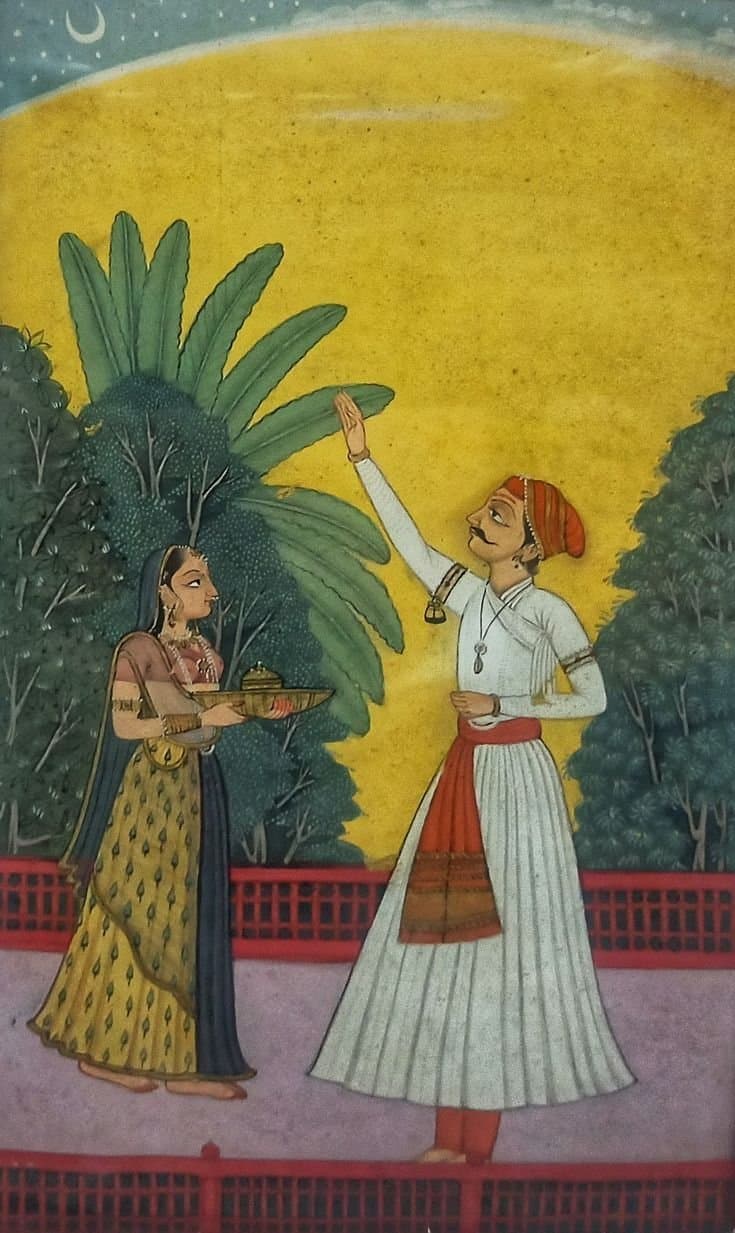
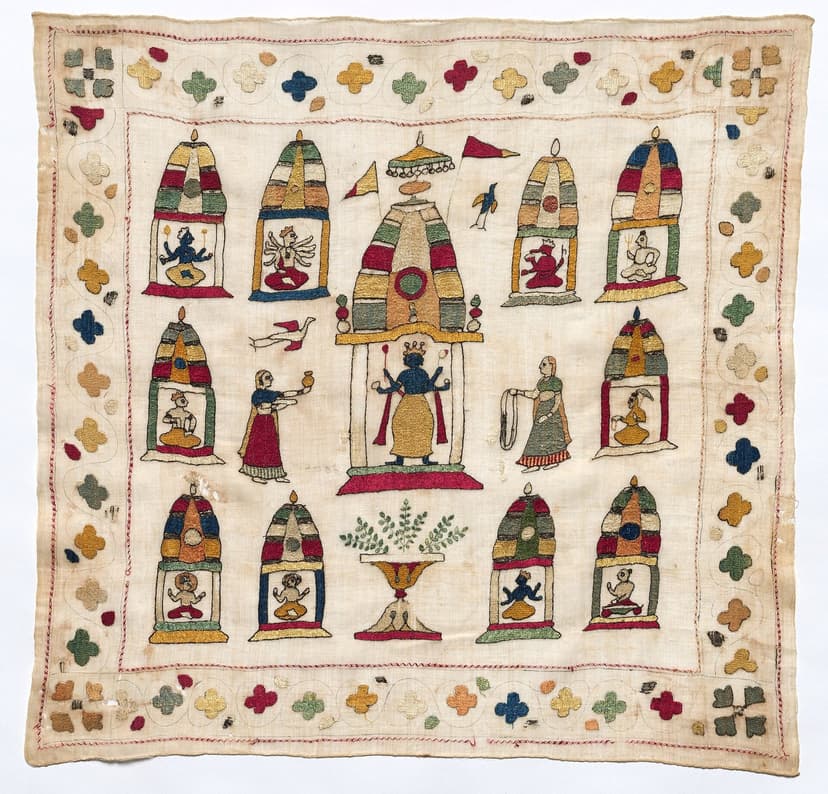
The painter sketched the composition in charcoal directly onto unbleached mulmul. That underdrawing is called the kharda. He chose the colour scheme too, the same palette logic he used on paper. Then the cloth went to the women of the household, often the zenana of the palace itself, who filled the drawing with untwisted silk floss. Hindi sources on the craft put it simply: each rumal is a painting in thread. Not "inspired by" Pahari painting. Drawn by the same hands that made the paintings, then translated into silk by a second artist who had to honour every line.
That collaboration is still how it works. Vijay Sharma, the Padma Shri Pahari painter based at the Bhuri Singh Museum, supplies authentic kharda drawings to embroiderers and runs revival workshops there. The painter half of the equation is the part most write-ups skip, and it is the part that decides whether a rumal looks like art or like a cushion cover.
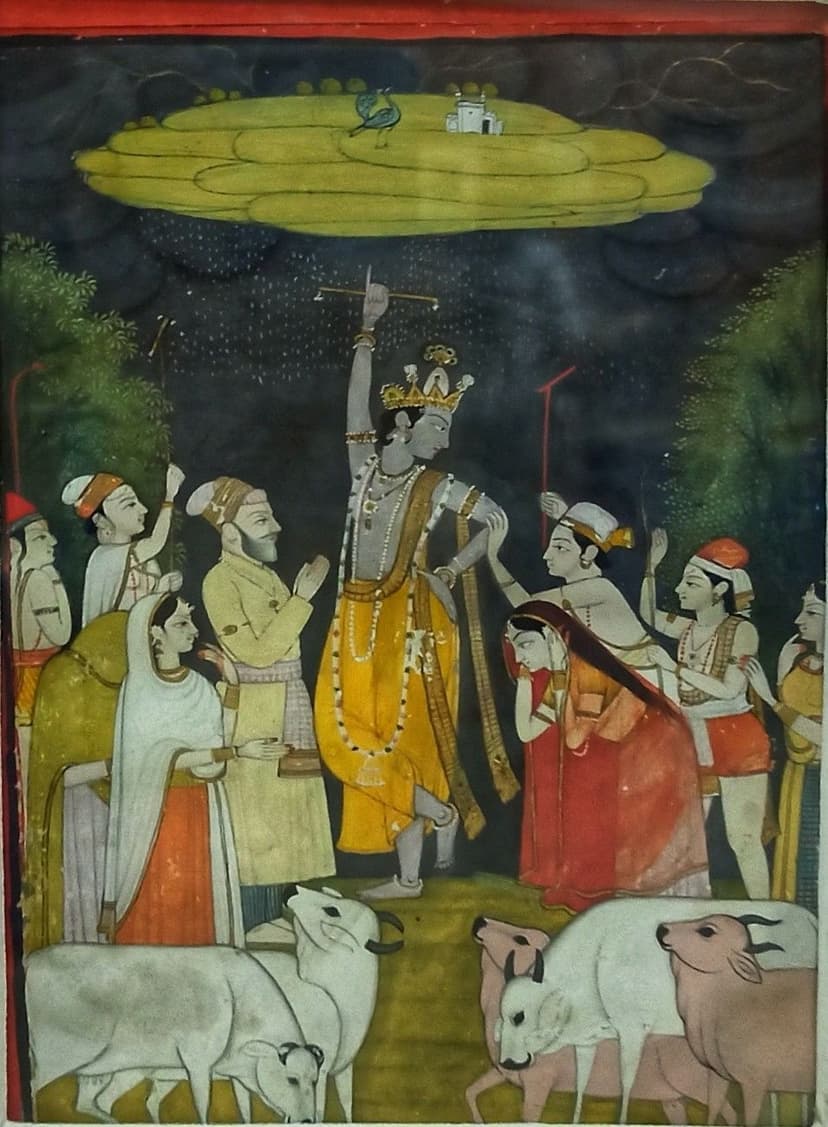
What happens to that profession now is an open question, and you can watch it being asked in real time. A young Pahari miniature artist and heritage student who posts on Reddit as u/horhun56 put his work up last year and asked whether it could ever be a living. "Taking money for an artwork from Indians is hard," he wrote. "Otherwise it's just depressing." In another thread he said the quiet part: "miniature painting takes a lot of time and patience. As a heritage student, I've taken some interviews of those whose family forefathers were associated with miniature paintings." The families are still here. The market is the question.
The stitch with no knots
Dorukha means two-faced, and the term does all the work. The embroiderer uses a double satin stitch carried forward and backward in alternation, so that the thread lays flat colour on both faces of the cloth simultaneously. There is no backing fabric. There are no knots, anywhere, ever; the stitch tension alone holds the floss in place. Lalita Vakil, the craft's most decorated living practitioner, described it to Hindi media this way: "चंबा रुमाल की एक खासियत यह है कि इसकी कढ़ाई होने पर यह दोनों तरफ से एक सा ही दिखाई देती है": the special quality of the Chamba rumal is that once embroidered, it looks the same from both sides.
The thread matters as much as the stitch. Pat is silk floss left untwisted, which is what gives old rumals that flat, liquid sheen; twisted thread catches light in dots, untwisted floss catches it in sheets. It came up from Amritsar, dyed before it travelled. The base is handspun mulmul so fine you can read the charcoal kharda through it, or rougher khaddar when the budget was thinner. The working rate on good mulmul is about one square inch per hour. Sit with that number, then look at a cloth two feet across.
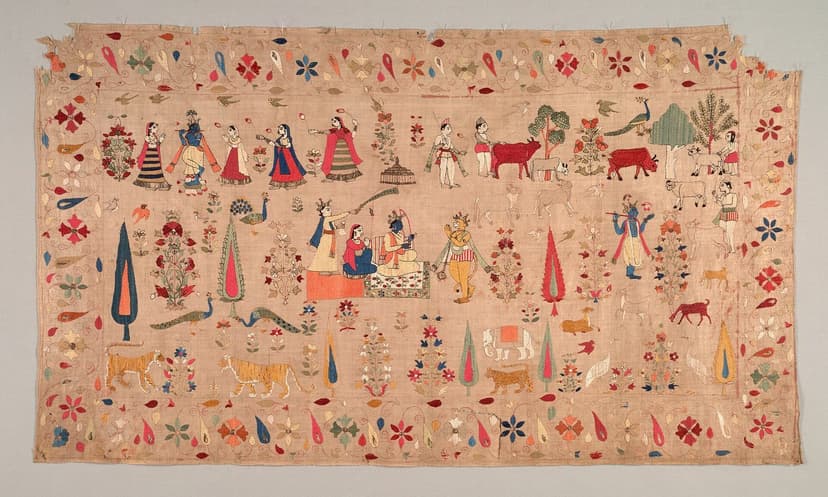
Reddit's textile people know the signature when they see it. When an unidentified embroidered cloth turned up on r/textiles, u/newsensequeen called it from the technical tells alone: "Unbleached cotton base fabric. Silk floss. Double satin stitches done in both right and wrong side, where the effect is reversible (Do-Rukha). Motifs of stylized parrot, Ganesha, Swastika and local flora-fauna. I'm pretty sure that's Chamba Rumal." A thrifter on r/ThriftStoreHauls (u/kartoos) made the same identification on a find in an American charity shop: "I believe this could be a Chamba Rumal, which is a recognized and GI tagged art form!" Pieces of Chamba are sitting in thrift stores on the other side of the planet, waiting for someone who knows to flip them over.
What the cloths are actually saying
A rumal is never just decoration. The classic subjects are narrative, and the embroiderers chose them the way a temple muralist chooses: for theology first.
The signature composition is the Raasmandala. Krishna multiplies himself and dances with the gopis in a circle, and the circular dance sits inside the square cloth with the corners filled by flowering sprays. The geometry is the point. A circle of divine play, framed and held, made to cover an offering or a bride's dowry box. The Quint's Hindi service noted that a single good Raasmandala takes 20 to 25 days and sells around Rs 30,000 today, which tells you the form still carries its old prestige.
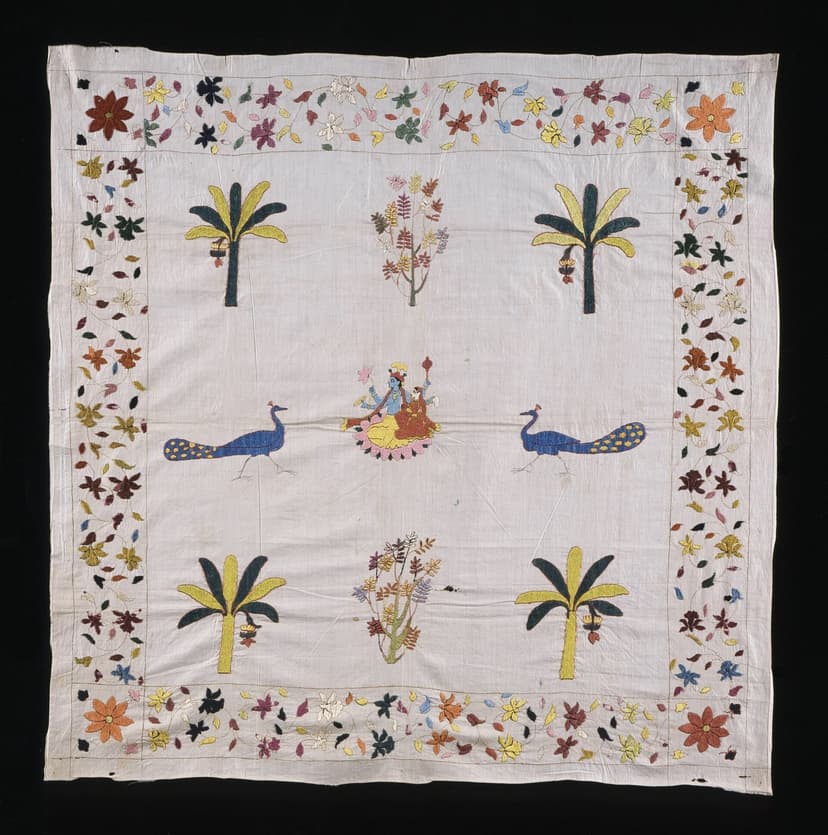
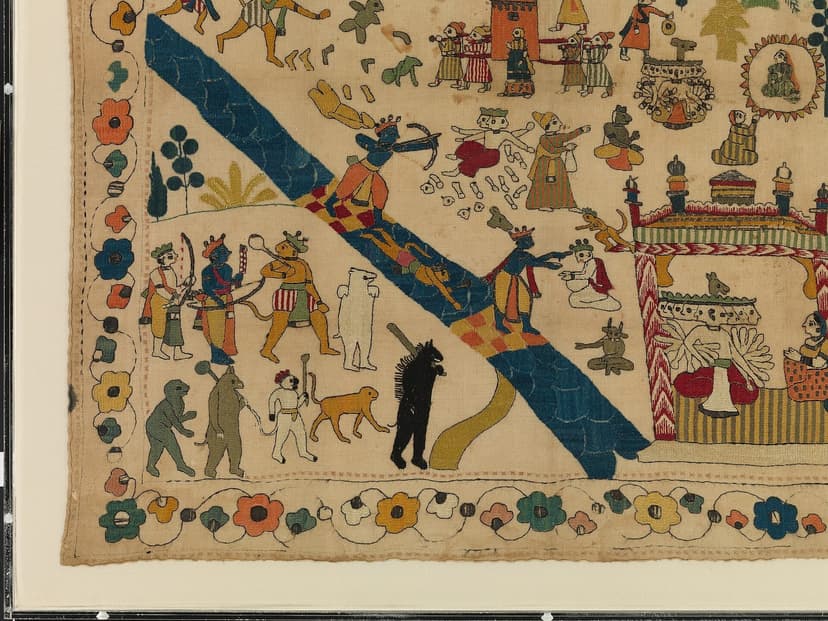
Beyond Krishna the range runs wider than most buyers ever learn: Rukmini Haran (the abduction-elopement of Rukmini), Kaliya Daman, the Gita Govinda's verses turned into figures, Ashta Nayika cycles of the heroine's eight moods that the Pahari painters loved, Baramasa scenes of the twelve months, Shiva with Parvati, and wedding processions or royal hunts whenever the court wanted itself on cloth. And battle, too: at least one famous rumal carries the Kurukshetra war entire, armies, chariots and all.
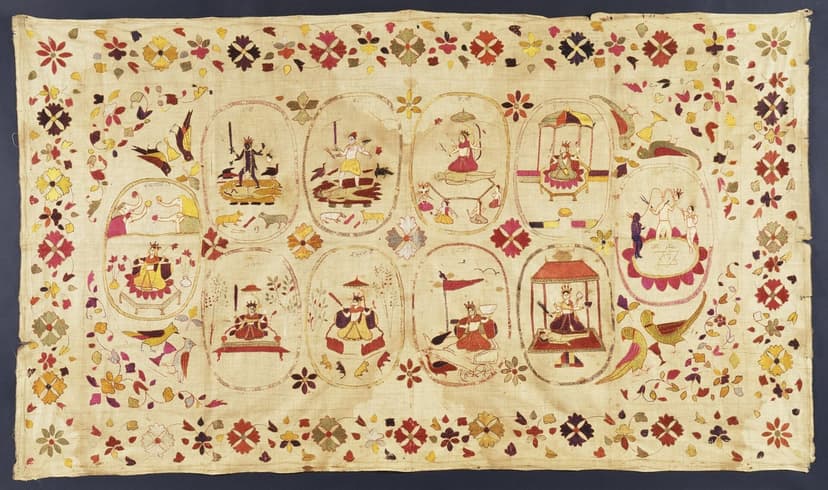
My favourite of the museum pieces is the Mahavidya rumal above, the ten great goddesses each in her own medallion with her name stitched above her head, Kali holding her sword among them, all of it on what is technically a handkerchief. Whoever commissioned that was not making table linen.
Queens, dowries, and a war scene that ended up in London
The deep history is older than the court workshops. The earliest reported rumal of this type was made in the sixteenth century by Bebe Nanaki, sister of Guru Nanak, and is preserved at a gurudwara in Hoshiarpur. The tradition as Chamba practised it, though, is a seventeenth and eighteenth century court phenomenon. Hindi sources credit Raja Prithvi Singh's seventeenth-century court with formalising the dorukha tradition, and Umed Singh's reign with its golden period a century later.
Inside the Akhand Chandi Palace, embroidery was what accomplished women did. Rumals covered wedding gifts moving between aristocratic households, wrapped offerings carried to the Lakshmi Narayan temples, and travelled in dowries as proof of the bride's hand. The exchange of rumals between families at a wedding was etiquette, not ornament. A plain gift was a slight.
The craft's one piece of imperial fame came in 1883, when Raja Gopal Singh gifted the British a rumal embroidered with the entire Kurukshetra war. That cloth sits in the Victoria and Albert Museum in London today. Other rumals are spread through the Metropolitan Museum in New York, LACMA in Los Angeles, the Cleveland Museum of Art, the Philadelphia Museum of Art, the Bhau Daji Lad Museum in Mumbai, and the National Museum in Delhi. For a craft from one small Himalayan town, the museum footprint is absurd.
About that UNESCO claim
Search "Chamba rumal" and within two results you will read that UNESCO declared it a world heritage on 31 October 2008. Travel blogs repeat the line, exam-prep sites teach it to HPAS aspirants, and even otherwise careful craft writers pass it along uncited.
I spent an afternoon trying to source it and came up empty. UNESCO's World Heritage designation applies to sites, not crafts. The body's craft-side mechanism, the Intangible Cultural Heritage lists, does not include the Chamba rumal; India's ICH entries run from Ramlila to Kolkata's Durga Puja, and no Himachali embroidery appears among them. The Wikipedia article on the rumal contains no UNESCO claim at all. Neither does the Delhi Crafts Council, the institution that actually led the revival and would have every reason to advertise such an honour. What did happen around that date: the craft's Geographical Indication paperwork, application no. 79 filed on 22 January 2007 under the GI Act 1999, was moving through registration, and an October 2008 Hill Post headline about GI registration seems to have mutated, somewhere in the blog mines, into a UNESCO coronation.
If a seller tells you a piece is "UNESCO certified," walk away. No such certificate exists for this craft. The real authenticity marker is the GI registration (no. 79 under the GI Act 1999) and, more reliably, the cloth itself: flip it and check both faces match.
Here is the thing: the rumal does not need the borrowed credential. A four-century-old technique no machine can reproduce, a GI tag, three National Awards and a Padma Shri in its corner, and walls in the V&A and the Met. That is a better resume than most listed heritage can show.
The women who pulled it back
The court collapsed in 1948 when Chamba state merged into India, and the patronage went with it. By the 1960s the dorukha tradition was functionally dead: a handful of older women remembered the stitch, cheap one-sided imitation work was circulating under the rumal name, and the kharda-drawing painters had no commissions. The twentieth century nearly finished what Ghazni, the Mughals and the British never touched.
The rescue came in stages, and it came almost entirely through women. Usha Bhagat, Indira Gandhi's longtime aide, began pushing a revival in the late 1970s. In 1992 the Delhi Crafts Council under her vice-presidency adopted the rumal as a formal project, compiling over a hundred old designs from the collections of the Indian Museum in Calcutta, the National Museum in Delhi, the Bhuri Singh Museum, the Calico Museum in Ahmedabad and the Crafts Museum, then set up a training centre on the ground in Chamba in 2003. The DCC still runs collections with contemporary designers; its pieces have shown at the India Art Fair.
Inside Chamba, the revival has a name: Lalita Vakil. Born in April 1954, married into Chamba at 15, she learned the dorukha stitch and then spent five decades teaching it free of charge from her own home, training generations of local women into an artisan network that now earns from the craft. The state gave her three National Awards; the Nari Shakti Puraskar came in 2018, the Padma Shri in 2022. Fifty years on one stitch.
The economics of that network are not abstract. Masto Devi was widowed at 27 with three children and a mother-in-law to feed; she trained in a 35-day Delhi Crafts Council programme arranged through Vijay Sharma and built a life on the needle, eventually winning the Kamaladevi Chattopadhyay Award and the Kamala Devi Martand Award in 2020, and chairing the local crafts chapter. She told Amar Ujala: "पति के जाने के बाद तीन बच्चों का पेट पालना था — धागों ने ही मुझे खड़ा किया।" After my husband died I had three children to feed; it was these threads that put me back on my feet.
And the work can still be monumental. At the Chamba Shivratri fair, artisan Sunita Thakur, who runs a self-help group selling rumals from Rs 200 up to Rs 1 lakh, showed ETV Bharat a piece she began during the Covid lockdown: "इसे बनाने में 2 साल लग गए।" Two full years of stitching, one cloth.
One museum does this better than anywhere in India
The Bhuri Singh Museum opened on 14 September 1908, founded by Raja Bhuri Singh with the Dutch epigraphist J. Ph. Vogel, and it is, for my money, the best small museum in North India. Not close, honestly. Around 8,500 objects: Basohli, Guler and Chamba-school miniatures, carved palace doors, frescoes from the Rang Mahal, copper-plate land grants, royal costume, arms.
The reason it belongs in this article is one curatorial decision. In the Chamba Rumal and Textile Gallery, eighteenth and nineteenth century Raasmandala and Rukmini Haran rumals hang side by side with the Pahari miniature paintings they were drawn from. Cartoon and cloth, painter and embroiderer, on the same wall. No other museum in India shows the craft's two halves together like this, and once you have seen the pairing you cannot unsee how completely the rumal is a painting that traded pigment for silk.
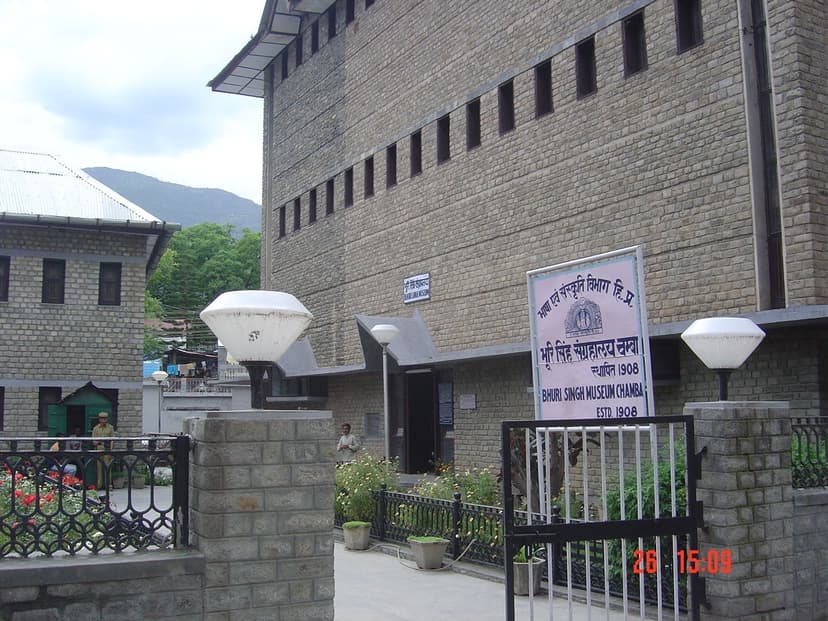
Bhuri Singh Museum, Hatnala Gali near the Chaugan, Chamba. Open Tuesday to Sunday, 10 AM to 5 PM, closed Mondays and gazetted holidays. Entry Rs 50 (Indian), Rs 150 (foreign), Rs 30 (children under 10). Mobile or camera photography Rs 100-200; verified from the museum site in June 2026.
Chamba town, if you go
Chamba is the HP district capital tourists skip. Dalhousie and Khajjiar absorb the crowds 40-odd kilometres up the hill, and the old capital on the Ravi gets the leftovers. One Reddit user (u/Negative-Paint9386) dug up the reason the art survived here at all, from a colonial officer's journal: Kangra sat open on the border and got hammered by every invasion and every fashion, while Chamba stayed up its own valley, hard to reach and left alone. The thread's author added that this isolation "was the exact reason why architecture like rock cut temples, art like Chamba Bronze shields and sculpture have survived." A thousand years of being inconvenient to invade is the best conservation policy ever devised.
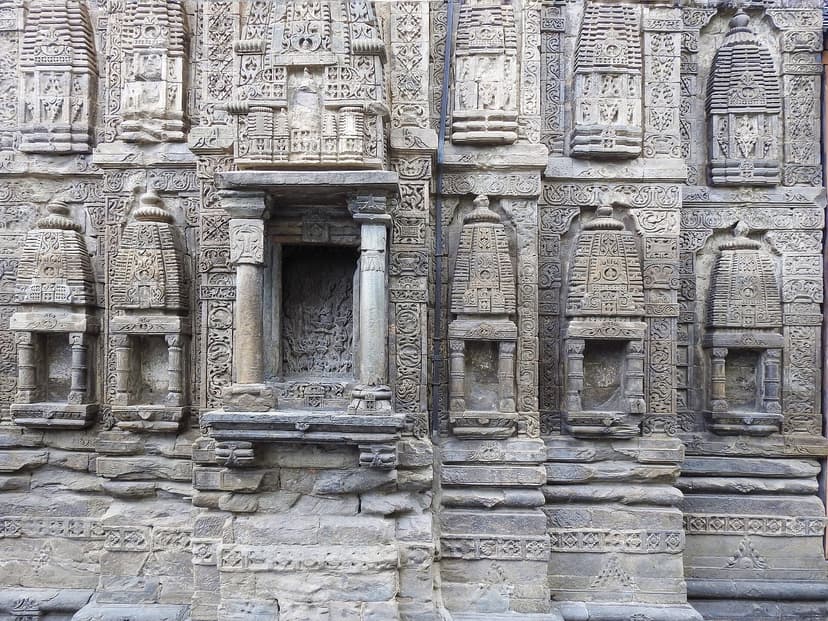
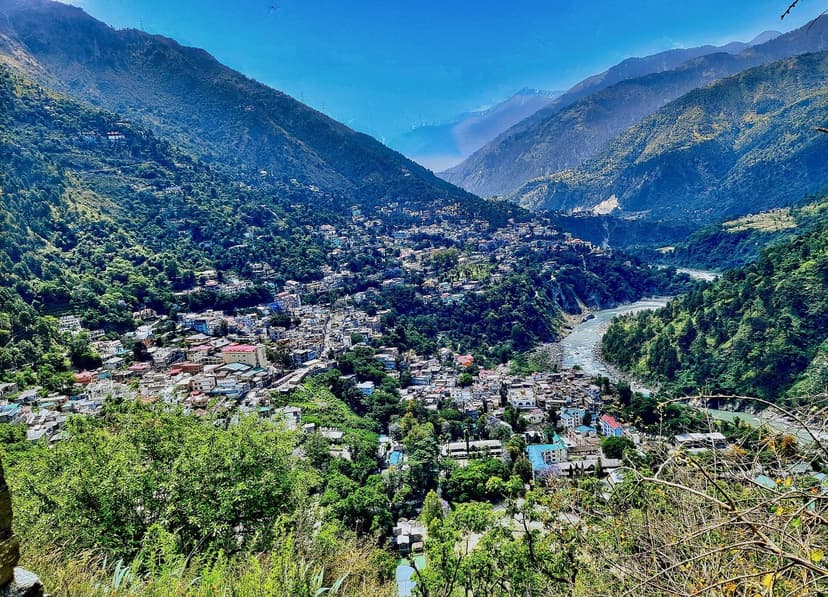
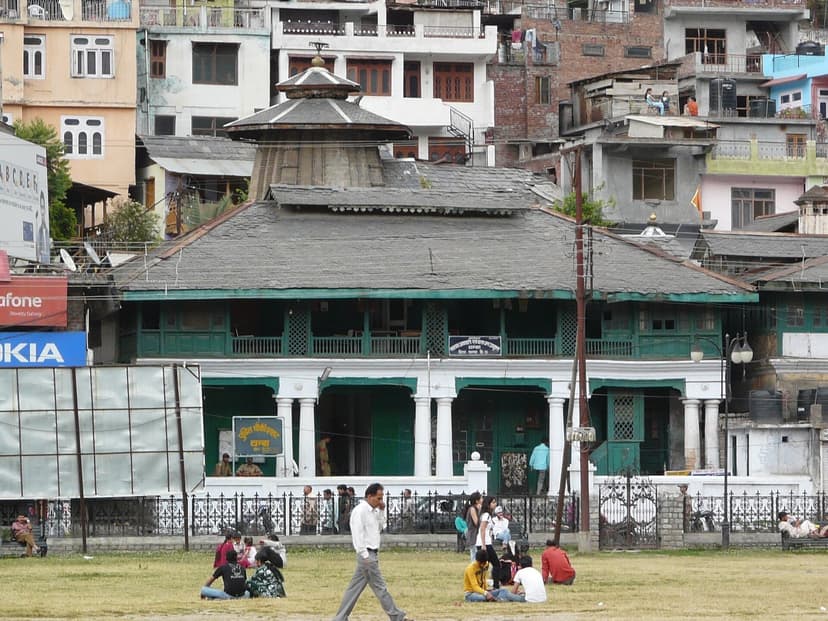
The town itself is a compact half-day on foot. The Lakshmi Narayan complex with its row of stone shikharas, the eleventh-century Champavati temple that gave the town its name, the Chaugan, the museum. If old temple towns are your thing, Bharmour, the original Chamba capital with its 1,400-year-old Chaurasi temple compound, is 65 km further up the Budhil valley; we wrote a full guide to it in Bharmour: 84 temples, zero tourists.
Planning a Chamba-Bharmour loop and not sure the buses line up? Email us your draft route. We will tell you which day is too ambitious, whether the museum fits before the afternoon bus, and where the road has been rough this season.
Buying one without getting fooled
Now the practical part, because the difference between an authentic dorukha piece and the machine-stitched souvenir sold under the same name is the difference between art and landfill.
Timing matters more than anything. The Minjar Mela, Chamba's biggest fair, runs from the last Sunday of July; in 2026 that is 26 July to 2 August, and the Chaugan fills with stalls where artisans sell direct, next to the stands selling Chamba chukh, the red-chilli pickle this district is quietly famous for. The International Shivratri fair in March is the second window. Outside fair season, the Bhuri Singh Museum shop stocks verified pieces, and Lalita Vakil's home studio in Chamba town trains and sells year-round. In Delhi, look for Chamba artisan stalls at Dilli Haat INA.
Online, the GI-certified route is the safe one. GI Heritage lists a 12-by-12-inch hand-stitched piece on mulmul at Rs 2,237 as of June 2026, which is a fair benchmark for an entry-level authentic rumal. Memeraki curates art-grade pieces, and Bridge Bharat carries collector work in partnership with Padma Shri artisans. Expect to pay real money for real narrative work; the Hindi press pricing data is consistent on this.
| Piece | Price | Notes |
|---|---|---|
| Small ladies rumal (about 2 days work) | Rs 200-500 | Simple floral motifs, good first piece |
| Entry GI-certified 12x12 inch piece, online | Rs 2,000-2,500 | GI Heritage benchmark Rs 2,237 in June 2026 |
| Mid-size mulmul piece (10-18 days work) | Rs 5,000-30,000 | Where most serious buyers should aim |
| Standard Raasmandala (20-25 days) | Around Rs 30,000 | Price observed at Shimla craft mela, per Amar Ujala |
| Masterwork narrative piece (1 month to 2 years) | Rs 50,000-1,00,000+ | Sunita Thakur showed a 2-year piece priced at Rs 1 lakh |
How to spot the fakes, since the bad news is they are everywhere in souvenir shops from Dalhousie to Shimla Mall Road:
| Authentic dorukha | Machine or fake | |
|---|---|---|
| The flip test | Both faces identical, design equally clean on each | Reverse is messy, threads crossing, one face clearly the back |
| Knots | None anywhere on the cloth | Knots and thread ends visible on the reverse |
| Thread | Untwisted silk floss (pat) with a flat liquid sheen | Twisted or synthetic thread, glittery point-like shine |
| Outline | Hand-drawn kharda, slight human irregularity | Printed or perfectly uniform outlines |
| Base cloth | Handspun unbleached mulmul or khaddar | Thick mill cotton or synthetic |
| Time and price | Weeks of work, priced accordingly | Under Rs 500 for anything bigger than a napkin |
| Subject | Narrative scene: Raasmandala, epics, Ashta Nayika | Generic florals with no story |
Will buying one fix Chamba's economy? No, and locals are blunt about this. In a sharp r/HimachalPradesh thread on why the district stays poor, u/SnooSeagulls1976, who is from Chamba, wrote: "Chamba has no economic growth. you cannot make recurring money by selling chamba rumal and chamba chappal." Another commenter (u/andi-mandi-sandi) pointed out that "other hill places got great boon with the horticulture but what chamba got nothing." They are right, and pretending a handicraft purchase is economic policy would be tourist-brochure thinking. What your money does do is keep a specific woman stitching instead of quitting, and keep the dorukha skill alive one trained hand at a time. That is worth Rs 2,237 of anyone's money.
Want a second opinion before you spend Rs 30,000 on a Raasmandala, or help telling pat floss from polyester in a seller's photos? Email us the listing and we will give you an honest read before you pay.
One thing I have not been able to pin down, and I will admit it: how many active dorukha embroiderers Chamba has today. Lalita Vakil has trained thousands over fifty years, but trained is not the same as practising, and nobody publishes a census. If you know, the email above works in both directions.
Frequently asked questions
What is a Chamba rumal?
A pictorial embroidery from Chamba town in Himachal Pradesh, made since the 17th century. Scenes from the Krishna story and the epics are stitched in untwisted silk on unbleached cotton using the dorukha double satin stitch, which makes both faces of the cloth identical. It holds GI tag protection (application no. 79 under the GI Act 1999, filed January 2007).
What makes the dorukha stitch special?
Dorukha means two-faced. The double satin stitch is worked forward and backward in alternation so the design appears identical on both sides, with no knots anywhere and no backing cloth. Machine embroidery cannot reproduce it, which makes the flip test the simplest authenticity check.
Did UNESCO really declare the Chamba rumal world heritage in 2008?
No. That claim circulates widely online but has no primary source. UNESCO world heritage status applies to sites, and the rumal does not appear on UNESCO intangible cultural heritage lists either. The real protections are the GI tag and the national awards given to its master artisans.
How much does an authentic Chamba rumal cost in 2026?
Small two-day pieces start around Rs 200-500. A GI-certified 12x12 inch piece sells online for about Rs 2,237. Mid-size works run Rs 5,000-30,000, a classic Raasmandala about Rs 30,000, and large narrative masterworks Rs 50,000 to over Rs 1 lakh.
Where can I buy an authentic piece?
In Chamba town: the Bhuri Singh Museum shop, Lalita Vakil home studio, and artisan stalls at the Minjar fair (26 July to 2 August 2026) and the Shivratri fair in March. In Delhi: Chamba stalls at Dilli Haat INA. Online: GI Heritage, Memeraki, and Bridge Bharat. HP Emporium outlets in Shimla, Dharamshala and Manali also stock pieces.
How do I spot a fake?
Flip it. If the reverse is messy or clearly a back side, it is not dorukha. Other red flags: visible knots, shiny twisted or synthetic thread, printed outlines, thick mill-cotton base, and prices under Rs 500 for anything larger than a small napkin.
Who is Lalita Vakil?
The craft revival leading figure: born 1954, married into Chamba at 15, she has taught the dorukha stitch free from her home for five decades and trained generations of women. She received three National Awards, the Nari Shakti Puraskar in 2018, and the Padma Shri in 2022.
Who draws the designs?
Traditionally a Pahari miniature painter sketches the kharda, the charcoal underdrawing, on the cloth and sets the colours; the embroiderer then fills it in silk. Padma Shri painter Vijay Sharma continues this role today, supplying drawings and running workshops at the Bhuri Singh Museum.
How long does one piece take?
Roughly one square inch per hour on fine mulmul. Small pieces take about two days, mid-size works 10-25 days, and major narrative cloths a month to two years. One artisan showed a piece at the Chamba Shivratri fair that took two full years.
Is Chamba town worth visiting for this?
Yes, and pair it with Bharmour. The Bhuri Singh Museum hangs old rumals next to the Pahari paintings they were drawn from, the Lakshmi Narayan temple complex and the Chaugan are a short walk, and the town gets a fraction of the crowds that stop at Dalhousie and Khajjiar up the road.
Read next
- Bharmour: 84 temples, zero tourists: the old Chamba capital, 65 km up the valley.
- Kath-kuni: the ancient earthquake-proof architecture of Himachal: another HP craft that engineering forgot to credit.
- Kangra Fort and Masrur: the heritage belt one valley south.
- HP festival calendar 2026: includes Minjar, the fair where the rumals come out.
Sources
- District Chamba official portal: Minjar Mela.
- Bhuri Singh Museum official site: hours, fees, galleries (checked June 2026).
- Asia InCH, Encyclopedia of Crafts: Chamba Rumal embroidery of Himachal Pradesh.
- Delhi Crafts Council: revival project since 1992, Chamba centre 2003.
- Sahapedia: Chamba Rumal, reviving a languishing craft.
- 30Stades: Lalita Vakil profile.
- The Better India: the embroidery of queens.
- Amar Ujala (Hindi): Masto Devi profiles and craft-mela price reports, including the March 2026 Aparajita feature.
- ETV Bharat (Hindi): Sunita Thakur at the Shivratri fair, two-year rumal.
- The Quint (Hindi): rumal pricing and 20-25 day working time.
- Zee News (Hindi): Lalita Vakil on the dorukha stitch.
- GI Heritage: live GI-certified rumal pricing (June 2026).
- Wikipedia: Chamba Rumal: background reading; GI application details, V&A and Hoshiarpur holdings.
About Rajesh Thakur
Rajesh Thakur grew up in the Kullu valley and has been writing about Himachal Pradesh travel and culture since 2018. He's most at home in upper Kullu, Lahaul, and the Spiti circuit, and has done the Manali-Kaza loop more times than he's counted.
You Might Also Like
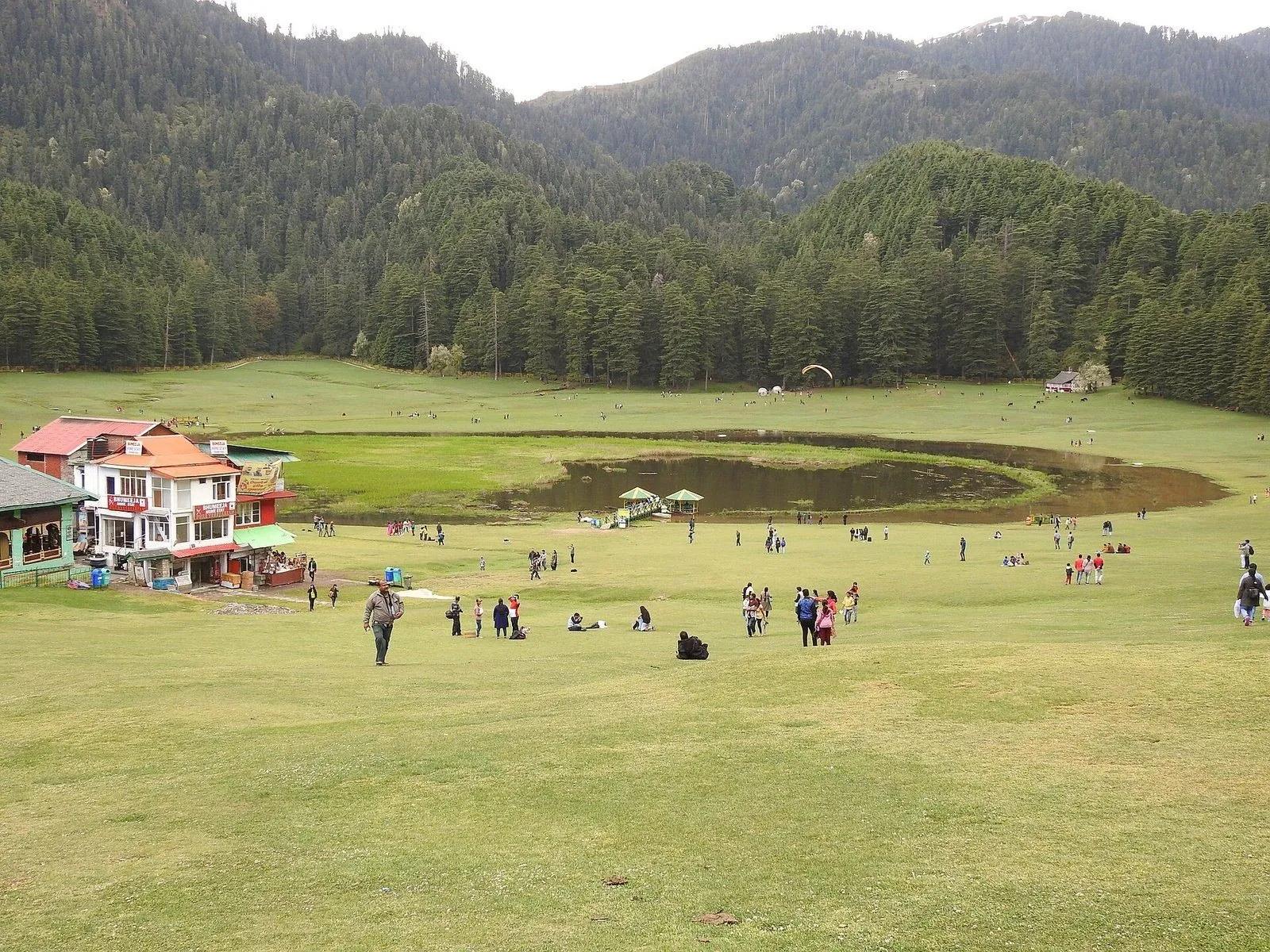
Dalhousie & Khajjiar in 2 to 3 Days: The Honest Itinerary, With the Chamba Upgrade
Reddit says Dalhousie has nothing except scenic beauty. Correct, and that is the pitch. A day-by-day Dalhousie-Khajjiar plan with Dainkund, Kalatop, real traveller budgets, and the Chamba day most people wrongly skip.
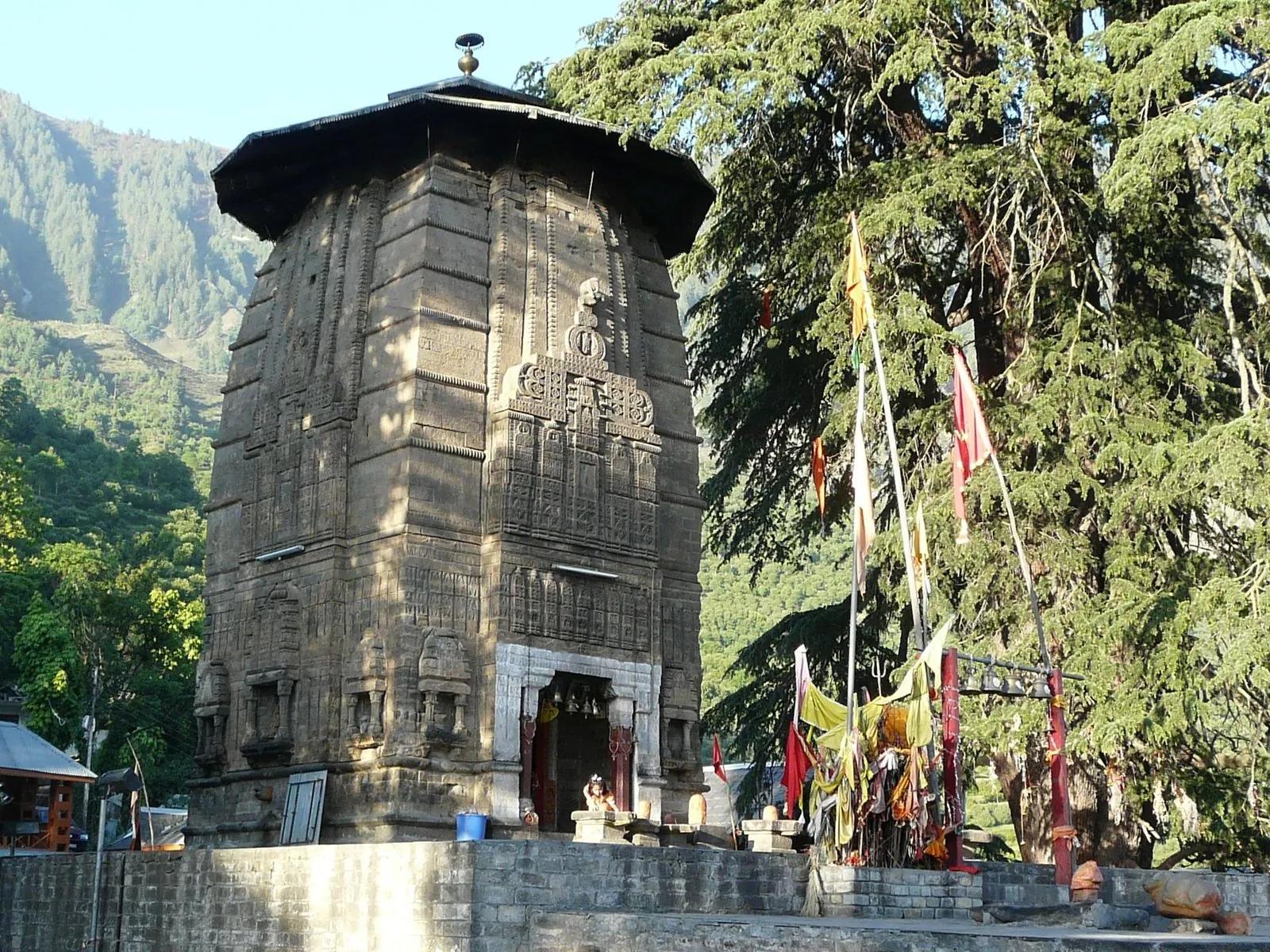
Bharmour: 84 Temples, Zero Tourists
Bharmour was the capital of the Chamba kingdom for four hundred years, and then a princess preferred a different valley. What got left behind is a courtyard of 84 temples almost nobody walks through, the only Yamraj temple on earth, the homeland of the Gaddi shepherds, and the trailhead for the Manimahesh Yatra. A full guide from a Kullu local who keeps going back: temple-by-temple, Gaddi culture, the 2026 yatra (Sep 4 to 19), routes, costs, and the honest hard parts.
Manimahesh Lake Trek 2026: Sacred Pilgrimage Guide from Bharmour
Trek 14 km to Shiva's sacred lake at 4,080 m in Chamba: 2026 yatra dates, NGT-framework registration, route, budget, and why the 2025 disaster reshaped how to plan.