
Farm Stays and Apple Picking in Himachal Pradesh: A Kinnauri Apple-Belt Guide
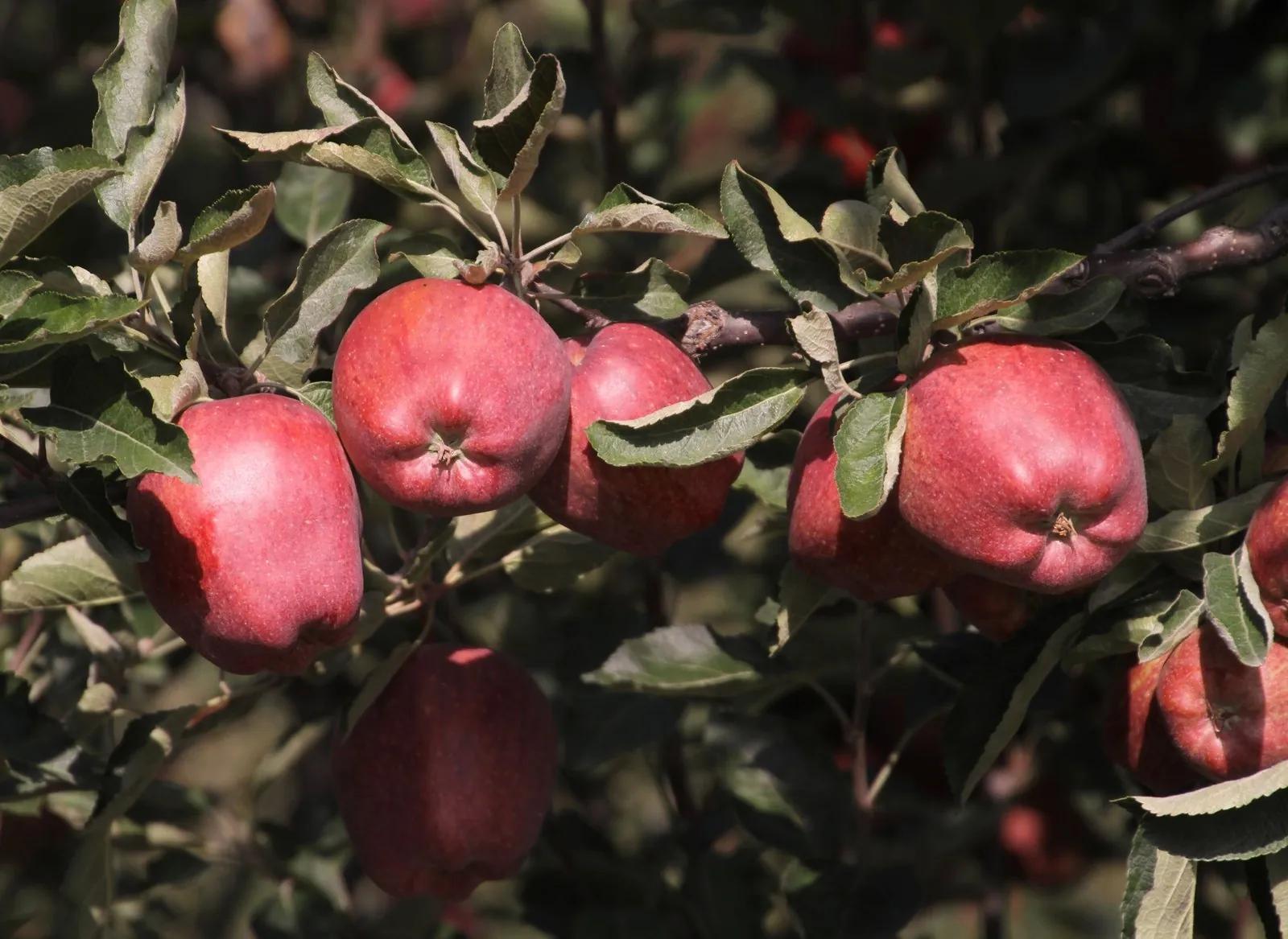
September is not the month people picture Himachal in. Spring blossom postcards, summer Manali & Spiti traffic and then, a gap. This is the gap when a Kinnauri orchard sits at its peak weight. A grafted Royal Delicious tree in Kalpa carries somewhere between 80 and 120 kilos of fruit in a good year; the branches drop under the weight until the props are installed, and the deepest crimson colour you’ll see on the apples in late September is unlike anywhere in north India. Most of the apples that show up in Delhi around Diwali came off a hillside apple tree, which, a few weeks earlier, looked like the photograph above.
So, skip the traditional hotel stay and opt for homestays or in-orchard properties.
What this guide actually is: A working map of where you can stay inside an apple orchard, a tea estate or an organic farm in Himachal in 2026. What each region grows and when. What do you actually do at a farm stay (the answer is not always pick)? And what a week of such a stay costs at the budget and at the high end. I am from Kalpa. The Kinnaur side of the apple belt is home. Every other section in this guide is researched, named, and price-checked against booking platforms or the operator directly, and where the source is Hindi press or a government portal, I have provided a relevant link. I won’t pretend to be a native to Kotgarh, Karsog or Palampur, but I have been to these places, and there’s a difference. Readers should anticipate and value such a level of transparency from any writer.
The big jumps from the older guides on the internet: The harvests are starting earlier than they used to, almost everywhere. The HP Homestay Rules 2025 are now live on a fresh portal, and the Stokes legacy in Kotgarh is on its second wind because Vijay Stokes (Samuel Stokes' grandson) has just gifted 50 bighas of family land back to local growers. Each of those changes the answer to "where should I go and when."
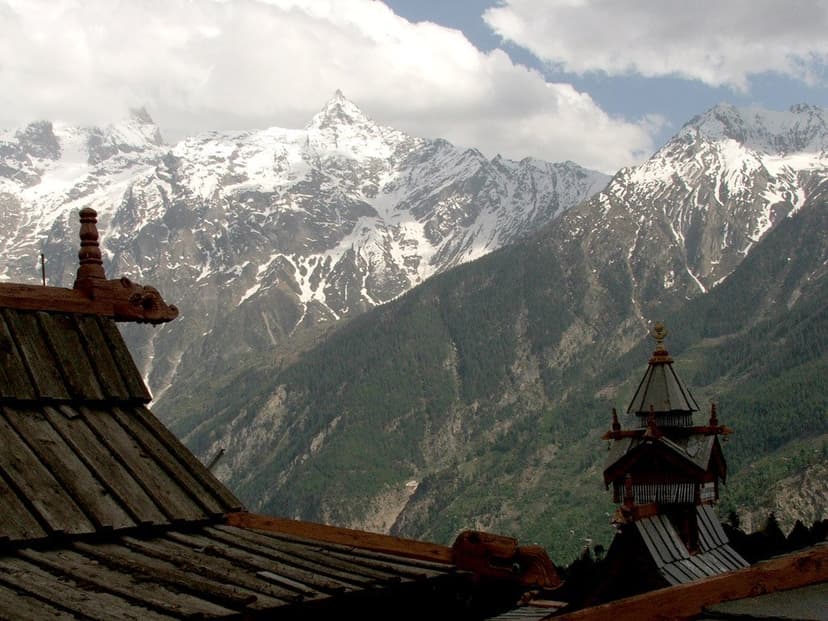
Kalpa wakes up to the Kinner Kailash range and goes to bed under it. Most homestays here built their second floors after the apple boom of the 1980s.
When the harvest actually happens, region by region
The folk wisdom that apples ripen "in September" is half-right. Apples ripen across a four-month window that depends on three things: variety, altitude, and how long the chilling hours were in that particular winter. In 2026, after January, with a 99% precipitation deficit in parts of HP, the first set of orchards is already running early.
A transparent, month-by-month breakdown of when the 2026 harvest cycle actually hits the soil:
- Karsog (Mandi)
- Early-mid August. Earliest harvest in HP.
- Kotgarh / Thanedar / Kotkhai
- Late July to mid September. Royal Delicious peaks mid-Aug to early Sep.
- Narkanda / Theog
- August to late September. Mid-altitude main belt.
- Mashobra
- Apple Aug-Sep. Strawberry March-May.
- Kinnaur (Kalpa / Sangla / Reckong Peo)
- September to early November. Royal Delicious peaks late September.
- Cherry
- May-July. Kotgarh and Sangla.
- Apricot
- Late March bloom; June-July harvest. Kinnaur and Lahaul-Spiti.
- Plum
- June-August. Kullu and Mandi.
- Tea harvest
- April-November. Palampur and Kangra Valley.
If you only have a one-week window and you want the genuine picking experience and not a crate-handover photo-op, the safest sequence is the third week of September into the first week of October, in Kinnaur. By late September, the Royal Delicious apples have reached their peak crimson hue, and the dry, 2,900-metre night air is sharp enough to crisp the crop. At this point, the homestays throughout this section of the apple belt have settled into their seasonal rhythms.
If you are trying to be in HP for the absolute earliest harvest, Karsog in the first half of August is the answer almost nobody else will give you. For two years, the Hindi media has highlighted Karsog as a "छुपा हुआ हिमालयी स्वर्ग" ("hidden Himalayan paradise"). The Amar Ujala photo feature remains the most accessible English-friendly resource explaining why this valley is so often overlooked.
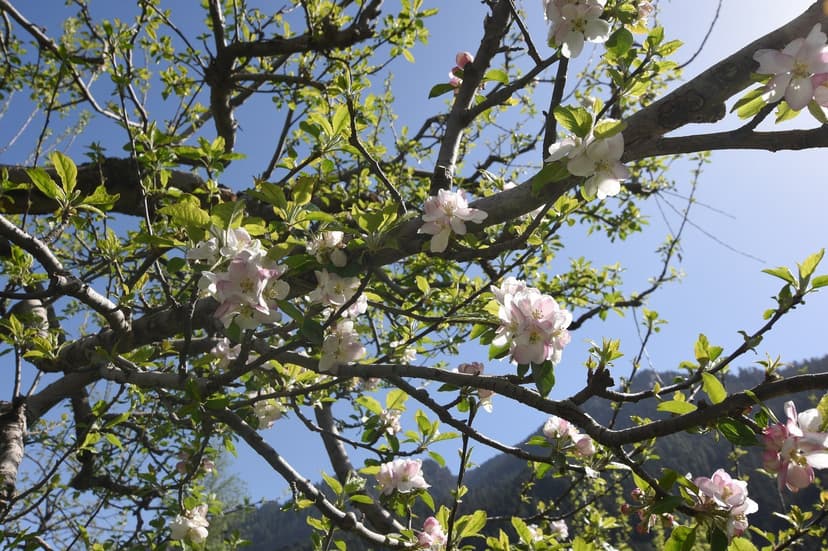
Apple blossoms in late April. The window is short, around ten days, and a hailstorm in this fortnight is the difference between an okay year and a Tribune front page about ruined orchards.
A candid note on the importance of timing: April brings blossoms, not a harvest. If you visit then with plans to pick fruit, you will encounter only pink clouds and swarms of bees, leaving with no produce to show for it. April is a season for orchardists and photographers, so schedule your trip accordingly.
The Kinnaur side: where I actually live
Kinnaur sits inside the Sutlej corridor, on the Hindustan-Tibet road, and it does almost everything later than the rest of the apple belt. Kalpa is at 2960m. Sangla, around the corner up the Baspa, is at 2700m. Chitkul, the last village before the Chinese border, is at 3450m. The further up you go, the deeper the colour goes, and the longer the season stretches. Kinnauri Royal Delicious is the variety that exporters in Delhi and Mumbai actually fight over, and Aaj Tak's Hindi business desk has been running pieces about it almost every harvest. There is a reason the Kinnaur apple is the one that gets gifted in steel boxes at Diwali.
If you are coming to pick, this is the route that works. Drive or take a public transport via the route, Delhi-Shimla-Sarahan-Reckong Peo. The Sarahan stop is worth a night by itself for the Bhimakali temple. Reckong Peo is the Kinnaur district HQ at 2,290m, which is where you sort logistics for everything above. Kalpa is a 30-minute climb from Reckong Peo. If you want orchards plus a real Kinnauri village atmosphere, Kalpa is the go-to place. If you want an orchard plus a campsite and a glacial river, take the second turn at Karcham and go up the Baspa to Sangla.
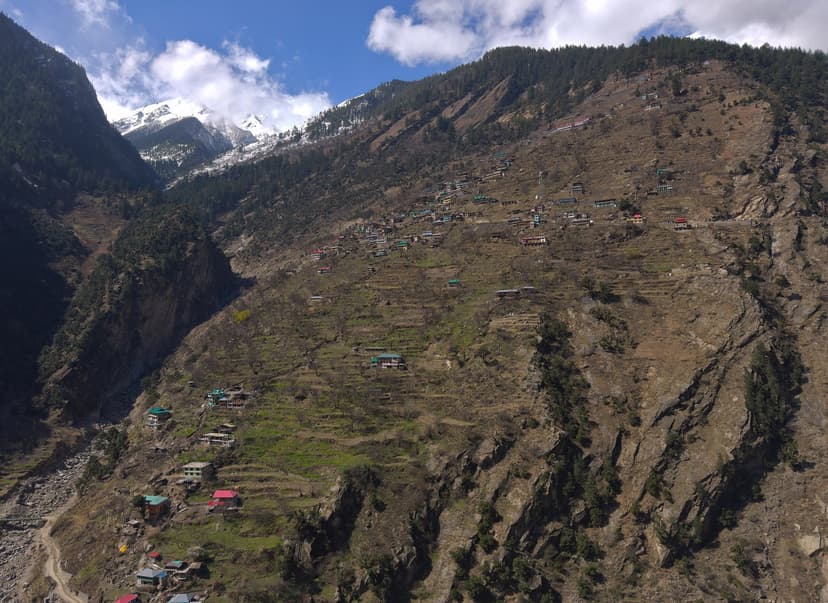
Brua, just before Chitkul on the Baspa. The pale terraces are not pasture, they are apple. The whole valley is.
The single most-named property in the Sangla section is Apple Orchard Farm and Camping. It sits at 2,700m in Batseri village, just before Sangla. It was set up in 2010, runs 13 Swiss tents and 2 rooms inside a 200-tree orchard with five varieties of apple, and the Baspa river is a five-minute walk from your tent. Tent rates run roughly from Rs. 600 to Rs 2,300 a night as per the operator's own page, and the TripAdvisor reviews backstop that. A candid assessment from the traveller reviews captures it well: "Very comfortable tents with best value for money in the entire Sangla valley... the best part of the camp is the staff, helpful, ever smiling and non-obtrusive service; food is excellent with great variety." The thing the reviews underrate is the orchard itself. In late September, the canopy above the tents is the same one being harvested, and the staff will let guests come and watch the picking and grading at the open-shed end of the property. Observation is key. You should never attempt to harvest any fruit unless the family has given you an explicit request to help.
For something less canvas and more roof, the Kalpa-Reckong Peo cluster has a stack of Kinnauri stone-and-wood homestays, most of them book directly on WhatsApp rather than on traditional booking websites and most of them under Rs. 2500 a night with breakfast. For verified listings, the Himachal Services portal provides a directory with direct contact details; however, plenty of informal options remain, which you can typically secure by strolling from the Kalpa bus stop and inquiring locally. The HP Homestay Rules 2025 caps these at six rooms/twelve beds, which means you will not accidentally book a hotel calling itself a homestay; that has been a real problem in the Kullu valley for a decade, and the rules finally fixed it.
Most Kinnauri orchards work on a thirty-day picking sprint, mid-September to mid-October. If you sleep in on one during this window, you will wake up before sunrise to the sound of crates being stacked. There is an etiquette: the family who owns the orchard is also the family who owns the homestay, and they are running on three hours of sleep. Pay them, eat their food, ask politely if you can come help in the afternoon shift, and do not photograph the women without asking. Hindi-side reporting captures this rhythm well; Amar Ujala's 22 Sept. ’24 piece (link) noted that Kinnaur and Lahaul-Spiti homestays were already running on bookings two months ahead of season, translated: "किन्नौर और लाहौल-स्पीति की वादियों में इस बार पर्यटकों की भारी एडवांस बुकिंग आ रही है, होमस्टे भर चुके हैं।" Securing a homestay in Kalpa during the late September harvest peak requires foresight; aim to finalise your reservation by the closing weeks of July to avoid the seasonal rush.
The western belt: Kotgarh, Thanedar, Kotkhai
Kotgarh serves as the historical cradle of the Indian apple trade, a landscape I navigate through the lens of a researcher rather than a local. The insights presented here are anchored in direct operator data, documented Hindi-press testimonials, and two price-point audits conducted via verified booking platforms during the drafting of this guide. A note on transparency: every detail below is curated for objectivity, and any perceived personal bias is a stylistic slip that readers are encouraged to flag.
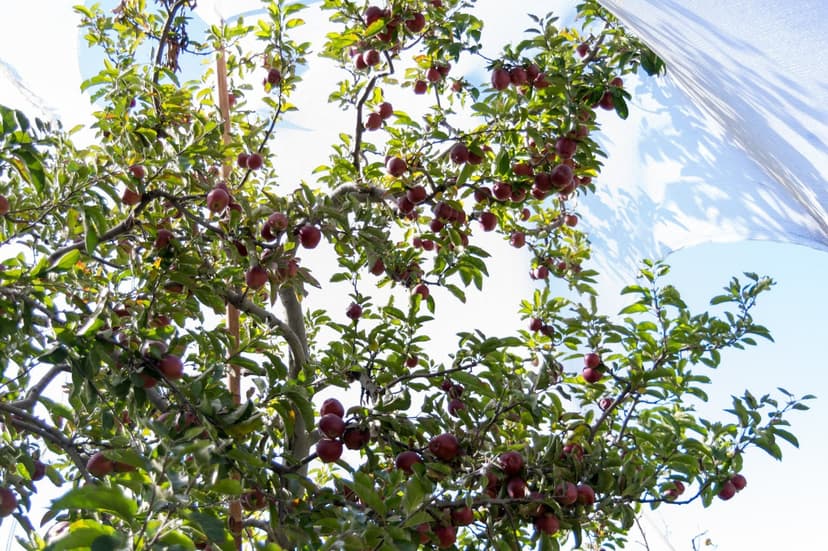
Kotgarh orchards are mostly under hail nets now. April hailstorms used to wipe out a third of the crop in a bad year, and 2026 was already a bad year.
Kotgarh is the Apple Bowl of India because in 1916, Samuel Stokes, an American who had moved to a Himachali village called Harmony Hall in 1912, planted the first commercial apple orchard at Kotgarh and gave saplings to local farmers. The two-line family story is in our Kotgarh history piece. The 2026 update is worth knowing if you are planning a Kotgarh stay: Vijay Stokes, the founder's grandson, has just donated 50 bighas of family land back to local growers with two acres earmarked for a museum and eight acres for a new research orchard. He told ETV Bharat Hindi: "दादा जी ने हिमाचल को सेब की सौगात दी थी, अब मैंने कोटगढ़ के बागवानों को 50 बीघा ज़मीन मुफ्त दी है ताकि सेब उत्पादन और बढ़े।" which translates to "My grandfather gifted Himachal the apple; I have now given 50 bighas of land free to Kotgarh orchardists so apple production grows further" (source). For travellers tailoring their itinerary to the legacy of the Stokes family, the recently established museum serves as the definitive geographic anchor.
A selection of three verified properties, clustered within the Kotgarh-Thanedar-Kotkhai circuit, with reservations currently available for the September 2026 harvest.
Banjara Orchard Retreat, Thanedar. This is the obvious luxury choice if you want polish and structured activity rather than a family kitchen. It sits at 2,350m on the old Hindustan-Tibet road, 80 kms from Shimla, with retreat rooms, family suites, log cabins, and condos. According to Banjara's internal 2025-26 price list, nightly rates for accommodation range from Rs 3,500 to Rs 7,000, with a separate daily dining charge of Rs 1,250 for each guest. Activities include guided fruit-plucking, orchard walks, forest walks, and bonfires. Banjara presents a distinct proposition compared to Kinnauri family-run homestays: as they own the orchard, your picking is limited to what they permit, with pricing structured around the convenience of a serviced experience. This managed approach is often preferred by certain travellers, particularly families with children seeking a more organised daily itinerary.
Himalayan Orchard, Rukhla village, Kotkhai. Positioned 65 km from Shimla at an elevation of 2,100m, this family-managed estate borders a deodar forest and features a trout-filled stream utilised by the household. A full-board stay is priced at Rs 2,500 per guest nightly. The Responsible Tourism India profile remains the most transparent online resource; founders Devanshe and Michael offer four guest rooms and two singles, preparing all meals using their own farm-fresh produce and dairy. They also maintain a Workaway listing for those wishing to exchange daily labour for accommodation. A candid review summarises the experience: "The hosts Devanshe and Michael were incredibly hospitable... homemade meals by Devanshe and her mom were absolutely delicious." Of every operator in this section, this is the one I would book if I were doing my first apple stay outside Kinnaur and wanted to actually understand how a small organic orchard works.
The Apple Farm Stay (Jhina Orchards), Domahar, Kotkhai. A 100-plus-year-old Kath-Kuni heritage homestay at 1980m, 60 km from Shimla, with two rooms inside a working apple orchard. The architecture alone is worth a night: traditional Himachali wood-and-stone construction in the system that survived the 1905 Kangra earthquake while colonial brick collapsed. Bookable on theapplefarmstay.com and on Facebook; the rates have not been published online, and you negotiate on the phone. There is one shared dining hall. Eat what they cook. If you want to understand how the Kath-Kuni building works, see our Kath-Kuni architecture guide.
Two more properties round off the western belt. Seetalvan Orchard on the Kotgarh-Narkanda road, run by a couple in their seventies and their son, has stone-and-wood cottages with private balconies and runs a farm-to-fork kitchen with their own fruit, vegetables, and milk. The phone number is +91- 98055 94069; bookings are direct, on Yatra or on Hichee.
And the Royal Orchard Homestay in Narkanda lists at Rs 1,800 to Rs 3,500 a night on MakeMyTrip and StayApart, which puts it at the budget end of the cabin-style Narkanda options.
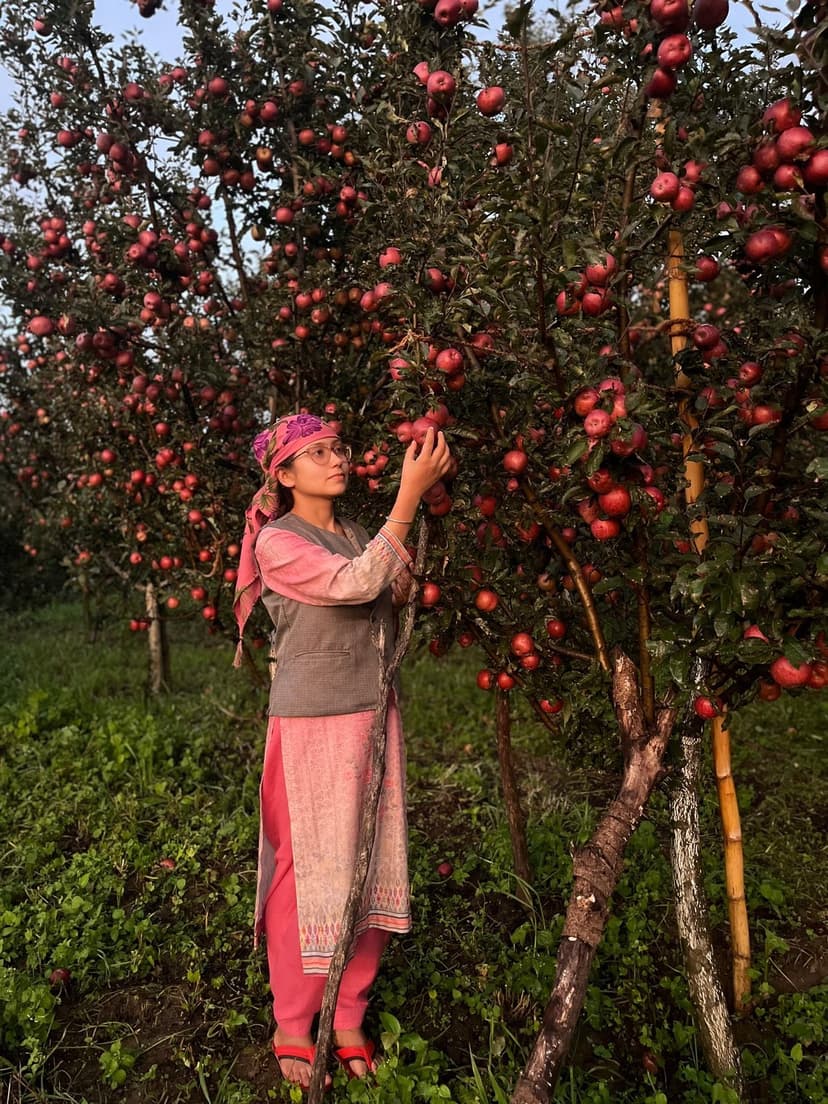
Picking is not a photo-op for the Nankhari women who do it twelve hours a day. If you are at a farm stay in season, ask before you grab a basket. They will let you, and then quietly correct your grip.
Karsog: the apple belt nobody writes about
Karsog comes in the Mandi district, sits at around 1400m, and is part of the apple belt that the English-language travel internet has almost completely missed. The numbers: roughly 1,260 registered homestays in and around the Karsog area on the homestays.co.in directory, budget rates starting at Rs. 224 a night and topping out around Rs. 2,500 a night for a full-board orchard stay. Karsog's harvest peaks in the second and third week of August, which is two to three weeks ahead of the Shimla belt, which means if you have a window in early August and you cannot get to Kotgarh, you can still see the same harvest happening here. ETV Bharat reported the local horticulture department has 20,000 high-quality fruit saplings ready in the Karsog nursery, "करसोग की नर्सरी में 20 हज़ार उच्च गुणवत्ता वाले फलदार पौधे तैयार हैं।" (link), which is the local proof that the belt is being actively replanted, not coasting on inheritance.
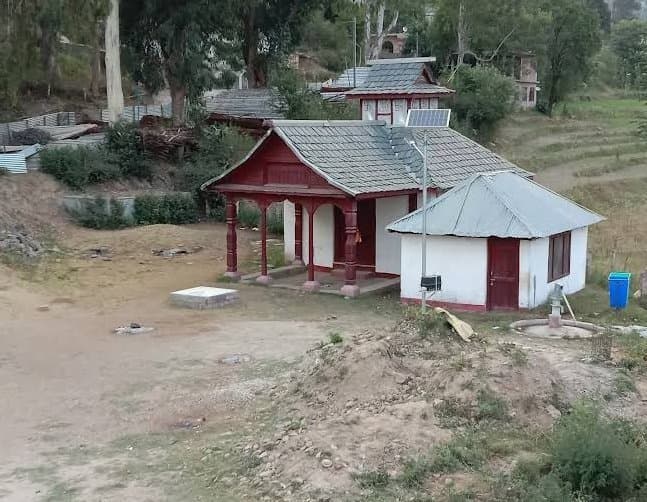
Karsog is the apple belt nobody writes about. Around 1,260 homestays, harvests starting in early August, and prices that begin around Rs 224 a night per the homestays.co.in directory.
Why does nobody write about Karsog: At 125 kms of drive from Mandi town, the road through Chindi is quiet, the bus connectivity is basic, and the valley does not have a single hotel chain on it. There is no Booking.com photoshoot inventory. The trade is that you arrive in a working farm valley with Mahabharata-era temples (Kamaksha and Mamleshwar in particular) and orchards on every slope. The apples here are mostly Royal Delicious and the Tydeman's Early variety, the latter of which is the only apple in HP that comes ready to eat in mid-July. For those planning a follow-up to a Kinnaur apple stay, Karsog represents the ideal next chapter in your journey.
Tea, not apples: Palampur
The Kangra valley does not grow apples. The altitude, soil composition, and rainfall patterns are unsuitable for apple cultivation. What Palampur does grow is tea, and at 1200m, it has been doing so since the Britishers set the Kangra Tea industry up in the 1850s. For those visiting Himachal in April during the apple-blossom phase, the orchards are beautiful but largely stagnant; however, you can find active work in the tea estates. In Kangra, the tea plucking season provides a hands-on alternative, stretching from April through to November.
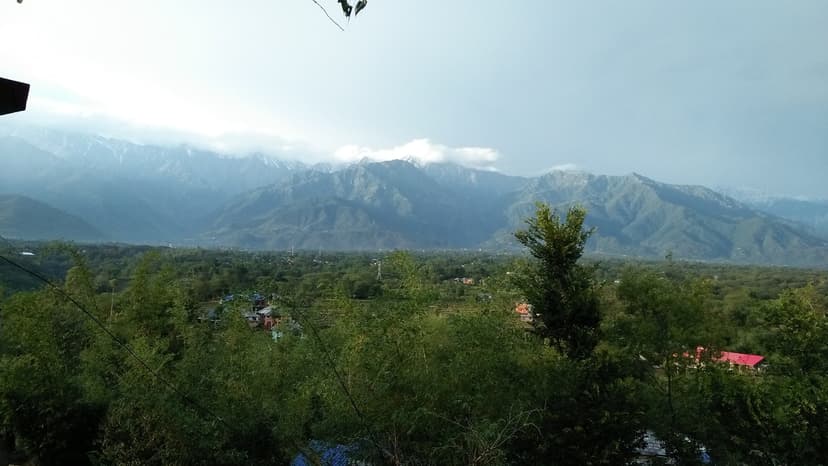
Palampur sits at 1,200 m, and the Dhauladhar rises to 5,000 m in the distance; you can see from your tea table. The vertical relief is what gives the Kangra leaf its long, slow-growing window.
The deep-end stay here is The Lodge at Wah in Kandbari, 8 km from Palampur. It sits inside Wah Tea Estate, the largest working estate in the Kangra Valley. Their current published tariff is Rs. 12,000 a night for double occupancy & Rs. 9,000 for single occupancy, plus 18% GST, including breakfast and dinner, a guided tea factory tour, tea tasting and an evening campfire; verified live from thelodgeatwah.com/kandbaritariff while drafting this piece. The tasting they do is the most often-quoted bit: 23 different teas, walked through by the owner and his son. A Revolving Compass review described it as: "The tour of the tea estate given by the owner and his son was incredible, including a tasting of 23 teas." The estate is 100% pesticide-free, the lodge is built mostly from local stone and slate, and there are eight rooms in total. This is for tea-curious travellers who can spend Rs. 12,000 above a night and want a working agricultural experience rather than a hotel.
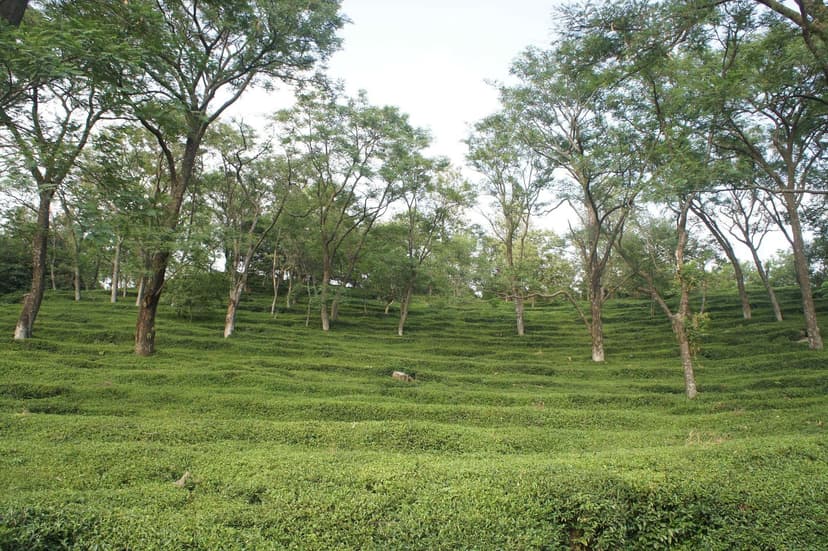
Mann Tea Estate, near Palampur. The orthodox Kangra leaf is older than most of the apple varieties on the Sutlej side, and a working estate is the cheapest research lab a tea drinker will ever walk through.
For a budget tea stop, the Palampur Cooperative Tea Factory runs short tours through the tea-making process for a small fee, and Bundla Tea Estate (the original 1850s plantation) has guided walks. Pair either with a Palampur homestay in the Rs. 1,500-2,500 range. Most of these you book on WhatsApp; phone numbers are listed on the Kangra district tourism portal.
If you want an eco-farmstay rather than a tea estate, 8MH Organic sits closer to Dharamshala and runs eco-cottages on a working organic farm. Rates are roughly Rs. 2,000-3,500 a night, and you negotiate inclusions per stay. This is researcher territory for me; book direct, ask for current rates.
Beyond apples: apricot, plum, trout, saffron
Apple is what made Himachal famous. It is not what makes the rest of the year worth planning around. A short list of what else gets harvested here, and where, and when:
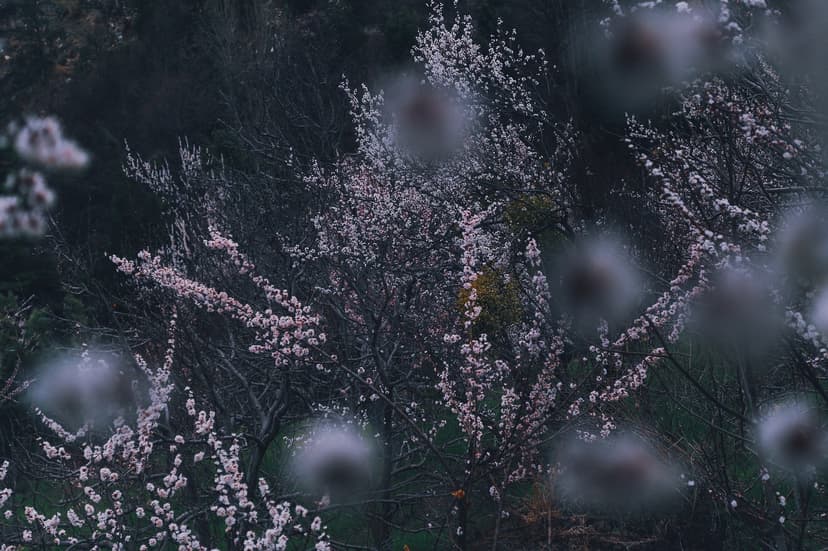
Apricot in Kinnaur, late March to early April. The khumani crop is older here than the apple is, and the kernels still go into local liquor and into the oil that women crush by hand for skin in winter.
Apricot on the Kinnaur side and in Lahaul-Spiti. The local name is ‘khumani’. Bloom is late March; harvest is June into early July. Nako at 3,650m is mostly apricot, not apple, because the elevation pushes apple out, and apricot is more tolerant of cold. The kernels still go into local liquor and into a hand-crushed oil that village women sell for skin care in the winter.
Plum in Kullu and Mandi, June to August. Plums are not a destination crop the way apples are, but you will see them as a side fruit at any Kullu-side farm stay in summer.
Cherry in Kotgarh and Sangla, May to June. Banjara Orchard Retreat runs a cherry-picking window separate from the apple one, and it is mostly the Kinnaur Bing variety. If you are thinking about cherries-then-strawberries, time the Mashobra strawberry belt March-May and the Kotgarh cherries May-June, and stitch them into one trip.
Trout in Tirthan Valley and Sangla. Tirthan in particular is fly-fishing country, with three named operators all running their own trout farms. Mashru Riverside Estate in Gushaini, Devat Farm Cottages in Pekhri, and the Himalayan Trout House are the three that actually take guests. Sangla trout is more of a side dish; Tirthan trout is the main event. Our Tirthan Valley guide has the operator phone numbers and rates.
Saffron. This is a 2025 development worth flagging. CSIR-IHBT Palampur, the institute that has been quietly running tea research for decades, started training farmers in Kinnaur, Chamba, Kullu, and Lahaul to grow saffron in pilot plots. The bloom is in October, the price point is roughly Rs 2.5 lakh per kilogram, and a working saffron-pick experience does not yet exist for tourists in HP, but it will, in two years. Gaon Connection's coverage is the cleanest read on what the IHBT is doing.
What you actually do at a farm stay
The honest version. You do not arrive on day one and start picking. Most of what makes a farm stay worth Rs 2,500 a night is the slow stuff that you only get from sleeping inside the orchard. A typical day at a Kinnauri orchard homestay during peak picking week looks something like this.
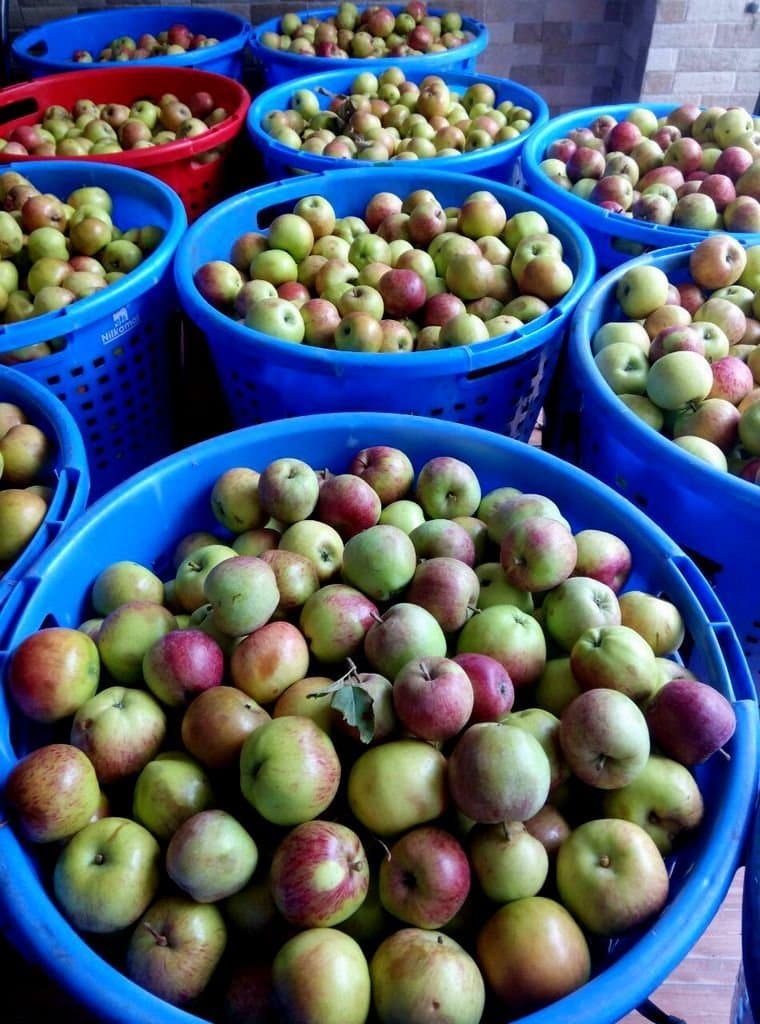
Plucking is the easy part. The actual work begins when you sit on the floor with a crate at 9 pm and grade A, B, and C by hand. Most farm stays will let you watch, and a few will let you help.
- 6:00 AM - tea on the porch
You hear crates being stacked. The picking shift starts at first light because the fruit is still cold, which means it bruises less. Drink your tea. Stay out of the way. - 8:30 AM - breakfast
Aloo paratha or madra or whatever the family ate yesterday for dinner. The kitchen is family-run; the menu is what is in the field this week. - 10:00 AM - permitted picking
Some homestays let guests in for an hour at mid-morning. The trick is grip and twist, not pull; pulling tears the spur and kills the next year's fruit. The owner's son will show you once. After that, you are on your own. - 1:00 PM - thali lunch
Likely Siddu to be served with ghee and either chana madra or rajma. Some Kullu-influenced homestays serve trout if you ask the day before. - 3:00 PM - grading and packing
This is the actual work. A picker's basket comes back with eighty fruit, and someone with thirty years of practice splits them into A, B, and C grades in around four minutes. Watch first, then ask if you can help. - 6:00 PM - the days last picking
Cooler air, second-shift pickers come down the slope. If you are paying attention to the orchard rather than your phone, this is the hour you actually understand it. - 8:30 PM - dinner
Often a heavier dal-chawal or a thukpa. Kinnauri families serve a homemade arak called angoori with dinner if you ask; do not ask if you have an early morning. - 10:00 PM - sleep early
You are at 2,800 metres and the next day starts at 5:30. The headache you wake up with at 6 AM the first morning is altitude, not the arak.
If you are at a Banjara-style structured property, the day is more guided and less like the picture above; you book a 90-minute orchard slot, a guide takes you, you pluck a curated allotment, photos happen, and you go back to a campfire. There is nothing wrong with this; it is just a different product running on a different schedule. Both are useful, and you should be honest with yourself about which one you want.
Cost: What does a week actually run in 2026
| Category | Cost (INR) | Note |
|---|---|---|
| Budget farm stay (Karsog or basic Kinnauri homestay) | Rs 1,500-2,200 | per night with breakfast |
| Mid-range farm stay (Himalayan Orchard, Kotkhai) | Rs 2,500-4,000 | per night, all meals included |
| Premium (Banjara, Seetalvan, kath-kuni heritage) | Rs 4,500-7,000 | per night plus Rs 1,250 per person per day for meals |
| Tea estate luxury (Lodge at Wah) | Rs 12,000+ | per night double, plus 18% GST, breakfast and dinner included |
| HRTC Volvo Delhi-Shimla | Rs 1,400-1,700 | per seat one way, books on AbhiBus or hrtchp.com |
| HRTC bus Shimla-Reckong Peo | Rs 600-900 | per seat, 8 hour ride |
| Local transport in Kinnaur (private taxi) | Rs 2,500-4,000 | per day, four to six hour shuttle |
| Apple to bring back home | Rs 80-150 | per kg of Royal Delicious from a homestay versus Rs 200-300 in a Delhi market |
| Daily food budget at the homestay | Rs 500-1,500 | per person, depending on whether meals are included |
A working week-long Kinnaur apple-pick budget for two people in late September 2026, in mid-range homestays with all meals and a private taxi for the harder days, lands around Rs. 60,000 to Rs 80,000 all-in, including Volvo from Delhi. The same week at Banjara, plus a tea night at the Wah Lodge, would come closer to Rs. 1.4 lakhs. The same week at Karsog, homestays with HRTC buses everywhere would come closer to Rs. 30,000. Pick the tier honestly and book early. Kinnauri homestays for late September are full by mid-July, Banjara for the same week is usually full by June.
Want a Kinnauri sanity-check on your apple-belt itinerary? Email us your draft for the week. We will tell you which day is too ambitious, which homestay is worth the detour, where the road has been rough, and which Hindi-press numbers got more accurate after the harvest started.
A planable seven-day apple route, Delhi to Delhi
This is the route I would actually plan for someone doing this for the first time, around late September 2026, wanting to experience both the Kinnaur and the Shimla belt. Geographically, meaning you’ll cover the Sutlej corridor up to Kinnaur and come back via Kotgarh.
- Day 1 - Delhi to Shimla
HRTC Volvo from Delhi ISBT Kashmere Gate, 21:30, arrives Shimla 06:00. Sleep in. The Volvo seat costs Rs 1,448-1,569 (HRTC Himsuta) and you can book on AbhiBus or hrtchp.com. Day in Shimla; eat at Himachali Rasoi for siddu (Rs 171-238 verified). - Day 2 - Shimla to Sarahan
Drive 175 km via NH-5. The road climbs slowly along the Sutlej. Stop at Sarahan for Bhimakali temple, 2,165 m, sleep at HPTDC Srikhand or a homestay near the temple. Rs 1,500-2,500. - Day 3 - Sarahan to Kalpa
160 km, six hours. The road via Karcham is a serious cliff-side, the kind that earns NH-5 its reputation. Take the Karcham bridge for the Kinner Kailash view. Stay in a Kalpa homestay; Rs 1,800-3,000 with breakfast, ask the family for an evening apple-orchard walk. - Day 4 - Kalpa orchards
Slow morning. Walk into a working orchard at 9 AM with permission, watch the picking, eat lunch with the family, do a half-day to Reckong Peo for the local market and the Padmasambhava monastery. Sleep in Kalpa again. - Day 5 - Sangla Valley
Drive 70 km from Kalpa to Sangla via Karcham, four hours including roadwork. Stay at Apple Orchard Farm and Camping in Batseri (Rs 1,500-2,300). The Baspa walk to Rakcham at sunset is worth the altitude. - Day 6 - Sangla to Kotgarh
Long backtrack day. 270 km, eight to nine hours. Stop at Rampur for lunch (Bushehr Palace history). Reach Thanedar by evening. Stay at Banjara Orchard Retreat or a Kotgarh homestay; Rs 4,500-7,000 with structured activities or Rs 2,000 with a family kitchen, your call. - Day 7 - Kotgarh to Delhi
Slow morning at Stokes farm, see Harmony Hall (1912) from outside, eat at Tani Jubba. Drive to Shimla in the afternoon, evening Volvo back to Delhi. You arrive Delhi 06:00 the next day.
Three honest notes on this route. One: Day 6 is exhausting. If you do not have to make it back to Delhi in seven days, split it into two days with a night at Rampur or Sarahan. Two: the road from Sangla to Kotgarh has had landslide work in 2025, and you should check in the morning before driving. Three: if you have a full ten days, swap Day 6 for two days in Karsog. The drive is harder, but the harvest is real.
Want help with the homestay, phone numbers and sequencing? Email us. We have spent the last three months calling these places and we will share what we know.
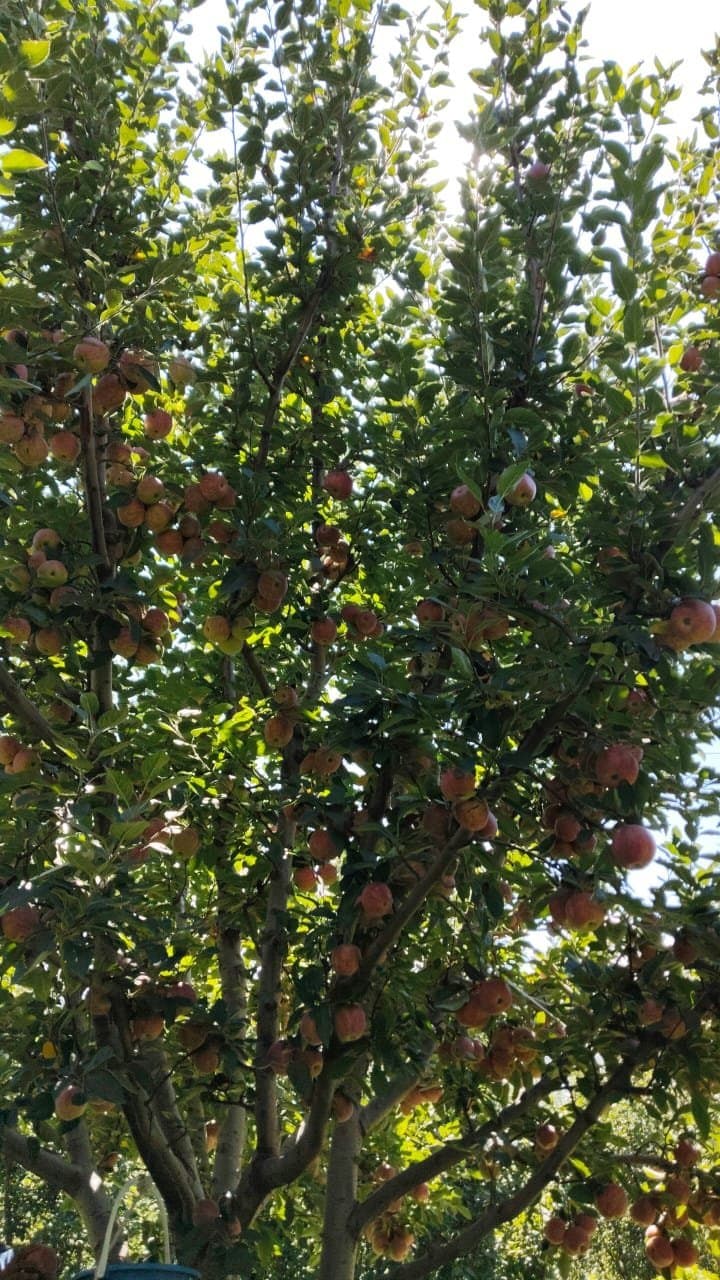
September on a hillside that has not been pruned hard. The good orchards thin in July; the lazy ones look like this, and the apples come out smaller.
The Homestay Rules 2025: what changed for guests
The reason all this is even legible to a traveller in 2026 is that HP rewrote its homestay rules. The new draft is on himachaltourism.gov.in; the registration portal is live at homestay.hp.gov.in as of 2 February 2026. The four changes that affect your booking:
| Old rules (pre-2025) | New rules (2025-26 onward) | |
|---|---|---|
| Maximum size | Up to 4 rooms with no formal cap on beds | 6 rooms or 12 beds, hard cap |
| Categories | Single-tier registration | Silver, Gold, and Diamond tiers with different fees |
| Eligible properties | Residential homes only | Residential homes plus farm houses, orchards, and tea-gardens |
| Loan subsidy | None specifically for homestays | 3 percent urban, 4 percent rural, 5 percent tribal interest subsidy |
| Women-led discount | Not applicable | 5 percent fee discount for women entrepreneurs |
| Pangi tribal area | Standard fee | 50 percent fee reduction |
Two of these matter to you as a traveller. First, the formal opening of orchards and tea-gardens to homestay registration means farms that were renting rooms informally are now coming onto the directory at homestay.hp.gov.in, which makes them findable, phone-numbered, and complaintable. Second, the six-room cap means a "homestay" in HP from 2026 onwards cannot legally be a 30-room hotel calling itself a homestay. That has been the loophole in Manali and Kasol for years, and it is finally closed. If a property has more than six rooms and calls itself a homestay, you should ask why.
The Pangi tribal area subsidy is interesting for a different reason. It is the state explicitly trying to push farm-stay growth into the genuinely remote belts (Pangi, but also by implication the upper Kinnaur and Lahaul villages), which means in two seasons there will be more bookable rooms in places where there currently are none. If you are coming back to HP in 2027 or 2028, the inventory in upper Kinnaur and Pangi should be deeper.
Map: where the orchards and the tea estates are
FAQ
When is apple picking season in Himachal Pradesh in 2026?
It runs late July to early November depending on altitude. Karsog (Mandi) is the earliest, with peak harvest early-mid August. Kotgarh-Thanedar-Kotkhai run late July to mid September. Narkanda-Theog run through August into late September. Kinnaur runs September to early November, with Royal Delicious peaking in late September. The single best week for the genuine picking experience is the third week of September into the first week of October, in Kinnaur.
How much does an apple farm stay actually cost in Himachal Pradesh?
Budget Karsog or basic Kinnauri homestay is Rs 1,500-2,200 per night with breakfast. Mid-range Himalayan Orchard in Kotkhai is around Rs 2,500-4,000 per night with all meals. Premium Banjara Orchard Retreat or kath-kuni heritage stays run Rs 4,500-7,000 plus Rs 1,250 per person per day for meals. The Lodge at Wah on Wah Tea Estate is Rs 12,000 per night double plus 18 percent GST.
What is the difference between Kinnaur apples and Shimla apples?
Kinnaur apples grow at higher altitude (2,700-3,000 metres), pick a month later, and develop a deeper crimson colour, particularly Royal Delicious. They also tend to be smaller and crunchier and are the variety that exporters and gift-box vendors pay a premium for. Shimla-belt apples (Kotgarh, Thanedar, Kotkhai) pick earlier, are larger, and dominate the domestic mandi market by volume. The two are complementary, not competing.
Can a regular traveler stay at the Stokes family farm in Kotgarh?
Not directly. The Stokes family runs the orchards as a working business, not a homestay. The closest legitimate Stokes-adjacent stay is at Tani Jubba Heights, Banjara Orchard Retreat, or Seetalvan Orchard, all in Thanedar. Vijay Stokes has gifted 50 bighas of family land back to local growers in 2026, with two acres earmarked for a museum which is the new public-facing piece of the Stokes story.
Where can a tea drinker stay in Himachal in 2026?
The Lodge at Wah in Kandbari, 8 km from Palampur, is on the largest working estate in Kangra Valley. Rs 12,000 a night double plus 18 percent GST, including breakfast, dinner, a guided tea factory tour, and tea tasting. Their tariff page is at thelodgeatwah.com/kandbaritariff. For a budget version, the Palampur Cooperative Tea Factory runs short factory tours, and Bundla Tea Estate runs guided walks; pair either with a Palampur homestay around Rs 1,500-2,500 per night.
Is the HP Homestay portal worth using to book direct?
Yes, particularly for the smaller Kinnauri and Karsog properties. The portal at homestay.hp.gov.in lists registered homestays with phone numbers and lets you book direct without an OTA fee. Direct bookings are typically 15-20 percent cheaper than Booking.com, MakeMyTrip, or Yatra rates. The catch is that not every working homestay is on the portal yet; for those, the homestays.co.in directory and Workaway are the best back-up sources.
What other fruit can be picked in Himachal besides apples?
Cherry in Kotgarh and Sangla in May-June. Apricot in Kinnaur and Lahaul-Spiti in late June and July; the bloom is late March. Plum in Kullu and Mandi in summer. Strawberry in the Mashobra belt in March-May. Pear and walnut on the Kinnaur and Karsog sides. Tea pluck in Palampur and the Kangra Valley April to November. Saffron pilots in upper Kinnaur, Chamba, and Lahaul are running through CSIR-IHBT but are not yet open to picking tourists.
Are organic farm stays a real thing or just a marketing label?
In HP both exist. Lodge at Wah Palampur is verifiably 100 percent pesticide and weedicide-free per their public certification. Himalayan Orchard in Kotkhai uses home-grown vegetables, dairy from their own cows, and eggs from their chickens, with a Workaway listing for travelers willing to do farm work in exchange for room and board. 8MH Organic near Dharamshala lists eco-cottages on a working organic farm. Many traditional Himachali smallholdings practice low-input sustainable farming without using the word organic; if it matters to you, ask the homestay directly what they spray and what they do not.
Sources
Primary government and operator sources, then journalistic, then secondary:
The Apple Farm Stay (Jhina Orchards), Domahar Kotkhai — official site
Amar Ujala — apple anrdens nois w eligible for homestay registration
Amar Ujala — Kinnaur Lahaul-Spiti homestay advance booking heavy
Revolving Compass — Lodge at Wah review with 23-tea tasting quote
If you read all the way through, the short version is this. Pick the season for the variety. Sleep inside the orchard, not in a Shimla hotel. Book direct via the HP portal. Treat the family who runs the homestay as the principal, not the staff. Bring an empty duffel bag for the apples you will buy on day six. And do not pretend you discovered the place.
About Ajay Negi
Ajay Negi is from Kinnaur — grew up between Reckong Peo and Kalpa, on the Sutlej side of the Hindustan-Tibet road. He has been writing about the apple belt and the Sutlej valley since 2019, and runs a small farm-stay collective in Telangi.
You Might Also Like
Volunteering in Himachal Pradesh: 12 Organisations and How to Apply (2026)
Teach English in McLeod Ganj, conserve the Great Himalayan National Park, build with earth in Bir, or harvest apples in Kullu. Twelve real HP volunteer organisations with honest costs, the visa rule that gets foreigners deported, and how to apply.
How to Travel Himachal Without Wrecking It: A Quiet-Travel Manual
A non-preachy field manual for responsible travel in Himachal, by a Kullu local: how to behave, when to go, where to go instead, and the 2026 rules and bans that actually matter.
Mamleshwar Mahadev: The Eternal Flame Temple of Karsog
An eternal fire, a fist-sized wheat grain and a six-foot drum, kept in a mortar-less timber temple in the quiet Karsog valley. The honest story of Mamleshwar Mahadev: what is real, what is faith, and how to go.