
Nati Dance: How 9,892 Women Gave Himachal a Guinness World Record
The Dhalpur ground in Kullu town sits at 1,278 metres on a flat shelf of old river terrace, ringed by deodars and three-storey wooden houses with slate roofs. Most days it is a cricket field with a fenced corner for a children's swing. For one week every October, after the rest of India has finished with Dussehra, it becomes the largest open-air religious gathering in the western Himalaya. Two hundred and ninety-odd village deities arrive on hand-pulled palanquins from their home temples, climb the slope to Raghunath ji's chariot, and pay him obeisance. Then the dancing starts.
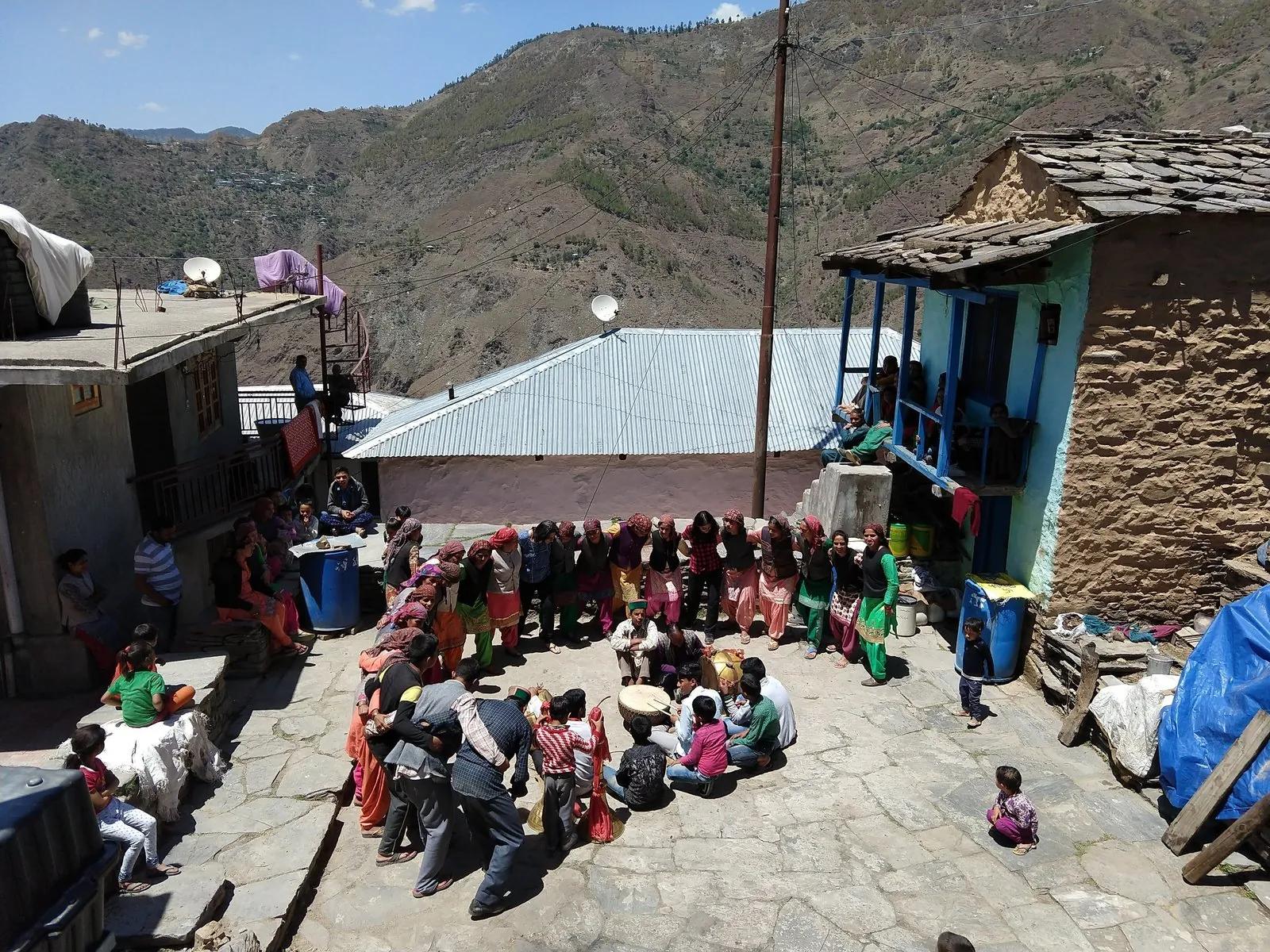
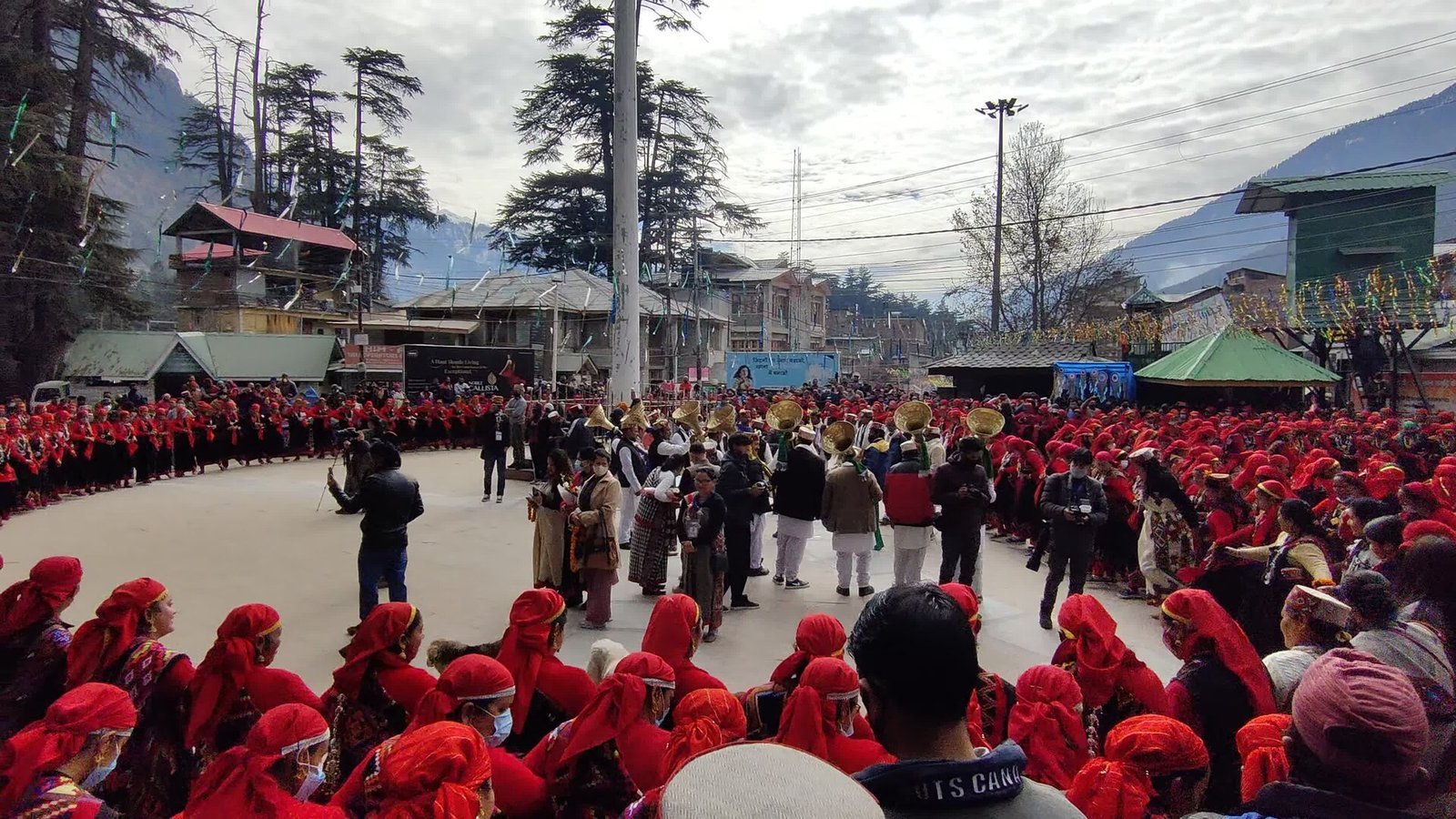
On the afternoon of 26 October 2015, 9,892 women in matching pattu and red dhattu caps formed a single circle on that ground. Hands criss-crossed, ankle to ankle. The dhol and damau drummers were in the centre. The karnal horns went up. The slow tempo of Dhili Nati started, and then it went on for one continuous take long enough for Guinness adjudicators to count every barcoded chip on every wrist. Thirteen thousand women had registered. Strict rules of formation and dress disqualified the rest. Nine thousand eight hundred and ninety-two stayed in line. The certificate arrived three months later, on 11 January 2016, naming it the largest Nati dance in the world.
I am from Kullu Valley. The festival is one I have grown up around. What I want to do in this piece is hand the reader the dance, not the Wikipedia entry; the regions and the costumes and the instruments and the social weight of Nati in this state, and the practical question of where, in 2026, an outsider can actually see it for himself.
Quick facts
- What it is: Himachal Pradesh's signature folk dance. Circle formation, criss-crossed hand-hold, 8-step foundation, slow to fast tempo.
- Guinness record: 9,892 women, Dhalpur Ground Kullu, 26 October 2015. Certified 11 January 2016.
- Where it lives: Across HP. Strong regional forms in Kullu, Shimla, Sirmaur, Mandi, Kinnaur. Lahaul calls its version Garfi.
- Best venue to see it: International Kullu Dussehra, 20-26 October 2026, Dhalpur Maidan.
- Other venues: Manali Winter Carnival every January, Renuka Mela in November, Mandi Shivratri in February.
- Can tourists join: Yes. The basic steps are simple. The dancers will not mind one more.
- What it is not: Not a Bollywood party dance. Hindi sources are firm: a disciplined community ritual, not rowdiness.
- Last updated: May 2026.
The short answer
Nati is Himachal Pradesh's traditional folk dance. Dancers stand in a circle or arc, hold hands in a criss-cross pattern that locks them shoulder to shoulder, and step through an eight-beat figure that starts slow and accelerates. Every district has its own version. The Kullu Dussehra mass Nati of October 2015, with 9,892 women on Dhalpur Ground, is the largest folk dance Guinness has ever certified. To see it well, time a Himachal trip for the first week of Kullu Dussehra (20-26 October 2026) and stay anywhere within walking distance of Dhalpur.
What 9,892 women on a riverside ground actually looked like
Kullu families take Dussehra week as the social calendar of the district. People who have been around the festival for years will tell you the Dhalpur ground has rarely held that many people in a single formation since. The 2015 attempt was organised under a state campaign called Beti Hai Anmol, the girl child is priceless; the year before, Kullu had set a Limca record of 8,540 women dancing Nati under the Beti Bachao banner, and the district administration wanted Guinness too. They published a registration call across Kullu, Mandi, Lahaul-Spiti and parts of Shimla. Roughly thirteen thousand women turned up on the day.
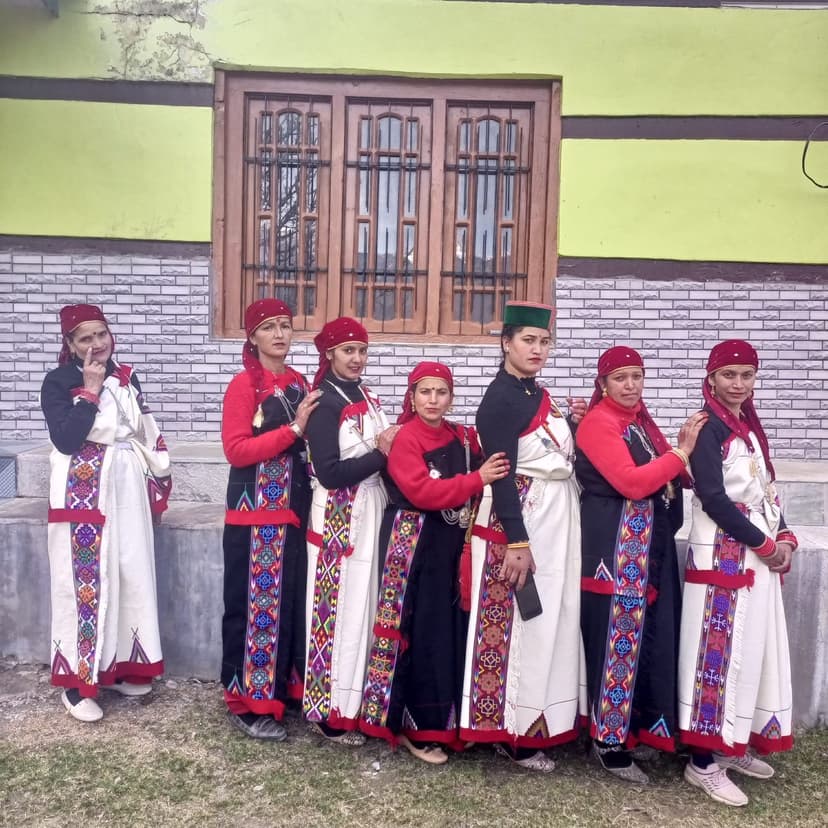
Every registered dancer wore the same outfit. White woollen pattu drape, red and black geometric border running down its length, a red dhattu cap with a brass hairpin, churidar pyjama in red, and the traditional pulla footwear that pilgrims from Tibet used to wear up the Pin valley. The line was assembled by Mahila Mandal, the village women's collective, then ribboned off by lot into concentric circles. A barcoded wristband was issued to each participant. Guinness adjudicators required minimum dance duration, formation integrity, and verified count.
The reason the final count was 9,892 and not 13,000 was the rules. Latecomers missed the formation cut. Some wristbands did not scan. Some dancers stepped out of line in the first ten minutes. One section near the riverbank lost its rhythm and broke up before the count was complete, and the adjudicators discounted that section. The certificate, when it arrived from London in January 2016, named the District Administration Kullu as the holder. The official Guinness URL for the record still has a typo. It calls it "Largest Kinnauri Nati Dance." The dance was not Kinnauri. It was Kullvi. Nobody has bothered to correct it for ten years.
Nati Nati, not Naatu Naatu
It became a small thing in the cultural press after the RRR Oscar in 2023. Naatu Naatu won Best Original Song. India clapped. Kullu shrugged. The most globally famous Indian dance is a 2022 Telugu film number; the largest gathering of Indian folk dancers ever assembled was the Pahari one nobody outside Himachal had heard of. An Outlook India piece from that year ran under the title "Nati Nati, Not Naatu Naatu", and the subhead was honest about why. We were never marketed. Nati does not travel well on Reels. It is slow at the start. It does not have a chorus. The dancers do not face the camera; they face each other.
I think this is the thing about Nati that the camera misses every time. The dance is built so that no single dancer is the centre. The leader who carries the dangru or the chowrie sets the rhythm and the figure, but he is one of forty or two hundred, not the front person. You are looking at the back of the head in front of you, and feeling the hand on either side of yours, and listening to the dhol behind you. If you point a camera at the leader, you get a man waving an axe. If you point a camera at the circle, you get a wheel of fabric and feet that takes three seconds to register as a wheel. The thing Nati does for the people inside the circle is hard to film from the outside.
Anatomy of the dance
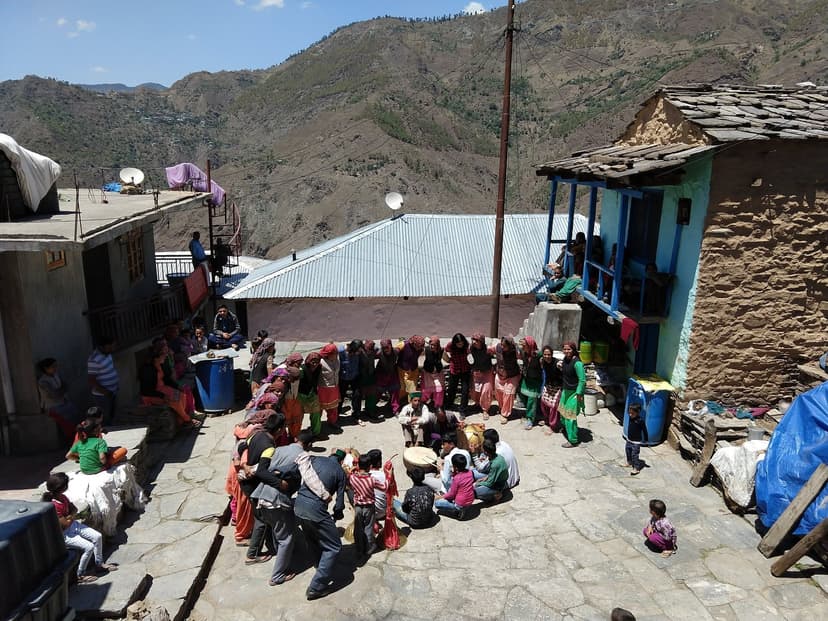
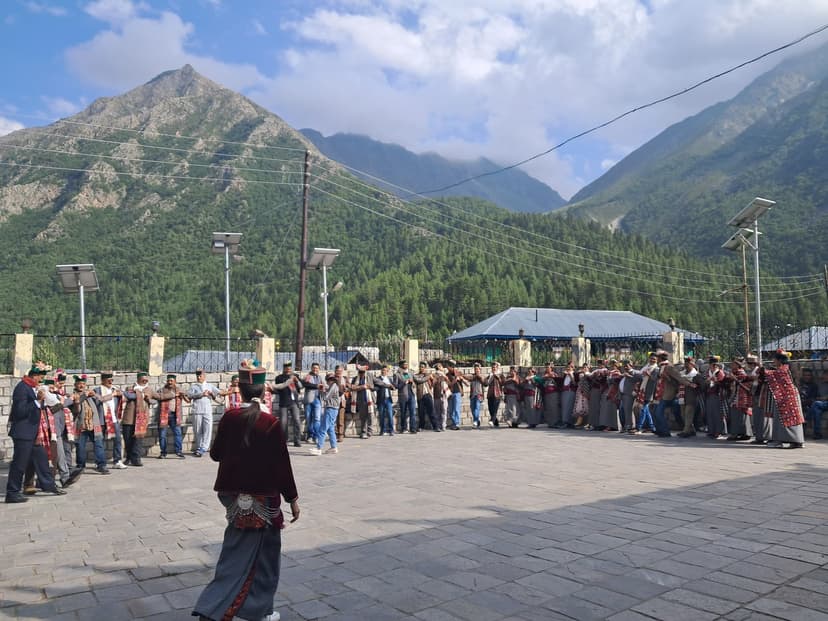
The eight-step Kullvi Nati is the simplest version, and the one a visitor is likeliest to be pulled into at a wedding or a small village festival. Dancers stand in a circle facing the centre, hold the hands of the two dancers on either side of them, and cross those hands so that each dancer's right hand is locked into the right hand of the dancer two places away. The criss-cross binds the circle. It is almost impossible to fall over once the figure starts; the dancers on either side hold you up.
The first eight beats are slow. Two steps to the left, one to the right, a small dip of the shoulders, two more to the left. The drummer matches the pace. Then the shehnai joins. Slowly the tempo lifts. By the third repetition you are no longer thinking about your feet. By the eighth or ninth you are inside a wheel of people that is rotating faster than any of the individuals are consciously stepping, and the karnal hits its long held note, and the leader brings the figure to its climax with a single twist of his fly-whisk.
Beyond the eight-step foundation, Kullvi Nati alone has at least five ritual sub-forms, each tied to a specific occasion. Hindi sources name them. Most English-language travel pages collapse them into "Nati" and move on. They are not the same dance.
- Birsu is a women-only form, danced at temples during Baisakhi in mid-April. Slow tempo, no men in the circle.
- Dhili Nati is the slow-tempo opening figure. This is what the Guinness circle started with on Dhalpur in 2015.
- Laladi Nati is the most musically demanding form. It is structurally a samvaad, a sung dialogue. Young women improvise lyrical verses to each other while moving house to house during the seven days of Kullu Dussehra. Closer to qawwali in structure than to dance, except the dancers never stop walking.
- Phagali Nati belongs to spring. It is performed at the Fagli festival in February-March, in masked sequences that survive only in upper Kullu villages now.
- Haran Nati is performed on the last night of Kullu Dussehra, the night called Lanka Dahan, when the deity Raghunath ji is taken in procession down to the Beas to symbolically burn an effigy of Lanka. The Haran Nati is fast and frenzied.
The regional map: Nati across HP
Cross any pass in this state and the dance changes. Hindi research lists more than ten named regional forms; the Somsi journal from 1976, the closest thing to a primary source on Pahari folk culture, lists sixteen historical sub-styles by name. The four versions a traveller is most likely to encounter on the road in 2026 are these.
Four versions of one dance, plus one exception
| Form | Where | What it feels like |
|---|---|---|
| Kullvi | Kullu, Mandi-Seraj | Festive, Dussehra-linked. Slow to fast tempo. Themes from Raaslila and Chandravali legend. The Guinness version. |
| Mahasuvi | Shimla, upper Mandi | Moderate tempo. Men's version dominant. Performed at agricultural festivals and weddings in the Mashobra-Theog belt. |
| Sirmauri | Sirmaur, Paonta valley, Nahan | Fast, energetic. Brightly coloured ghagra skirts. Strongest at Renuka Mela on Kartik Purnima in November. |
| Kinnauri | Kinnaur, Sangla valley, Chitkul | Slow, mime-like. Harvest-themed. Heavy traditional silver jewellery. |
| Lahauli Garfi | Lahaul, parts of Pangi | Not technically Nati. Lahaul has its own form called Garfi. Slower still, performed at Buddhist gompa festivals. |
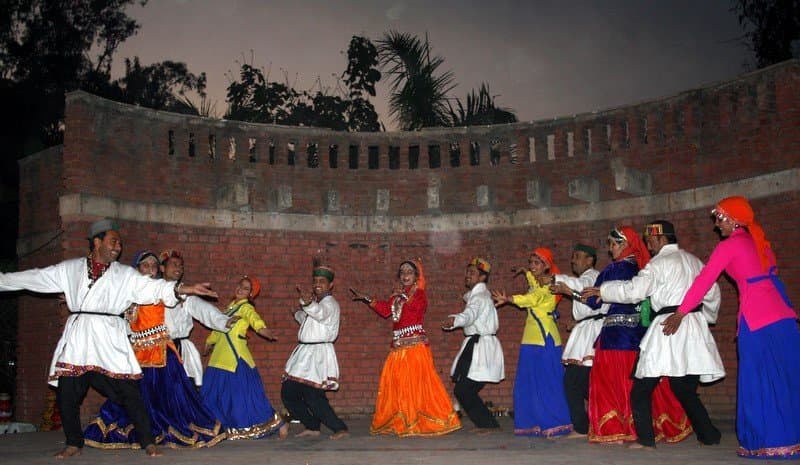
Sub-styles below this top layer name themselves by valley. Seraji from the Seraj sub-region of Kullu, Karsogi from the Karsog valley in Mandi, Chauhari from Chauhar in lower Mandi, Bangani from Banganga, Jaunpuri from upper Shimla and parts of Uttarakhand. Each has its own preferred song cycle, its own opening tempo, its own particular cap colour. The Somsi journal lists forms I have never seen danced even in Kullu: Khadayat, Lurdi, Bakhli, Kahika, Hulki. These almost certainly still exist somewhere up the side valleys. I have not found them, and I am Kullvi. They are out there.
It is not the Bollywood dance you think it is
An Amar Ujala feature on Himachali culture put this directly: "पहाड़ी उल्लास का प्रतिबिंब हिमाचली नाटी, बिना इसके सब नीरस". The reflection of mountain joy is Himachali Nati; without it everything goes flat. The same piece, and the longer ETV Bharat heritage essay it draws from, is firm that Nati is not "मौज मस्ती के लिए नाच-गाना या हुल्लड़बाजी", not merrymaking song-and-dance or rowdiness, but a folk dance performed with discipline. If you join a circle as a visitor, follow the dancer to your left. Do not improvise. The circle is a ritual.
The orchestra is the dance
You cannot have Nati without the music, and the music has its own architecture. A full Pahari folk orchestra, what the 1976 Somsi journal calls the pūrṇ vādya-vṛnd, is a minimum of ten instruments. Anything smaller is a partial Nati. The orchestra walks the deity in, then sits at the centre of the circle while the dance forms.
- Dhol. The large two-headed drum. Primary rhythm. Carried slung across the chest, struck with one hand and one wooden stick.
- Damau. A smaller kettle drum, played at the dhol's hip, providing the counter-rhythm. Always paired with dhol; never used alone.
- Nagara. A pair of large bowl-shaped kettledrums for ceremonial weight. Used at festival openings and at the climactic Haran Nati on the last night of Dussehra.
- Shehnai. Locally called sanha. Considered, in the words of the Somsi essay, "the soul" of Nati. The melodic spine of the dance.
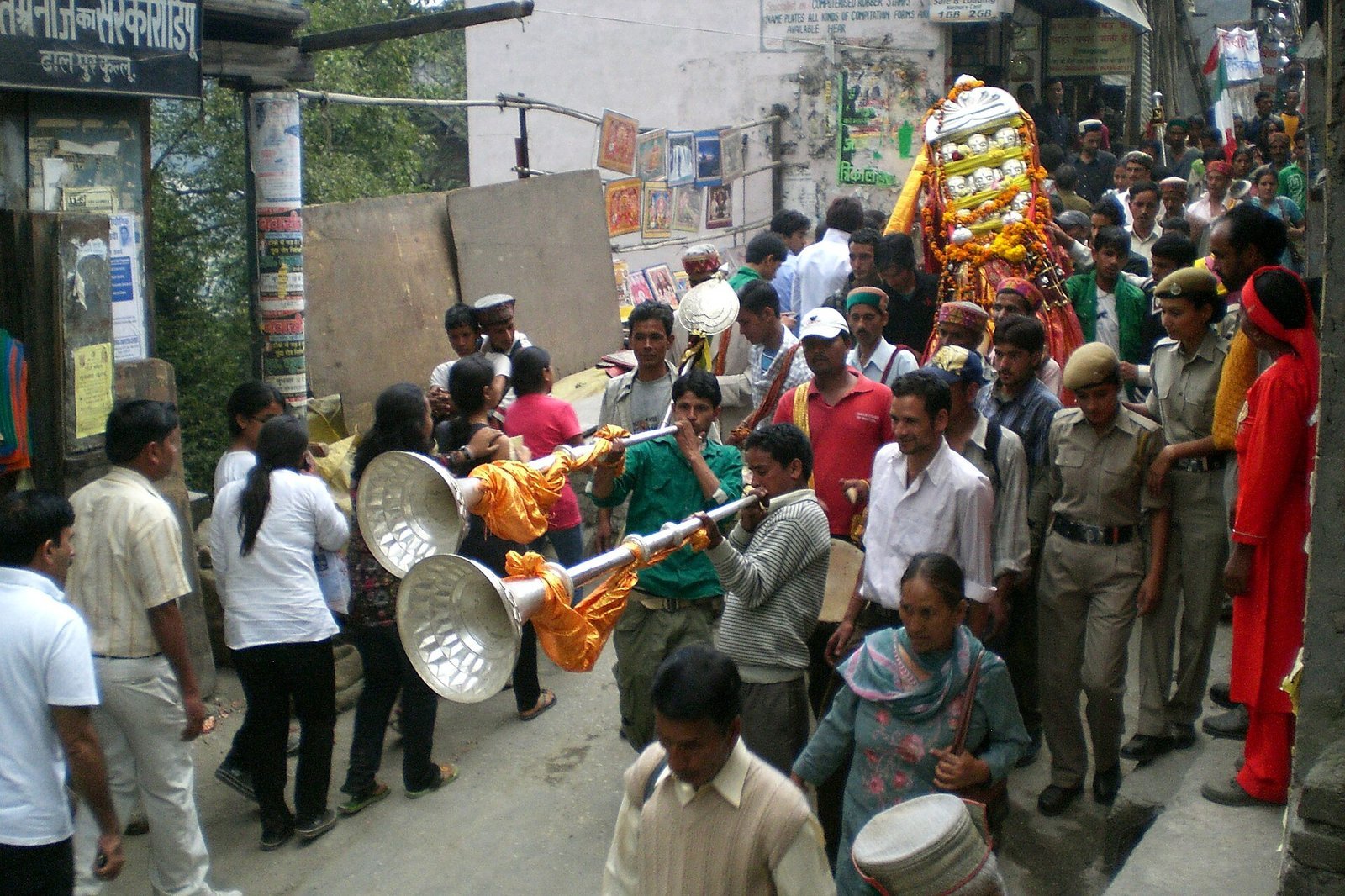
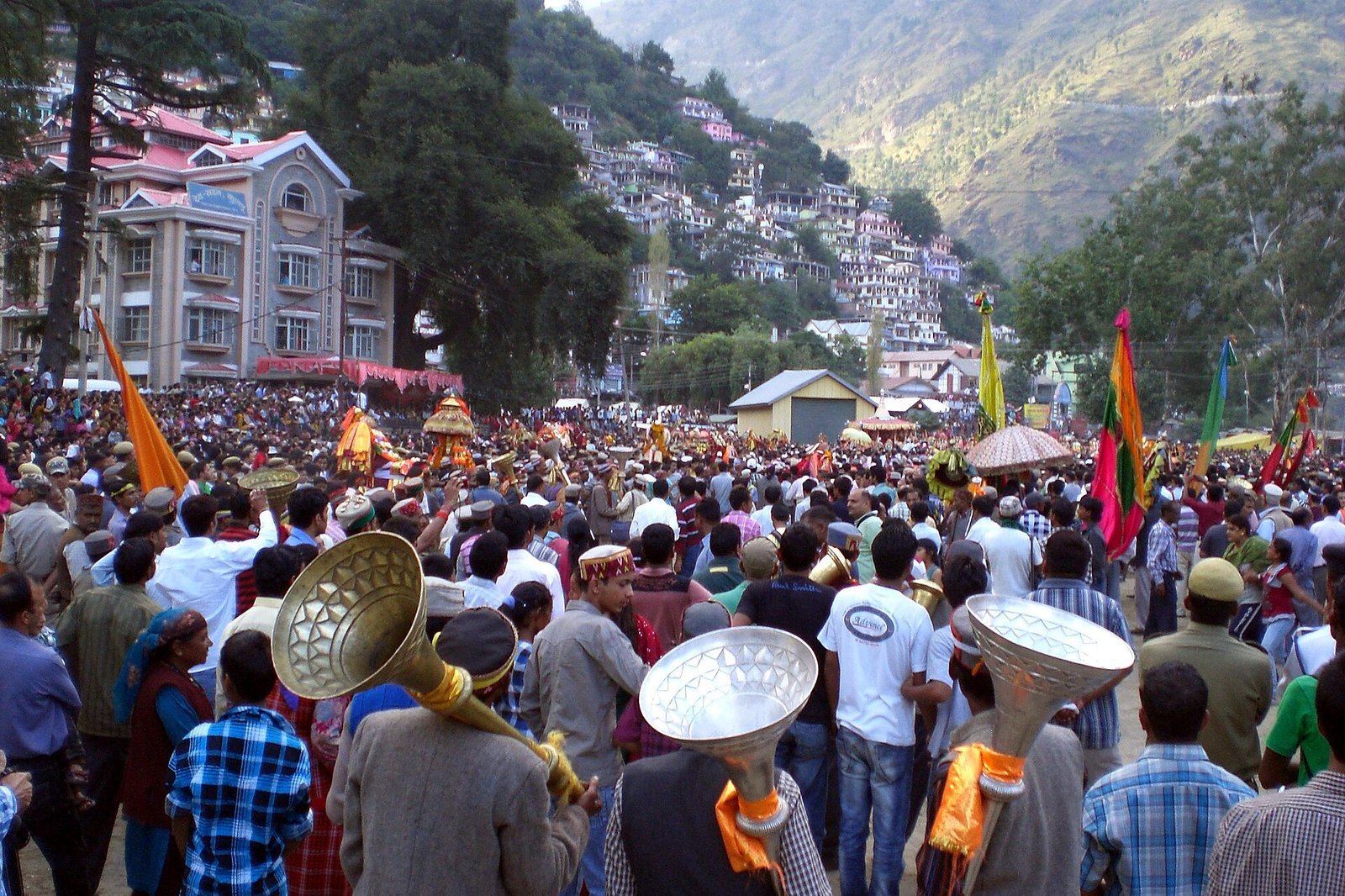
- Karnal. A long, bell-mouthed brass horn, two and a half metres long, wrapped in saffron cloth. Two karnal players walk at the front of any deity procession in Kullu.
- Narsingha (also called ransingha). A curved, S-shaped brass horn. Here is the detail nobody in the English-language sources gets right: the narsingha is processional only. It is used to bring the deity in to the dance ground. It is never blown while the Nati itself is in progress. Most outsiders, the first time it is pointed out to them, do not believe it. It takes listening across a couple of festivals before it lands.
- Bhana, dholki, flute. The minor instruments. Variable depending on village.
The Somsi essay puts the relationship between the players this way: "शहनाई नाटी की प्राण होती है... ढोलकिये ताल पकड़ता है और संगतिये उसे उठाते हैं". The shehnai is the very soul of Nati; the drummer catches the beat and the accompanists lift it up. It is a description, not a sentiment. The shehnai player carries the melody; the dhol player owns the rhythm; the other musicians colour the form. If you ask a village band whether they can play Nati and they say yes, ask how many of them there are. Anything fewer than ten and you are getting a rehearsal version, not the dance.
The costume, and the small detail of two Monal feathers
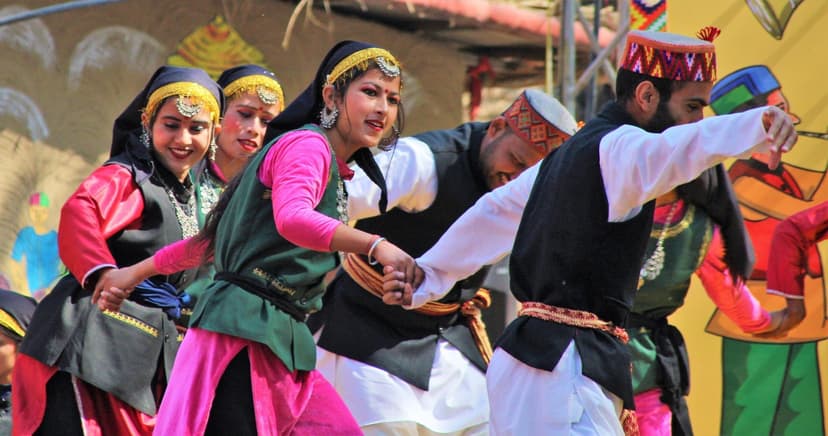
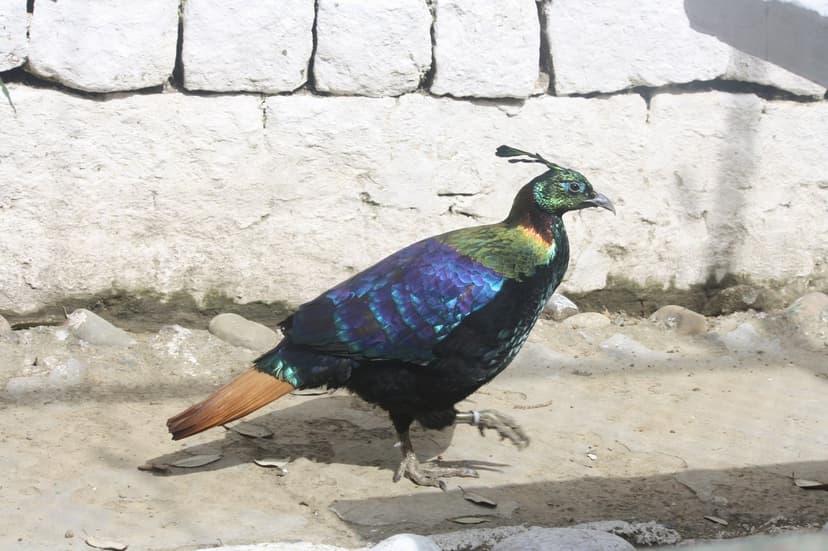
The Kullvi male Nati outfit is built around the cap. A round black or grey woollen cap with a vertical patterned band in red, gold and green wraps the forehead. The band is hand-woven and the patterns code specific regions inside Kullu Valley; the upper-Manali band is distinct from the Banjar one, which is distinct from the Lug valley one. Two feathers sit upright at the side of the cap, behind the band. These are taken from the Himalayan Monal, the iridescent state bird of Himachal Pradesh, whose two-coloured crest feathers are the small visible state symbol on a male dancer at full dress.
Below the cap is a white woollen chola, a tunic that falls to mid-thigh, gathered at the waist by a gachi, a long woven cloth wound four or five times around. Below that, a tight woollen suthan in red or natural wool. A handkerchief tucked into the right hand. The dance leader carries a chowrie, the long-handled yak-tail fly-whisk, or a small ceremonial axe called a dangru. He uses neither as a weapon; the dangru sets the tempo by being raised at the start of each new figure.
The Kullvi female outfit is heavier, and it is the one that the Guinness record made visible. A woollen pattu sheet, four metres long, wrapped diagonally over a churidar pyjama and a kurta and pinned at the shoulder with a brass pin. Embroidered geometric borders run down both edges of the pattu in red, black and green. On the head, the dhattu, a square scarf folded into a triangle and pinned, often dyed a deep red. A silver ornament called denga thipu sits across the forehead. Around the neck, the chandrahar, a moon-shaped silver necklace strung with old coins. The whole outfit weighs about two and a half kilograms; the chandrahar alone is half a kilo of silver. Try dancing in it for two hours.
The dance was a men's dance until very recently
Most of the English-language pages on Nati skip past this, but it is the most important social fact about the form. Through the nineteenth century and well into the twentieth, the Kullvi Nati was performed almost entirely by men. The Nati-raja, the leader of the dance, was always a man; the chowrie and dangru were carried by men; the elite Dussehra Nati teams that walked with the deities into Dhalpur were male. Women had their own versions, like Birsu, danced inside the temple precinct away from the public ground. They were not in the main Dussehra circle.
That shifted, in stages, between 1980 and the 2010s. As Mahila Mandals organised across rural Kullu and Mandi for adult literacy, government drinking-water schemes, and rural cooperatives, they began performing Nati at their own gatherings. The form they kept was the Kullvi pattu version, with the dhattu and the chandrahar, faithful to the costume but with all-women circles. The 2014 Limca record, 8,540 women dancing at Dussehra under the Beti Bachao banner, was the first time this version of Nati owned the main Dhalpur ground. The 2015 Guinness attempt was the formal claim. None of the 9,892 were men. The dance had not changed; the dancers had.
Most days now, in a Kullu village wedding, you will see mixed circles. Men in chola and cap, women in pattu and dhattu, the same eight-step figure. The men's-only Dhalpur teams still exist for the deity processions and the Haran Nati; the gender of the dance has not been ruled, only widened. It is one of the quieter cultural facts of this state. I do not think it gets written about enough.
The named Natis
A handful of singers and songwriters have, in the last forty years, kept Nati in the radio playlists and YouTube cycles that Pahari households actually listen to. They are not pop figures in the Bollywood sense. They are folk practitioners whose songs the bands at every village wedding learn. Three of them are worth naming for any traveller who wants to know what is playing in the taxi on the way to Kullu Dussehra.
- Karnail Rana. Born 1 September 1963 at Rakwal Lad in upper Ghalaur, Jwalamukhi tehsil, Kangra. Over 150 recorded albums by the end of 2025. Long-time Public Relations Officer with HP's Song and Drama Division. He is sometimes called the Lok Ratna of Himachal in the Hindi press. His 2025 release Adhi Raati Kuku Bolda is the kind of song you will hear in a teashop in Mandi at four in the afternoon.
- Vicky Chauhan. Pahari folk singer with 350-plus Nati recordings to his name across the Mandyali and Kullvi belts. The GNT TV documentary profile of him is one of the few honest interviews in English-language coverage of Pahari folk music.
- Kuldeep Sharma. Known across Kangra as the Nati King (नाटी किंग). The Amar Ujala piece on him from July 2025 is the easiest entry point to his work for non-Hindi readers. He is closer in form to the Mahasuvi style than to the Kullvi.
None of them, to be honest, has the international audience of an A.R. Rahman or even an Anirudh Ravichander. They do not need it. The Pahari folk-music market is large enough to keep them busy across the state, the diaspora in Delhi, Chandigarh and the Punjab, and the seasonal touring circuit that runs through every district festival between Lavi Mela in November and Mandi Shivratri in February.
Where to actually see Nati in 2026
You can see Nati at almost any small village gathering in Kullu or Mandi if you are lucky enough to stay long enough to be invited. The five times of the year when the dance is on a public stage, available without an invitation, are these.
Kullu Dussehra 2026 day by day, with the Nati schedule
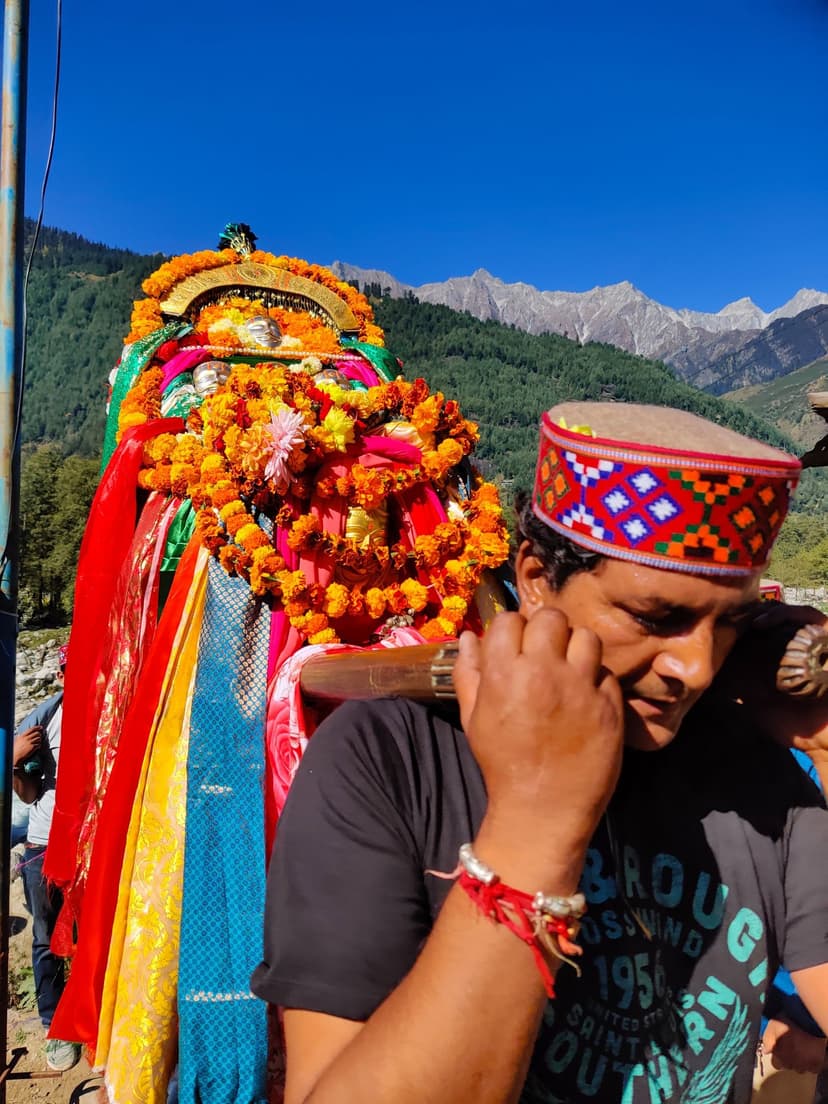
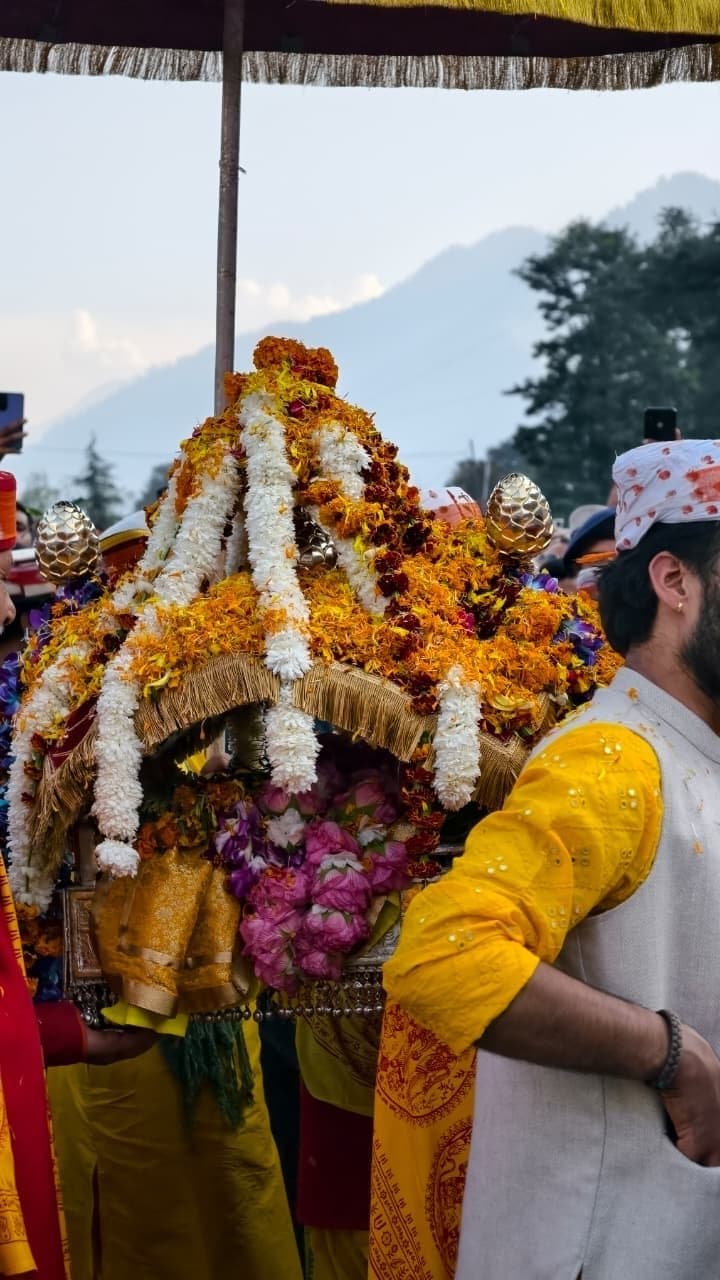
- Day 1 (20 October 2026), Vijayadashami, the Rath Yatra. Raghunath ji is brought out of his temple at sunrise. The chariot is pulled by hand from his temple ground to a marked stop on the slope of Dhalpur. About 290 village deities follow, each on a palanquin. Best viewing is from the temple side, before midday.
- Day 2 (21 October), the first Dhili Nati. The slow opening form begins at Dhalpur after morning deity assembly. Mahila Mandal teams alternate with men's troupes. Crowd is heaviest from 4 PM.
- Day 3-4 (22-23 October), the competitive cycle. District-level Nati competitions run on the main stage. Sub-styles from across Kullu, Mandi, Lahaul and Spiti are presented. This is the day to compare regional forms side by side.
- Day 5 (24 October), cultural evenings. Karnail Rana or one of his peers usually performs at the main cultural pandal. State Nati troupes from Sirmaur and Shimla travel up. Evening shows from 7 PM.
- Day 6 (25 October), Laladi Nati in town. The house-to-house improvised samvaad dance moves through Kullu town through the day. Walk Akhara Bazaar and Sarvari and you will run into at least three roving Laladi groups.
- Day 7 (26 October), Lanka Dahan and Haran Nati. The closing day. Raghunath ji is taken in procession down to the Beas. A symbolic effigy of Lanka is burned. The fast Haran Nati closes the festival on the riverbank around dusk.
Kullu Dussehra is a very crowded festival
The 2024 footfall on Dhalpur on the busiest evenings ran past one and a half lakh people. Hotels in Kullu town book out by mid-July; the Rs 1,000 budget room you can find any other week of the year goes for Rs 3,500-5,000 during the festival, and most of those are taken by August. If you are coming in 2026 and you have not booked by July, stay in Bhuntar (15 km south) or Naggar (20 km north) and bus in. Walking shoes, a water bottle, a power bank and a charged phone are the basics. Pickpocketing is rare; the crowd density is the bigger problem.
What a four-day Kullu Dussehra trip actually costs in 2026 (one person)
- HRTC Volvo Delhi to Kullu (return): Rs 3,200
- Stay, 3 nights in Bhuntar or Naggar at festival rates: Rs 4,500
- Local taxi Bhuntar-Kullu and back during festival: Rs 1,400
- Food (4 days, dhaba and Kullu town stalls): Rs 2,500
- Dussehra cultural pandal entry (free; cultural evening ticket optional): Rs 300
- One-off purchases (Kullu shawl, dhattu, small souvenirs): Rs 2,000
- Margin (water, phone, the second cup of chai): Rs 600
- Total per person: About Rs 14,500
Need help finding a homestay that still has a room?
Hotels and homestays in Kullu town book out by mid-July for Dussehra week. Refuje keeps a small list of family-run homestays in Bhuntar, Naggar, Patlikuhal and Jia (all on a 15-25 minute taxi line into Dhalpur) that still have rooms by August in most years. Write to hello@refuje.com and we will send you the current list with phone numbers.
The other four times to see Nati without an invitation are these.
- Manali Winter Carnival in the first week of January every year. Mass Mahila Mandal Nati at the town ground, with the snow on the deodars and the karnal players in the centre. The closest visual approximation of the Guinness day on a non-Dussehra week. The carnival also includes ice-sculpture and skiing events, but the Nati is the main daily attraction.
- Renuka Mela on Kartik Purnima in November (Renuka Ji village, Sirmaur). The annual Sirmauri Nati ground for the lower hills, performed during the five-day mela that culminates with Parshuram coming down from Jamu Koti to meet his mother Renuka. The dance here is faster, the costume is brighter, and there are fewer outside cameras than at Kullu Dussehra.
- Mandi Shivratri in February each year. The 2026 edition is the 500th, running 16-22 February, with about 216 deities arriving at Paddal Ground. Karsogi and Chauhari Nati troupes from across the district perform at the cultural evenings. Smaller scale than Kullu but visually distinctive because of the Mandyali topi colours.
- The Lavi Mela at Rampur Bushahr in mid-November. The annual trade fair with Tibetan traders since the 1680s, with Kinnauri Nati performed in the evenings by visiting Sangla valley troupes.
If you want to actually try the dance
The eight-step figure is genuinely simple. If you are at Dhalpur on any of the seven days and a Mahila Mandal circle has just formed, walk up, smile, and place your hand in the criss-cross between two dancers. Nine times out of ten you will be folded in without a word. The tenth time you will be politely turned away because the circle has already been registered for a competition. No offence is taken either way. Wear flat shoes. Cover your head. Watch the dancer in front of you, not the leader; the leader is steering, not demonstrating. If you stay for two figures you will have a foot-pattern memory you will not lose for years. Ask me how I know.
The map of HP that the dance traces
Where Nati lives across HP
- Dhalpur Maidan, Kullu: The Guinness venue. 26 October 2015.
- Manali: Winter Carnival, first week of January.
- Kalpa and Chitkul: Kinnauri Nati home villages.
- Nahan, Paonta Sahib, Renuka Ji: Sirmauri Nati country.
- Shimla, Mandi, Karsog: Mahasuvi and Karsogi.
- Jwalamukhi: Birthplace of Karnail Rana.
- Bharmour, Keylong: Pangwali and Garfi variants.
One honest line
I was not in the Guinness circle in 2015. The dancers were 9,892 women and I am not one of them. What I can tell you, from a lifetime around Kullu weddings and Dussehra mornings, is what the dance does to the people who are inside it. Most Kullu households have a few dancers in them; the basic figure travels through the family the same way the language does. The thing nobody tells you outside the valley is that the dance carries you. You step in and the circle holds you up. The first figure is awkward; by the third you are not steering yourself. By the eighth you have lost the small noise in your head, the one that thinks about whether you look strange. That is the bit Nati does that nothing else does. It empties you out. The shehnai's sanha, the dhol's pulse, the criss-cross of hands; you become the wheel.
It is the easiest argument I know for travelling to Himachal Pradesh in October instead of June.
Plan a Kullu Dussehra trip with us
Refuje is building a community of slow Himachal travellers. If you want help timing a Kullu Dussehra trip in 2026, finding a homestay in Bhuntar or Naggar that has a room left, or connecting with a local Mahila Mandal that will pull you into a circle, write to us at hello@refuje.com. Closer companion pieces from this corpus: our HP festival calendar 2026, the Kullu-Manali budget guide, and the state-wide HP travel guide.
Frequently asked questions
What is Nati dance?
Nati is the traditional folk dance of Himachal Pradesh. Dancers stand in a circle or arc, hold hands in a criss-cross pattern, and step through an 8-beat figure that starts slow and accelerates. Every district in HP has its own version. The Kullvi form is the one most outsiders know; the Sirmauri version is faster, the Kinnauri version slower, and Lahaul has its own dance called Garfi instead.
How many people danced in the Guinness Nati record?
9,892 women. The attempt was on 26 October 2015 at Dhalpur Maidan in Kullu, during the International Kullu Dussehra Festival. Around 13,000 women registered; the final count was reduced by strict Guinness rules on formation, dress and verified barcoded chips. The certificate arrived on 11 January 2016, naming the District Administration Kullu as the holder.
When is Kullu Dussehra in 2026?
20 to 26 October 2026. The festival opens on Vijayadashami (the day mainland India ends its Dussehra) and runs for seven days. Unlike mainland Dussehra, there is no Ramlila, no burning of Ravan, Kumbhkaran or Meghnath effigies, and no fireworks; only deity processions and dance.
Can a tourist join a Nati circle?
Yes. The basic 8-step figure is simple. The dancers do not mind another pair of hands in the criss-cross. Walk up to a Mahila Mandal circle at Dhalpur on any festival day, smile, and place your hand between two dancers. You will be folded in nine times out of ten. The tenth time the circle has been registered for a competition and you will be politely turned away. Wear flat shoes and cover your head.
What is the difference between Kullvi, Sirmauri and Kinnauri Nati?
Kullvi Nati is the festive Dussehra-linked form from Kullu Valley, slow to fast tempo, performed with white pattu drapes and red dhattu caps. Sirmauri Nati from the lower hills around Nahan and Renuka is faster, with brightly coloured ghagra skirts. Kinnauri Nati from Kinnaur and the Sangla valley is slower, mime-like, harvest-themed, with heavy silver jewellery on the women. They share the criss-cross hand pattern but the costume, tempo and occasion differ.
What instruments are used in Nati?
A full Pahari folk orchestra is a minimum of ten instruments. The dhol (large drum), damau (small kettle drum, always paired with the dhol), nagara (ceremonial kettledrum), shehnai (locally called sanha, considered the soul of Nati), karnal (long bell-mouthed brass horn), narsingha or ransingha (curved S-shaped horn, used only for processional entry, never during the dance itself), bhana, dholki, and sometimes a flute.
Where else can I see Nati apart from Kullu Dussehra?
Four other reliable venues. Manali Winter Carnival in the first week of January (mass Mahila Mandal Nati at the town ground). Renuka Mela on Kartik Purnima in November in Sirmaur (Sirmauri Nati). Mandi Shivratri in mid-February (Karsogi and Chauhari forms). Lavi Mela at Rampur Bushahr in mid-November (Kinnauri visiting troupes). All four are public events without an entry fee.
Why was the Kullu Dussehra Nati record performed by women only?
Until the 1980s, Kullvi Nati at the public Dhalpur ground was almost entirely male. Women's versions like Birsu were performed inside temple precincts. The shift began as rural Mahila Mandal collectives organised across Kullu and Mandi in the 1980s and 1990s. The 2014 Limca record (8,540 women, under the Beti Bachao banner) was the first formal claim that women had reclaimed the public ground; the 2015 Guinness attempt confirmed it. The dance itself did not change; the dancers did.
What does Nati mean? Is the word Sanskrit or Pahari?
Nati comes from the same Sanskrit root as nritya (dance) and nat (actor). The everyday Pahari pronunciation rounds it to Nati. The word covers the family of related dances across HP and parts of Garhwal (where the form is called Tandi). Lahaul, distinctively, calls its version Garfi, an older Bhoti-influenced word; some scholars trace it to Tibetan court dance traditions.
Are there famous Nati singers I can listen to before I go?
Three names worth knowing. Karnail Rana (born 1 September 1963, Jwalamukhi tehsil, 150-plus albums), the senior figure in HP folk; his 2025 release Adhi Raati Kuku Bolda is on YouTube and Apple Music. Vicky Chauhan, 350-plus Pahari Nati recordings across Mandyali and Kullvi styles. Kuldeep Sharma, known in Kangra as the Nati King, closer in form to the Mahasuvi style. Their YouTube channels are the easiest entry point.
Sources
Written from Kullu Valley, May 2026. The Guinness record details are from the official Guinness World Records page (record ID 15-118787, achieved 26 October 2015) and corroborated by The News Himachal's 2016 report on the certificate's arrival. The 13,000-registered figure and Beti Hai Anmol campaign theme are from the Hill Post 2016 piece. Kullu Dussehra dates and structure are from the official Kullu Dussehra portal, the Kullu Dussehra Wikipedia entry and the India Utsav Ministry of Culture page. The Hindi research backbone, including the 5 ritual sub-forms of Kullu Dussehra Nati (Birsu, Dhili, Laladi, Phagali, Haran), the 10-instrument orchestra structure, the shehnai-as-soul phrase, and the narsingha-is-processional-only ethnomusicological detail, comes from the Hindi Wikipedia entry on Nati, the 1976 Somsi journal essay reprinted at tharahkardu.in, the ETV Bharat "King of Folk: Himachali Nati" feature, and the Amar Ujala feature on Himachali Nati. The Nati singer biographies are from the Amar Ujala Karnail Rana profile, the JioSaavn Vicky Chauhan catalogue and the Outlook India "Nati Nati, Not Naatu Naatu" essay. I write from Kullu Valley; the regional observations are mine, not from any single cited source.
About Rajesh Thakur
Rajesh Thakur grew up in the Kullu valley and has been writing about Himachal Pradesh travel and culture since 2018. He is most at home in upper Kullu, Lahaul, and the Spiti circuit, and has driven the Manali-Kaza loop more times than he has counted.
You Might Also Like
Volunteering in Himachal Pradesh: 12 Organisations and How to Apply (2026)
Teach English in McLeod Ganj, conserve the Great Himalayan National Park, build with earth in Bir, or harvest apples in Kullu. Twelve real HP volunteer organisations with honest costs, the visa rule that gets foreigners deported, and how to apply.
How to Travel Himachal Without Wrecking It: A Quiet-Travel Manual
A non-preachy field manual for responsible travel in Himachal, by a Kullu local: how to behave, when to go, where to go instead, and the 2026 rules and bans that actually matter.
Mamleshwar Mahadev: The Eternal Flame Temple of Karsog
An eternal fire, a fist-sized wheat grain and a six-foot drum, kept in a mortar-less timber temple in the quiet Karsog valley. The honest story of Mamleshwar Mahadev: what is real, what is faith, and how to go.