Overview
Common carp (Cyprinus carpio) is one of the oldest cultivated fish in the world — domesticated in China and Central Asia over 2,000 years ago and now present on virtually every continent. In India it plays a dual role: a prized aquaculture species farmed extensively across the Indo-Gangetic plains and lower Himalayas, and a self-sustaining wild fish in major reservoirs, river backwaters and irrigation canals from the foothills to the plains.
In Himachal Pradesh it is a cornerstone of composite fish culture (polyculture) in the lower and mid-elevation districts — Bilaspur, Hamirpur, Una, Kangra and Mandi — and is well established in the wild in Gobind Sagar, Pong Dam and Koldam reservoirs and the slower stretches of the Beas and Sutlej in the foothills. For anglers it is arguably HP's most accessible sport fish: widespread, robust, and willing to feed across a broad range of conditions.
Physical Characteristics
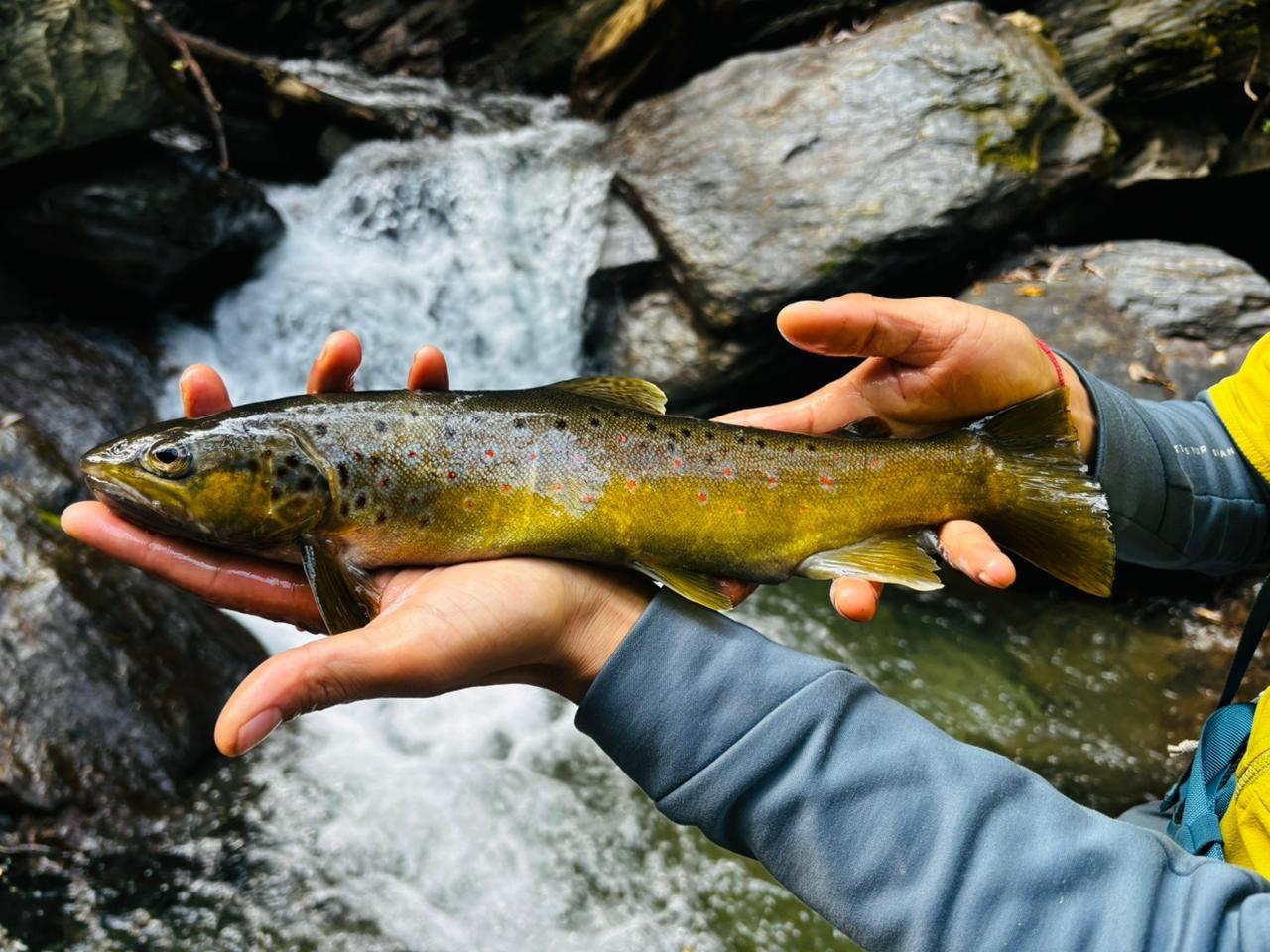
The single most reliable field mark is the two pairs of barbels at the corners of a downturned mouth, which separate common carp from catla, rohu and the native mahseer. The build is deep and thick-bodied, with a long dorsal fin and a serrated, hardened leading spine on both the dorsal and anal fins, and the scaling varies by lineage — standard (saras) fish carry uniform concentric scales, mirror carp show scattered oversized scales on otherwise bare skin, and leather carp are nearly scaleless. The sides are golden-olive to brownish over a pale yellowish belly, the fins tinged orange-red in breeding fish. Farm-reared fish in HP typically reach 1–3 kg in 12–18 months; wild fish in Gobind Sagar run 3–12 kg, with exceptional reservoir fish over 15 kg, and the IGFA all-tackle world record is 34.35 kg.
Distribution in Himachal Pradesh
The strongest waters are Gobind Sagar (Bilaspur), with an abundant wild population in its silty margins and creek inlets, and Pong Dam Wetland (Kangra), a Ramsar site and one of the most productive carp fisheries in HP. Koldam Reservoir (Bilaspur/Mandi), recently established, was rapidly colonised after filling; the lower Beas from Mandi to Pandoh and below holds carp in its slow pools and agricultural backwaters; the lower Sutlej below Bilaspur produces fish especially near irrigation headworks and canal outlets; and farm ponds and irrigation tanks across the Una, Hamirpur and Kangra tehsils round out the picture.
Habitat & Location
Common carp are habitat generalists whose tolerance for silt, low oxygen, temperature swings and turbidity lets them thrive where most fish can't, which makes them dominant in HP's large warm-water reservoirs and lowland ponds alike. Look for them over soft-bottom flats and silty coves — the tell-tale "mudding", or silt clouds from rooting fish, is the most reliable visual cue — and along weedy margins and submerged vegetation, in shallow bays that warm fast in spring (and the deeper, stable water in peak summer), at creek mouths and seasonal inflows, around undercut banks, fallen timber and gravel points, and in the slack-water bays behind points and headlands.
On water quality they are extraordinarily forgiving — dissolved oxygen as low as 0.5–1 ppm (though they prefer above 4 ppm), pH 6.5–9.0, turbidity into the hundreds of NTU, and salinity up to 14 ppt — so in HP reservoirs they stay active year-round even through the monsoon turbidity peak. Feeding is most reliable between 18–28°C, which is April through October in Gobind Sagar and the lower Beas valley; below 12°C it slows sharply and the fish stack in the deepest, most thermally stable water, where they are very hard to tempt.
Gear Recommendations
You can catch common carp on basic tackle, but the larger reservoir fish reward proper carp setups — their power, vibration-sensitivity and habit of bolting on the take make a freespool reel and a rod rest essential on the bank. Use a 3.0–3.6 m medium-heavy rod of 2–3 lb test curve (Indian feeder rods or imported carp rods both work) with a baitrunner/freespool reel of 4000–6000 size (the freespool function is critical, since carp bolt the instant they feel resistance), 12–20 lb monofilament or 30 lb braid with a 12–15 lb fluorocarbon leader of 8–10 ft, and a hair rig with a size 4–8 wide-gape hook behind an inline lead of 30–80 g. A method feeder or flat-pear lead with a PVA bag of pellets concentrates fish over the hookbait, and bite alarms help detection, especially at night.
In shallower farm ponds and reservoir margins down to 2–3 m, the float or lift method shines: an 8–12 ft float rod, 6–10 lb line, and a sensitive waggler or peacock-quill float set slightly overdepth, with the hookbait lying on the bottom and the float cocked at an angle — when a carp lifts the shot, the float rises or lies flat, and you strike at once. For fly fishing, a 7–8 weight with floating line and 10–14 lb fluorocarbon tippet handles weighted nymphs (Hare's Ear, Pheasant Tail, an olive or brown Woolly Worm) that imitate the chironomid larvae and caddis carp root for in silt, mulberry (shahtoot) and fig patterns under overhanging trees in the monsoon at Gobind Sagar and Pong margins, and a bread fly or deer-hair dog-biscuit pattern for surface feeders in calm bays — spot a cruising fish in clear shallows, lead it by 1–2 m, let the fly sink to feeding depth, and strike on any line movement or when the fish tips head-down.
On baits, boilies of 14–18 mm in strawberry, pineapple, scopex or fishmeal work well, and pre-baiting a spot a day or two before dramatically improves results; sweetcorn is the most universally effective bait across HP conditions, cheap and everywhere; bread serves as floating crust for surface fish or pinched flake on the hook for the bottom; dough balls laced with anise, garlic or chili are the traditional Indian carp bait; earthworms and bloodworms suit smaller fish and high monsoon water; cooked chickpeas, tiger nuts and wheat berries on a hair rig are favourites of experienced HP anglers; and a particle groundbait of crushed corn, breadcrumbs and pellets pulls fish into the feeding zone.
Behaviour & Conditions
Common carp are omnivorous bottom-rooters that use a protrusible mouth to vacuum invertebrates, plant material and detritus from soft sediment — the "mudding" silt plumes give away feeding fish almost at once — though they also forage in the water column and at the surface when conditions allow. The diet runs to chironomid larvae, caddis nymphs, worms, snails, crayfish, plant seeds, algae and fallen fruit, and because their sense of smell and taste is exceptional, heavily scented baits (anise, garlic, fruit flavours, fishmeal) outfish unscented ones in turbid reservoir water. Surface feeding picks up under fruiting mulberry, fig and guava and during warm-evening hatches; smaller fish school loosely while the largest tend to be solitary and grow warier with every catch-and-release, and a single spooked fish releases alarm pheromones that can clear an entire flat in seconds, which is why a stealthy approach matters as much as bait choice.
Carp spawn when the water reaches roughly 17–20°C, typically April–June at HP's lower reservoir elevations. Males develop white tubercles on the head and pectoral fins, several of them pursuing a single female into shallow weedy bays in a boisterous, visible affair — leaping, splashing fish in 20–60 cm of water. Pre-spawn fish are the hungriest and least cautious of the year, so fishing the shallows in April and May with surface or shallow presentations can be exceptionally productive.
Conservation & Regulations in Himachal Pradesh
Common carp are well established and self-sustaining in HP's warm-water systems, are not threatened globally, and are actively encouraged in aquaculture — but their rooting raises turbidity and disturbs macrophyte beds, which can affect native species and waterfowl habitat, a real concern at an ecologically sensitive site like Pong Dam. Fishing in Gobind Sagar, Pong Dam and Koldam requires a valid angling permit from the HP Fisheries Department or the relevant District Fisheries Officer; the Himachal Pradesh Fisheries Act 1976 and its amendments govern size limits, gear restrictions and closed seasons; Pong Dam, a Ramsar wetland and Wildlife Sanctuary, carries extra restrictions (check with the Kangra District Fisheries Office first); the closed season is typically January–June to protect breeding fish (verify the current gazette notification); there is no nationally mandated minimum size for common carp, so follow local guidance or a voluntary 30 cm minimum; nets and traps run through licensed contractors while recreational hook-and-line angling is generally permitted with a licence; and night fishing is allowed on most HP reservoirs, though the rules vary by waterbody.
The ecology deserves care: Pong Dam is one of India's most important waterfowl wintering sites, where submerged aquatic vegetation supports tens of thousands of migratory birds — bar-headed and greylag geese and numerous duck species — so an overly dense carp population that destroys that vegetation would damage the sanctuary's value, and anglers are encouraged to release fish, particularly larger breeders. Common carp are hardy and recover well from careful catch-and-release: use barbless or debarbed hooks, keep the fish in the water during unhooking where possible, wet your hands and support the full body weight if photographing, and return it within 30 seconds — larger fish above 5 kg should be held upright in shallow water until they swim off under their own power.
Aquaculture in Himachal Pradesh
Common carp is one of the six major species farmed in composite fish-culture ponds across HP's lower and mid-elevation districts. It fills the bottom-feeding omnivore niche in polyculture, using the detritus and leftover feed that other species miss, which adds both to production efficiency and to water-quality management.
Fishing Tips for HP Reservoirs & Rivers
At Gobind Sagar — HP's largest reservoir, holding abundant carp in its silty arms and creek inlets — the Lathiani ghat and the Naina Devi inlet are established bank spots: pre-bait with corn or pellets the evening before, fish a hair rig with a baitrunner setup, expect fish of 2–8 kg, and note that night fishing in the warm months of May–September can be especially productive. At Pong Dam, the northern Beas arm and the Nagrota Surian shoreline hold good numbers; access is regulated as a wildlife sanctuary, so get your permit from the Kangra DFO before arriving — the carp average a little smaller than Gobind Sagar at 1–4 kg, but the tranquil setting makes for exceptional fishing, and floating bread or surface dog biscuits work well along reed-fringed margins on calm mornings. On the lower Beas between Mandi and Una, the slacker pools from Mandi to Pandoh and the deep glides below Pandoh dam hold carp alongside mahseer: fish the upstream end of pools where the slack meets a gravel run, and in the monsoon try worm or corn on a simple leger rig in the coloured water, since carp lean on scent more than sight when it's turbid.
Across all of it, the best months are May, June, September and October, with dawn sessions (5:30–8:30 AM) and evening sessions (5:00–7:30 PM) consistently beating midday; overcast, mild days with a light south-westerly in the monsoon bring some of the best feeding, while cold north winds in winter put the fish off quickly.