
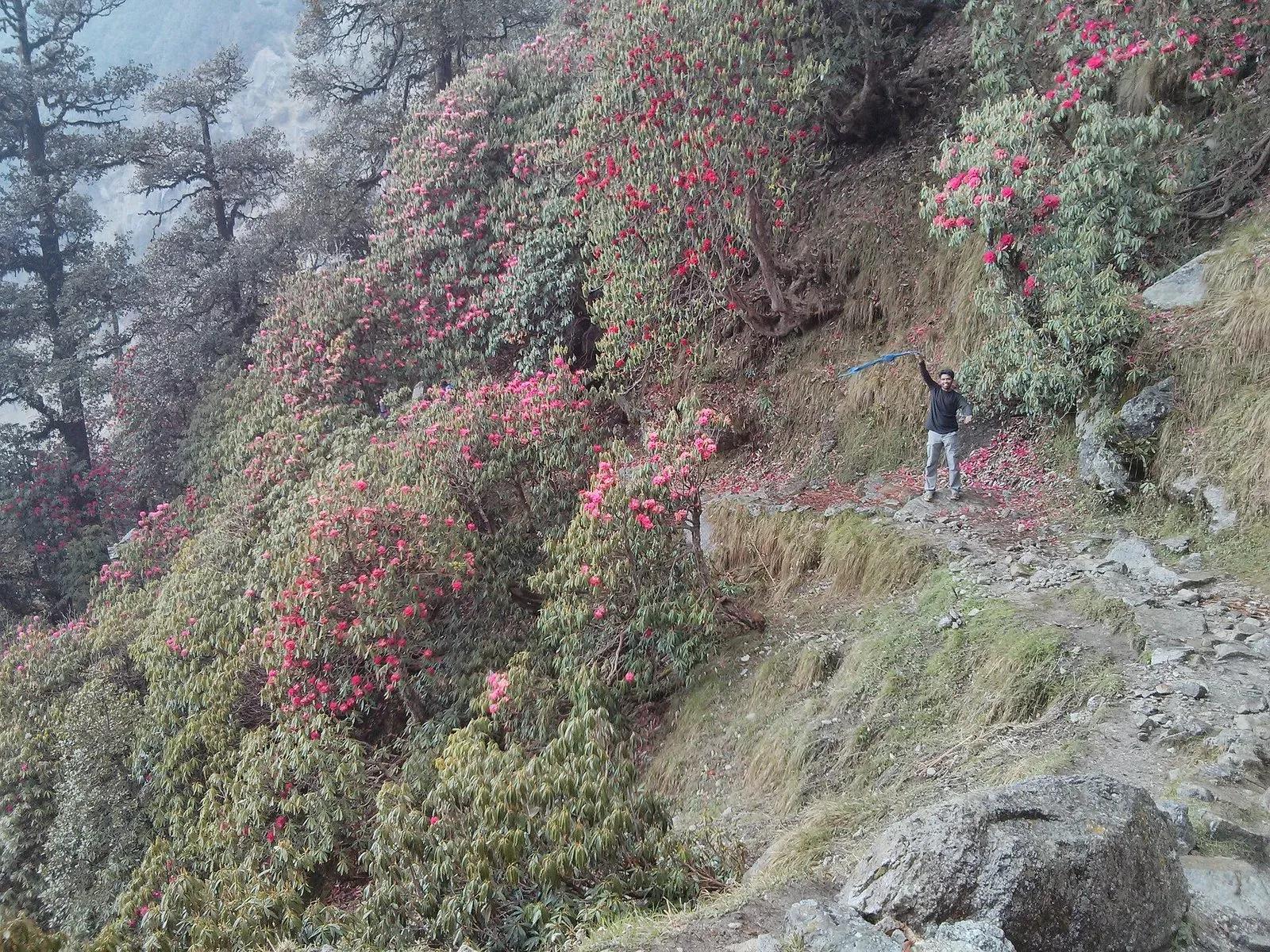
Rhododendron Season in HP: When the Hills Turn Pink
So I was driving back from Mashobra to Shimla one morning in March, half-listening to a friend on the phone, when the hillside on my right went red. Properly red. Not autumn (Himachal does not really do autumn at that altitude). Not the rust-brown of old rhododendron leaves either. The crowns of whole trees were lit up, the way a hill goes when something has just caught fire and you cannot yet tell what.
That is buransh. It happens every spring. The mountain does it whether you bother to look or not.
What was different this year was the timing. The lal buransh around Shimla started opening in late February. By the first week of March most of the lower-elevation forests near Kufri and Mashobra were already past peak, which is wrong by any standard our parents would recognise. A News Himachal piece in early March called it a silent alarm of weather shift. This year specifically, the lower-belt bloom ran two to four weeks early. The longer trend, tracked by field-research stations across the western Himalayas, is bigger: against pre-2010 baselines the advance is closer to three to eight weeks, and the gap is widening. Our trees are flowering early. Our writing about them has not caught up.
So this is the catching-up. Where the bloom shows up in HP and when, what you are actually looking at when you say "buransh," why the state flower is in real trouble, where to get a glass of sharbat that was not made in a factory, and which of the road-accessible spots are worth the drive if you do not want to trek. Most of what gets published about rhododendrons in India is about Uttarakhand and Sikkim. Our hillsides are different. Worth saying so.
Quick facts
- Peak bloom 2026: ~2 to 4 weeks earlier than normal
- Bloom window: Feb-end to early June (altitude-staggered)
- Species in HP: 6 (R. arboreum, campanulatum, anthopogon, barbatum, lepidotum, nivale)
- State flower: R. campanulatum (gulabi buransh, NOT lal)
- Easiest road access: Kufri-Mashobra-Narkanda belt + Pajhota Valley
- Best trek for bloom: Triund, April
The bloom clock: a single mountain, four seasons of red
What people get wrong about rhododendron in HP is treating it as one thing on one calendar. It is not. There are six species growing here across an altitude band that runs from roughly 1,200 m to 5,500 m, and they bloom in shifts. Lower forests open first, mid-elevations a few weeks later, alpine meadows last. If you time it right you can chase the same flower up the mountain across two months.
The bands work roughly like this on a normal year. The 2026 calendar has shifted everything about three weeks earlier, so subtract from these dates accordingly.
The bloom by altitude (normal year, 2026 is running ~3 weeks early)
- Lower belt | 1,500 to 2,000 m | Late Feb to mid-March: Shimla periphery (Mashobra, Naldehra, Taradevi), Pajhota Valley and Habban Valley in Sirmaur, Nohradhar forests. R. arboreum mostly. Roadside, no trek needed.
- Mid belt | 2,000 to 2,800 m | March to mid-April: Kufri, Mashobra ridge above Shimla, Triund trail, Khajjiar-Kalatop edge, GHNP lower zones around Gushaini and Banjar, Shimla-Narkanda highway forests. Lal buransh peak.
- Upper-mid belt | 2,800 to 3,500 m | April to early May: GHNP higher trails (Shilt, Rolla), Sangla Valley, Prashar Lake slopes. R. arboreum gives way to R. barbatum and the start of R. campanulatum (gulabi).
- Alpine | 3,500 m and above | May to early June: Higher Spiti adjacencies, Rohtang periphery, Beas Kund area, Khirganga ridges. R. campanulatum, R. anthopogon, R. lepidotum, R. nivale. Trek-only. Trails just out of snow.
You can verify this for yourself if you ever ask a Sirmaur farmer when buransh starts. They will not say March. They will say something like "after the second cold spell, before the first wheat-sowing rain," and that is a more honest answer than any calendar I can give you, because the trigger is temperature, not date. The flower opens when daytime temperatures cross a 15 to 20 degree threshold for long enough. Milder winters, lower snowpack, longer-running warm afternoons in February and the trees go.
The state flower nobody photographs
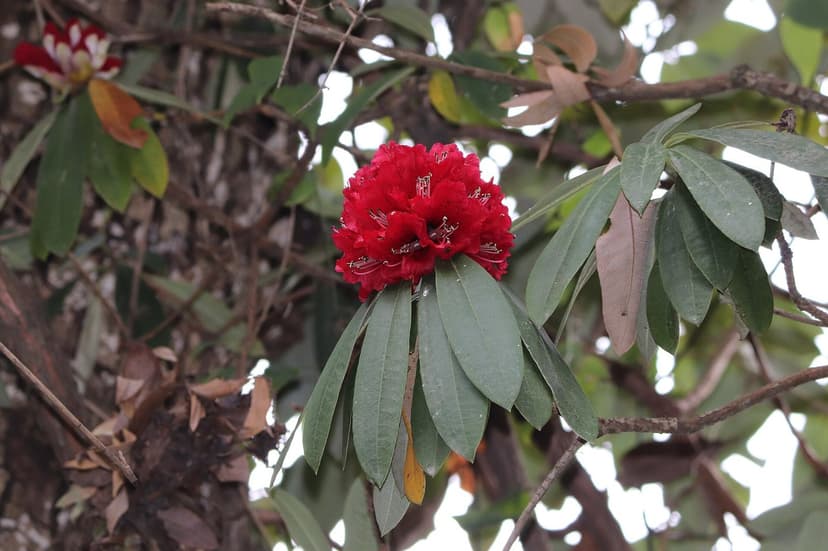
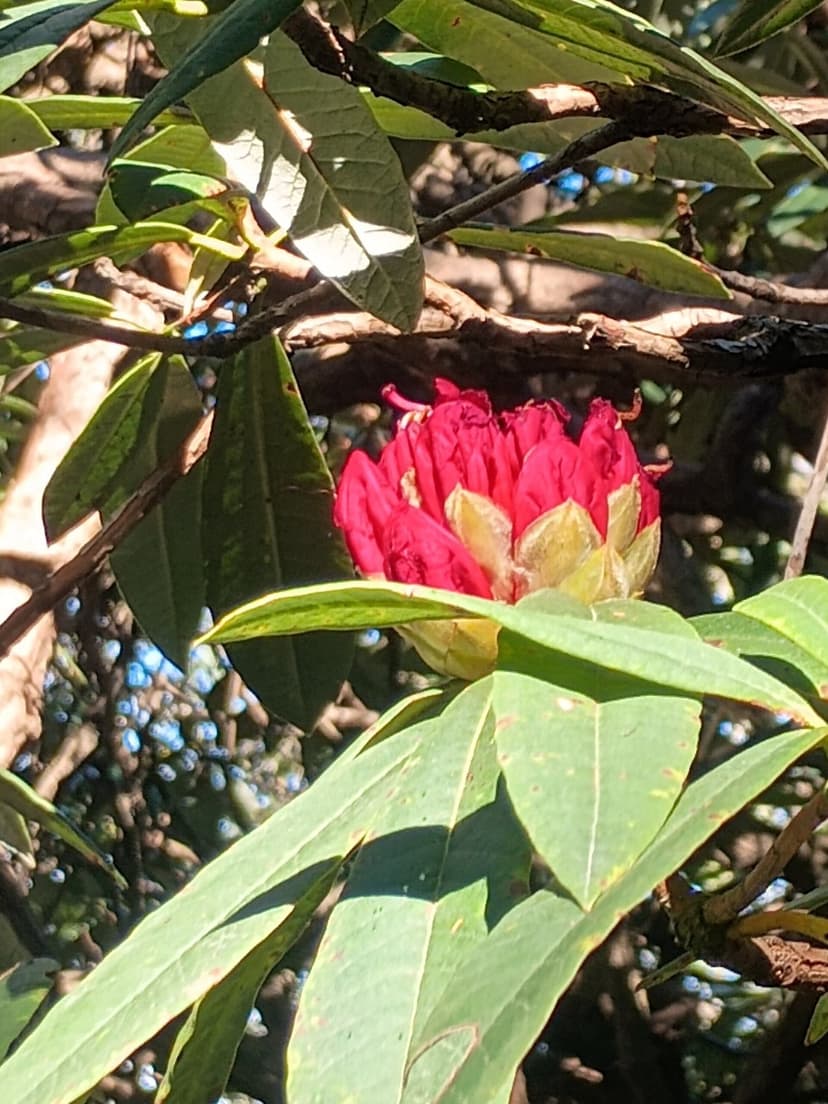
Here is the part that most travel writing skips. The flower you see on every Himachal Tourism poster, the one in the Reddit posts, the close-ups on Instagram with the caption "state flower of HP", that is almost always R. arboreum, the lal buransh. It is not the state flower.
The state flower of Himachal is Rhododendron campanulatum, locally called gulabi buransh, and it lives higher up. Pink to lavender, bell-shaped, tighter shrub form, mostly above 2,800 m. It is also genuinely endangered. A 2023 review on the species summarised what most field reports already say: the gulabi buransh is "on the verge of extinction" because of overharvest for medicinal trade, habitat erosion, and shifting bloom timing pulling its pollination calendar out of sync with the bees and pikas that work it.
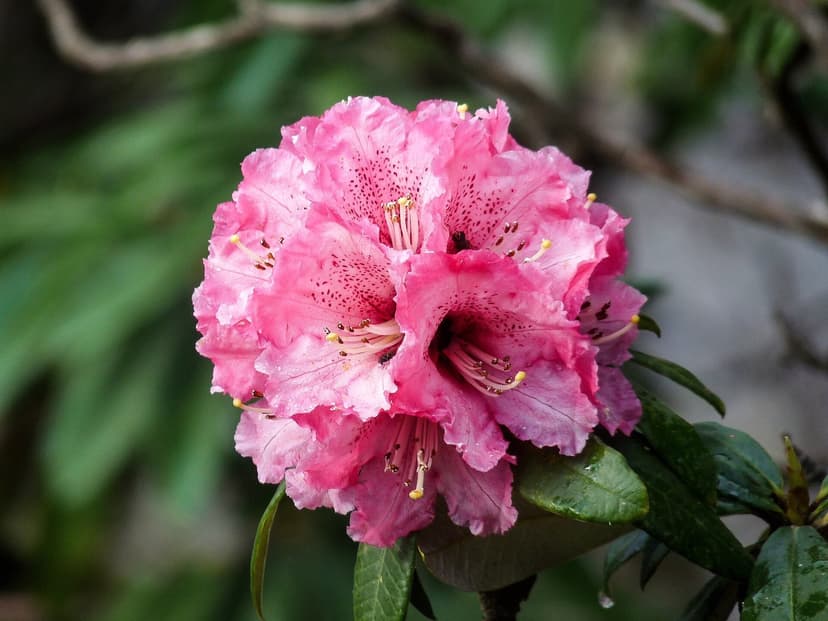
So if you want to honestly photograph the state flower you are walking. Around Prashar Lake, into the higher GHNP trails, up onto the Khirganga and Bhrigu Lake ridges. You will see it in clumps in the alpine meadows, often after the snow has just gone off, often when nothing else around it is in flower yet. And you will also see, quite often, dried branches stripped for the chemist trade. That is the second half of this story.
Red versus white: the safety thing nobody tells tourists
Lal buransh (R. arboreum, red, found below ~3,000 m) is edible. The petals make the sharbat, the chutney, the pickle, the jam. Pahari kitchens have used it for generations and the modern processors (Minchy's, HPMC, Dev Narayan) all use this species.
The white buransh you see at higher altitudes, R. anthopogon and one of the variants of R. campanulatum, is a different chemistry. The juice from the white flower is considered toxic by Gaddi tradition; it was historically burned as dhoop incense, not drunk. Do not pluck and squeeze a white rhododendron because it looks like a flower. The colour is the warning.
If you are buying at a hill-market stall and they cannot tell you which species the bottle came from, it almost certainly came from the safe one (because the white one has no commercial market). But if a kid offers you "fresh juice" from a flower they have just plucked at 3,500 m, the answer is no.
Where to actually see it (sorted by how much you have to walk)
Most rhododendron writing assumes you are going to trek. Most travellers in HP are not going to trek. The good news is the bloom is generous about its accessibility, there are hillsides flush with red within a half-hour drive of Shimla. Here is the honest version of which spots reward which level of effort.
Bloom spots by effort
| Spot | Effort | Bloom month | What you get | Honest take |
|---|---|---|---|---|
| Mashobra-Naldehra ridge | Drive + walk | Late Feb to March | Crimson R. arboreum against deodar canopy, snow-dusted Shali behind | Best easy bloom anywhere near a city in HP |
| Kufri valleys | Drive (16 km from Shimla) | March to early April | Roadside red blooms across the Kufri-Junga drive | Crowded but legitimately scenic, do it on a weekday |
| Pajhota and Habban valleys, Sirmaur | Drive (~3 hr from Shimla) | Mid-March to early April | 15 days of buransh flush across forest hillsides | Almost zero competing tourists, our pick if you want quiet |
| Khajjiar-Kalatop edge, Chamba | Drive + 1-2 hr forest walk | March to April | R. arboreum mixed into deodar-oak forest | Pair with a Khajjiar afternoon, not a destination on its own |
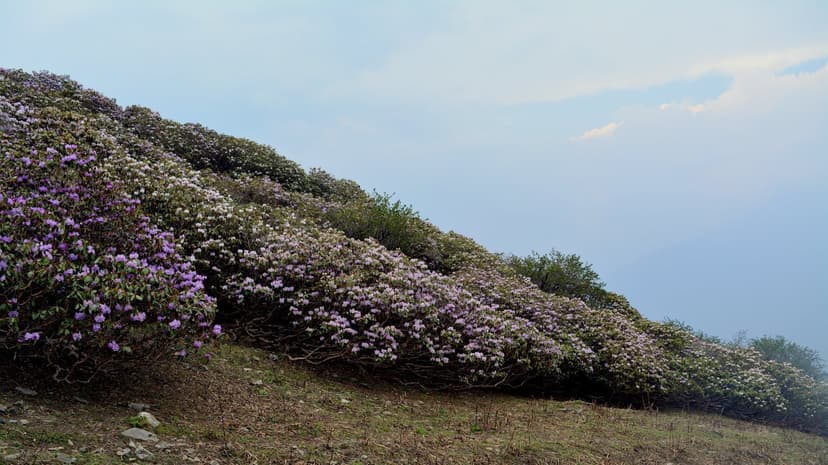
| Triund | 9 km moderate trek from McLeodganj | April peak | Hillsides covered in pink-red, Dhauladhar above | The single best bloom-trek in HP that a fit beginner can do |
| GHNP Tirthan side | Permits + trek (1-3 days) | March-May (altitude-staggered) | Multiple species in sequence, deep forest, very few people | Best for serious bloom-chasers; budget the time |
| Sangla-Chitkul, Kinnaur | Long drive (10-12 hr from Shimla) | Late April to May | Bloom plus apple-blossom plus snow-tipped peaks | Worth the drive but commit to it; not a weekend trip |
| Prashar Lake slopes | Drive + short hike | April | Pink R. campanulatum (state flower!) on the temple slopes | The easiest way to actually see the state flower |
The Shimla cluster (no trek)
If you are flying into Chandigarh and driving up for a long weekend, the Shimla cluster gives you the most flower for the least effort. Mashobra is the under-rated one in this set. The ridge from Mashobra to Naldehra runs through deodar-oak forest with pockets of R. arboreum that catch morning light very well. Walk it; do not drive it. The walking pace is what reveals the bloom because the flowers are dense in patches, and the patches are easy to miss from a car.
Kufri gets the press. Kufri also gets the families with kids on yaks and the photographers with drones, so the experience depends a lot on which day you go. Weekday morning, before 9 a.m., it is genuinely lovely. Saturday afternoon, it is a parking lot with flowers. The Shimla-Narkanda highway above Kufri thins the crowd quickly; there are stretches around Theog and Matiana where the road runs through bloom forest with very little stopping.
Hatu Peak above Narkanda is the upper boundary of this cluster. The peak itself is mostly oak and fir, but the climb up from Narkanda passes through R. arboreum at the right elevation. Worth a half-day if you have already done Kufri.
The Sirmaur secret (still no trek)
This one is genuinely under-known and we have been recommending it to small groups for two years. Pajhota Valley sits behind Rajgarh in Sirmaur, the same Rajgarh that everyone calls "Peach Valley" in summer. In March and early April the same hillsides that produce HP's best peaches are also flush with buransh. Local elders Jai Prakash Chauhan and Sherjung Chauhan, quoted in a Himachal Headlines piece a few years back, gave the simple version: the Burans rules the air for almost 15 days here in spring.
What makes Pajhota worth the drive is the absence of the bloom-tourism circuit. There are no guided photo-walks. There are no jeep stands. There are PWD and Forest Department rest houses if you book in advance, plus a handful of village homestays that run informally. The drive from Shimla is about three hours via Solan and Dadahu. Continue further into Habban Valley if you have a second day, the same bloom carpet, even fewer cars.
The Haripurdhar self-help groups make buransh squash here, sold in bottles to passing visitors and to the wider HP market. It is one of the few places in the state where buransh tourism is genuinely supporting village incomes rather than just supplying Instagram captions.
Triund (the one trek you should actually do)
If you are going to walk for the flower, walk to Triund. The 9 km trail from McLeodganj climbs through oak, deodar, and rhododendron forest, and in April the rhododendron section is the reason you forget you are gaining 1,000 m. The bloom is dense from about the 4 km mark to the top, and the top opens onto the full Dhauladhar wall.
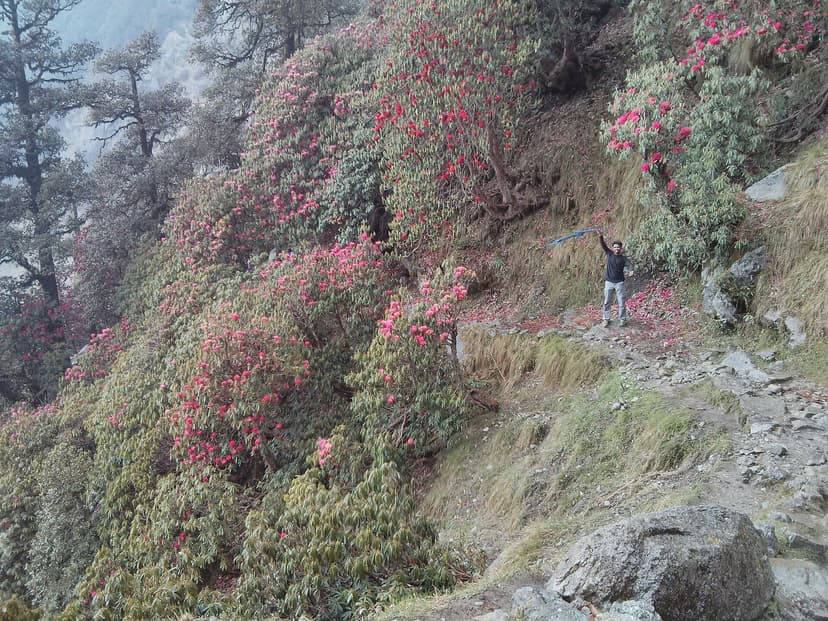
Triund itself does not require a permit. If you continue beyond Triund toward Snowline Café or Indrahar Pass, the forest department has been issuing permits for that section through McLeodganj-based outfitters; verify on the ground before you go because the rules are reviewed every year. Camping at Triund top is by guest house only; the old free-camping era ended a few seasons back and the cleanup has been slow but real.
Go on a weekday in April if you can. Friday-Sunday trail traffic on Triund has tripled in the post-pandemic years, and the lower section in particular is now a queue at peak hours.
GHNP for the serious bloom-chasers
The Great Himalayan National Park is where the species count goes up. Permits come from the Sai Ropa range office on the Tirthan side or from Ropa for the Sainj side, and a guide is mandatory inside the park's core. Standard rule, applies the same in bloom season as out of it.
The Tirthan-side trail to Shilt Hut is the bloom route most park guides recommend. R. arboreum dominates the lower forest; as you climb, the species shift. You begin to see R. barbatum's bristly stems and blood-red flowers, and on the right slope-aspect the higher trails will get you into the lower edge of R. campanulatum. The route is two to three days at a fair pace; serious bloom-chasers do it as a four-day return trip with a buffer day for weather.
If you are not ready for a multi-day commitment, the day-walks from Gushaini into the buffer zone still get you into bloom forest without permits. Banjar, Jibhi, and the lower Tirthan villages are essentially homestay country with rhododendron on the walking-distance hills around them.
Sangla and Chitkul (Kinnaur, late season)
Kinnaur runs late on this calendar. The drive in is long, really long, about 11 hours from Shimla to Sangla even in good road conditions, and currently the Negi byline writes our Kinnaur-specific dispatches from the area itself. What I will say from the trips I have made up there is that late April and the first half of May puts Sangla Valley in a triple bloom: apple blossom in the orchards, R. arboreum on the lower slopes, and the start of R. campanulatum on the higher meadow approaches above the village. The combination is hard to find anywhere else in HP.
Treat Kinnaur as a separate trip, not a Shimla day-add. Three nights minimum, ideally five.
Drink the flower: the buransh sharbat economy
The other half of the rhododendron story in HP is what people do with it after the petals fall. Buransh is not just a tourist photograph. It is also a small but real cottage economy, squash, sharbat, chutney, jam, pickle, and an experimental run of soaps and shampoos coming out of Kullu and Mandi units. If you are travelling through HP in March and April, this is the part you can actually take home.
Buransh products and what they actually cost (2026 ground rates)
- Minchy's Rhodo Squash 750 ml: ~₹125. Most widely available HP brand, Shoghi-made.
- My Pahadi Dukan Buransh Squash: ₹200-300. Online-only, ships from Uttarakhand mostly.
- Dev Narayan Cooperative honey-sweetened sharbat: ~₹200. Bhatkral cooperative near Rayson, Kullu, sugar-free version.
- HPMC Kalpa fruit-wine range (rhodo): rate varies, ask at HPMC outlets.
- Buransh chutney: ₹150-250. Hill-market stalls, Minchy's retail line.
- Buransh jam / murabba: ₹200-350. Less common, look in Shimla and Manali markets.
- Fresh sharbat from a stall: ₹50-100 a glass at hill bus-stand stalls in season.
The most interesting of these is the Dev Narayan Beekeeping & Dairy Cooperative Society at Bhatkral, just off the main road past Rayson on the way to Kullu. Eighteen members, formed in 2013, and they did something nobody else in the buransh industry has bothered with: they spent two years figuring out how to replace sugar with their own honey in the sharbat. It worked. They sold 3,000 bottles in the first commercial run from eight quintals of honey. Hemraj Thakur, one of the cooperative members quoted in an ETV Bharat piece a few years ago, said the substitution was driven by their need to find a market for honey that bee-rich, fruit-rich Kullu produces in surplus. The cooperative's product is the closest thing to traditional sharbat you will find in a bottle.
The most widely-stocked brand is Minchy's, made in Shoghi just outside Shimla. The 750 ml Rhodo Squash sells for around ₹125 at most general stores in the Shimla-Manali corridor. It is sweet, it is consistent, it ships cleanly, and it is the version most kids first taste. If you want a single bottle to take back as a gift, this is the one.
HPMC's Kalpa range includes a rhododendron fruit wine. Available through HPMC outlets across HP and at the bigger HP-government tourism stores. Ask current price at the counter; it has moved a couple of times in recent years.
For the home-pickle, home-chutney version, ask at any decent dhaba in Sirmaur or rural Shimla in March. Several Pahari grandmothers still make Buransh chutney from petals, green chilli, garlic, salt, and a touch of amchur, ground on the sil-batta. There is also Aelu chutney made from cassia tora seeds and called by similar local names; do not confuse them. They are different plants and different recipes.
"Yeh phool nahin, pahad ki dawai hai", this isn't a flower, it's the mountain's medicine.Dr Vishwbandhu Joshi, Ayurvedic physician, Pajhota
The medicine question (handle with care)
Pahari families have used buransh as a household remedy for generations. The summer chutney is given to children to prevent heatstroke and nosebleeds. The sharbat is taken for "garmi ki kamzori," the seasonal fatigue. Older relatives will tell you it is good for the heart, for blood pressure, for digestion, for joints. Some of this has now been studied.
The most-cited piece of recent research came out of IIT Mandi and the International Centre for Genetic Engineering and Biotechnology (ICGEB). Dr Ranjan Nanda's team identified phytochemicals in R. arboreum petals that bind to SARS-CoV-2 replication enzymes and the ACE-2 receptor in cell-line studies. That is not the same as a clinical treatment claim, and any honest take on this work has to say so. But the underlying chemistry, quercetin, hyperoside, and a handful of related flavonoids, does seem to be doing something measurable in the lab.
The traditional nutrient-content claim, repeated by Ayurvedic practitioners across the western Himalayas, is that the petals carry vitamins A, B-complex, C, E, and K, plus calcium, iron, zinc, and copper. That number is broadly consistent with what published flower-flora analyses have found. Not a wonder-food, but a real one.
What we would not endorse is the medicinal-trade overharvest that is hammering the gulabi buransh. The state flower's slow disappearance from its higher habitat is, more than anything, the result of branches being cut and leaves being stripped for the alternative-medicine market. The cure-narrative has eaten the source.
The conservation conversation, briefly
Two things are happening to HP rhododendrons at the same time, and they are not both fixable by tourists.
The first is climate. Bloom timing is shifting two to four weeks earlier on the lower slopes, and that is documented across multiple field-research stations in the western Himalayas. The species that bloom early are coming out before their pollinators are active, and over time that pulls down seed-set rates. This is a slow, structural decline that will play out over decades, and tourist behaviour does not change it directly.
The second is overharvest, and that one tourist behaviour does affect. R. campanulatum branches are being stripped for the chemist trade. The state biodiversity board lists it as vulnerable. Critical refugia for the species sit inside Kalatop-Khajjiar, Chail, and Churdhar wildlife sanctuaries, which is exactly where commercial harvest is officially banned but practically ongoing. If you are buying buransh squash, buy from the licensed processors (Minchy's, Dev Narayan, HPMC) who source from R. arboreum stands at lower elevations. Avoid roadside sellers offering "wild gulabi buransh extract" because that is the chain pulling the state flower off the mountain.
Do not pluck and pocket. The instinct is universal, beautiful flower, want to take a piece, and we have all done it once. But buransh trusses do not last cut, the petals brown within hours, and a missing truss is one fewer seed-set for the next year.
Photographing the bloom (a note from a non-photographer)
I am a writer, not a photographer, but I have learnt enough from sitting next to the actual photographers to pass on what they say.
Direct noon sun blows out the red channel. The petals look saturated to your eye, but the camera reads them flat. Shoot before 9 a.m. or after 4 p.m., or shoot on a slightly overcast day. The cloud-light is the bloom-photographer's friend.
Backlight makes petals translucent. Mid-morning, with the sun behind the truss, the red turns almost stained-glass. The pictures everyone associates with rhododendron come from this light angle.
The signature HP shot is crimson against snow. You get this best at Mashobra, Triund, and the higher Sangla approach roads in early April when the lower bloom is on and the higher snow has not yet melted. You have a window of about ten days for that shot at any given altitude. Plan accordingly.
Shoot the truss, not just the flower. R. arboreum is famous for fifteen to twenty bell-shaped flowers per cluster, and that cluster shape is what distinguishes it from rose-family flowers when you look at the photo later. A close-up of one petal could be any flower. A full truss is unmistakeable.
If the trip is two days from now: a checklist
- Where: If you are flying into Chandigarh and have a weekend, drive Mashobra-Naldehra ridge then take the Shimla-Narkanda highway out. Two days, no trek, peak window late Feb to mid-March.
- If you have four days: Add a Pajhota Valley night via Solan-Rajgarh. Quiet, dense, almost no other tourists. Or add Triund if you are walking-fit.
- If you have a week: Drive Shimla-Banjar-Tirthan (3 nights GHNP edge homestay), best species variety in HP for serious bloom-chasers. Or push on to Sangla-Chitkul for the Kinnaur late-season triple bloom (apple, lal buransh, gulabi).
- What to pack: Layers (March mornings are still 5-8 °C in the lower belt, freezing at higher), a basic monocular if you have one (R. campanulatum is best seen from below), and patience for weather. Bloom seasons are pre-monsoon but Himachal still throws three-day overcast spells in March.
- What to bring back: One bottle of Minchy's Rhodo Squash, one Dev Narayan honey-sweetened sharbat from a Kullu road-stop, and one jar of homemade Pahari buransh chutney from a small village homestay if you can get it. The first two will travel; the last is the one that will surprise you a month later.
If you would like our team to pull together a bloom-chasing itinerary based on which weekend you actually have free and which level of effort you want, write to us at hello@refuje.com with your dates, your fitness level honestly stated, and whether you want to combine bloom with food, festival, or quiet. We do not run packaged tours; we work the route around your constraints.
Where these spots actually are
Frequently asked questions
When is rhododendron season in Himachal Pradesh in 2026?
About two to four weeks earlier than the old normal this year. The Shimla-belt forests started opening in late February and most were past peak by the first week of March. Mid-elevations are in flush right now (early to mid April). Alpine zones above 3,500 m run May into early June. The shift is documented across multiple field-research stations and is not a one-year quirk; the trend is in the same direction every year now.
Is there a single best place to see rhododendron blooms in HP without trekking?
Mashobra-Naldehra ridge above Shimla, if you ask me. Drive plus easy walk, dense bloom, snow-dusted Shali behind it, much less crowded than Kufri. If you want zero tourist competition, drive further south into Sirmaur and stay near Rajgarh for the Pajhota Valley. Both are no-trek options. Pick by mood, not by distance from your hotel.
Which species do tourists actually photograph in HP?
Almost always Rhododendron arboreum, the lal buransh. The common red one. Lives between 1,200 and 3,000 m. The state flower is a different beast, R. campanulatum, gulabi buransh, lives above 2,800 m, and most road-tourists never see it. People still tag the red one as state flower on Instagram all the time. The taxonomy on Instagram is unreliable.
Is buransh juice safe to drink?
The sharbat made from R. arboreum (red) is safe and has been a Pahari kitchen staple for generations. Stick to commercial brands (Minchys, Dev Narayan, HPMC) or buy from licensed stalls in hill markets. The juice we would not drink is anything made from white-flowered higher-altitude rhododendrons. The chemistry is different and Gaddi tradition has always treated it as toxic. Colour-coded warning, basically.
Where can I buy authentic buransh sharbat in HP?
Three options worth knowing. Minchys 750 ml Rhodo Squash sells for around 125 rupees at most Shimla and Manali general stores; the easiest to take home as a gift. The Dev Narayan Cooperative bottle (honey-sweetened, no sugar, about 200 rupees) is the closest thing to traditional and you can pick it up at their Bhatkral unit on the Manali-Kullu road. HPMC sells through HP government tourism stores. For fresh sharbat by the glass, look for hill bus-stand stalls in March and April.
Which trek is best for rhododendron viewing in HP?
Triund. No competition. Nine kilometres of moderate climb from McLeodganj, dense bloom in the upper half of the trail in April, and the Dhauladhar wall waiting at the top. You do not need a permit for Triund itself. Permits are needed for the section beyond, toward Snowline Cafe and Indrahar Pass, and the forest department reviews those rules every year, so confirm on the ground.
Why is the state flower of HP endangered?
Two things at once. The first is overharvest. R. campanulatum branches are being stripped for the alternative-medicine and chemist trade, leaves dried, sold as remedy material. The second is climate-driven bloom-shift, which pulls pollination calendars out of sync with the species that work the flower. Slow structural decline. Critical refugia are inside Kalatop-Khajjiar, Chail, and Churdhar wildlife sanctuaries, where it is officially banned but practically ongoing.
How many rhododendron species can I actually expect to see in HP?
Six grow here. Four are pretty rare for road-tourists, R. anthopogon, R. barbatum, R. lepidotum, and R. nivale, all upper-mid to alpine. The two you will actually run into are R. arboreum (lal, common, anywhere below 3,000 m) and R. campanulatum (gulabi, state flower, above 2,800 m, easiest to see at Prashar Lake slopes or on the higher GHNP trails).
What is the IIT Mandi study on buransh that everyone keeps referencing?
A 2021-22 piece of work by Dr Ranjan Nandas team at IIT Mandi and ICGEB. They identified phytochemicals in R. arboreum petals that bind to SARS-CoV-2 replication enzymes and ACE-2 receptors in cell-line tests. Lab-stage finding, not a clinical treatment, and any honest take has to say so. The chemistry it surfaces (quercetin, hyperoside, related flavonoids) is what underpins the long Pahari claim that buransh is the mountains medicine.
Plan your bloom trip with us
If you have read this far you are probably the kind of traveller we like working with, interested in the species, not just the photo. We do not run packaged bloom tours, but we plan custom routes for travellers who want to see the bloom in HP without the bus-load experience.
Tell us your weekend dates, where you are flying into, your fitness level for any trekking portion, and whether you want to combine bloom with Sirmaur food, the Mandi-Kullu cooperative trail, or the deeper Dhauladhar / GHNP forests. Write to hello@refuje.com. The flower is generous; it does not stay long. Good time to plan.
You Might Also Like
Volunteering in Himachal Pradesh: 12 Organisations and How to Apply (2026)
Teach English in McLeod Ganj, conserve the Great Himalayan National Park, build with earth in Bir, or harvest apples in Kullu. Twelve real HP volunteer organisations with honest costs, the visa rule that gets foreigners deported, and how to apply.
How to Travel Himachal Without Wrecking It: A Quiet-Travel Manual
A non-preachy field manual for responsible travel in Himachal, by a Kullu local: how to behave, when to go, where to go instead, and the 2026 rules and bans that actually matter.
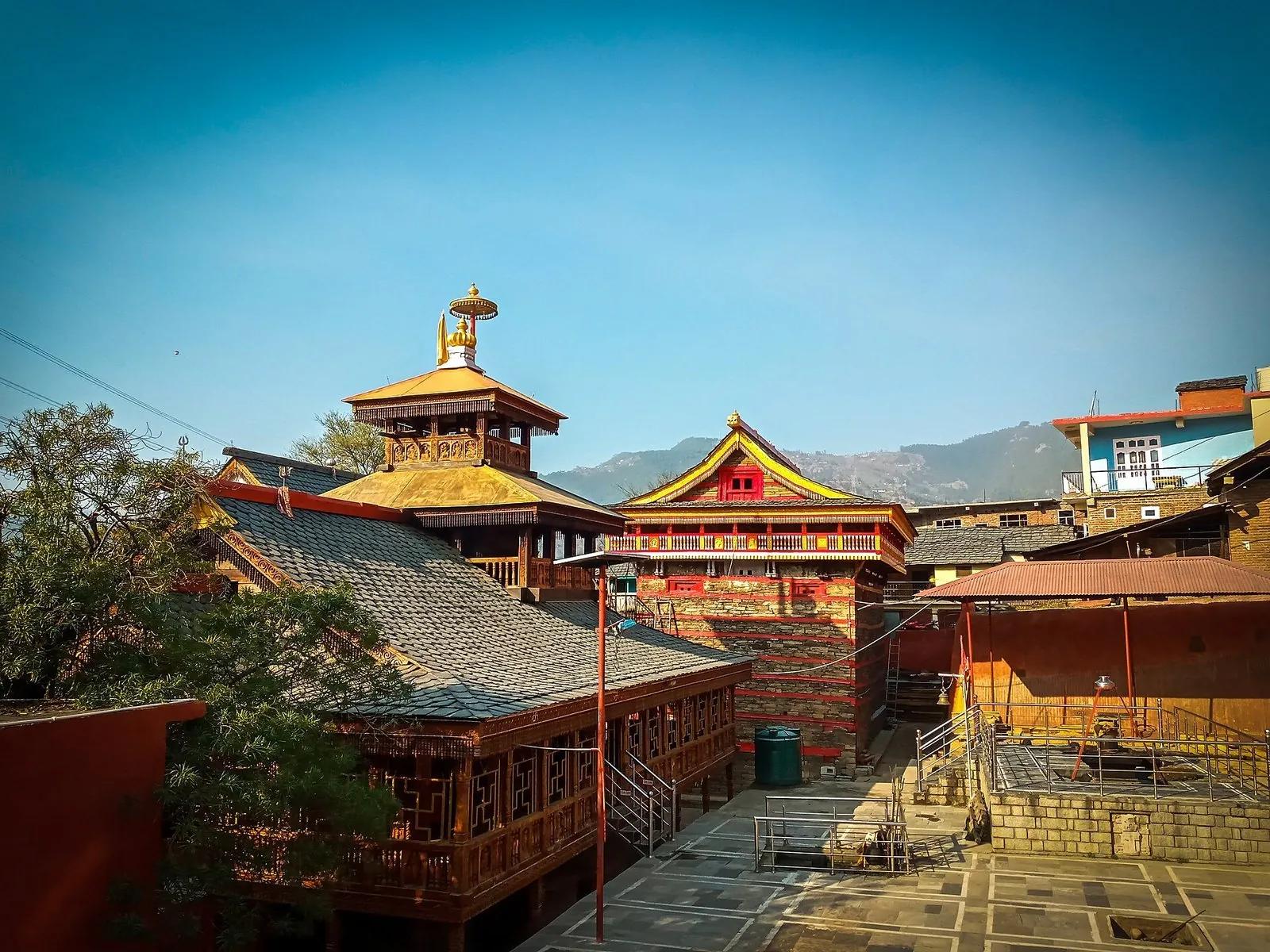
Mamleshwar Mahadev: The Eternal Flame Temple of Karsog
An eternal fire, a fist-sized wheat grain and a six-foot drum, kept in a mortar-less timber temple in the quiet Karsog valley. The honest story of Mamleshwar Mahadev: what is real, what is faith, and how to go.