
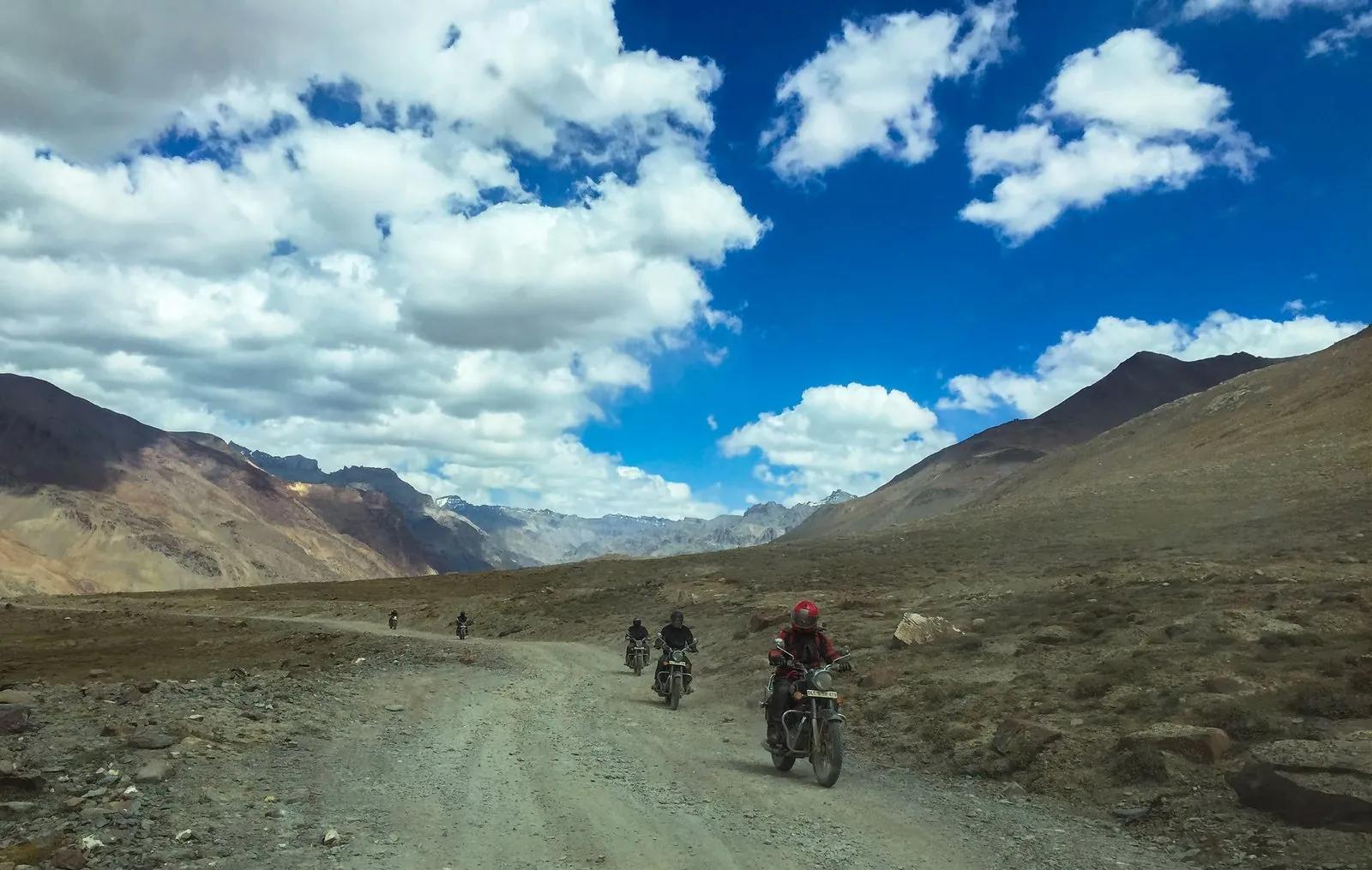
Spiti by Royal Enfield: The Complete Motorcycle Guide 2026
Kalpa sees the summer rider traffic peak in July, thirty or forty bikes a day, before the early snows thin the herd. Having lived here my entire life, I have learned to spot who will reach Kaza just by watching their gear shifts on the first steep pitch out of Reckong Peo. Riders who snap the clutch like a toggle switch usually stall out before Nako. Those who double-check their front brakes on the apple orchard road are the ones who make it. This guide is for that second group, and for anyone in the first group looking to join them.
It is also, honestly, a long argument for doing Spiti the way most bike rental shops in Manali will tell you not to do it: from the east. From Shimla, through Kinnaur, up the Sutlej, into Spiti through Sumdo, out through Kunzum and the tunnel. Twelve days. Thirteen if your body tells you to take one.
My own machine is a pre-owned 2019 Himalayan, the same one that has carried me through every Spiti loop since. My trusty machine has navigated the circuit four times now—once solo, twice in good company, and once with someone riding pillion. The Refuje team operates out of my cousin's small homestay in Kalpa whenever we are in Kinnaur. The advice collected here is essentially the same briefing we give friends who call us a fortnight before their departure, anxious about rental choices, packing lists, and whether the Gramphu to Batal stretch truly lives up to its reputation. To answer that: yes, it is that difficult, and yet, for the prepared rider, it is manageable.
- Best route
- Shimla in, Manali out (12 days, Kinnaur-first)
- Standard bike
- Royal Enfield Himalayan 411 or 450
- Manali rental range
- Rs 999 to Rs 2,500 a day by model (2026)
- Only fuel in Spiti
- Kaza. Carry at least a 5L metal jerry can.
- Permits for Indians
- None. Foreigners: PAP from SDM Reckong Peo or Kaza.
- Kunzum Pass
- Open mid-June to mid-October, weather-permitting
- Sumdo SADA fee
- Rs 500 per vehicle (added Feb 2026, Tribune)
- Rohtang permit (Manali side)
- Rs 550, books at 10 am for next day
- Absolute minimum days
- 8 (Manali-only loop, experienced riders)
- Total riding distance
- ~1,200 km for the full Shimla-Kinnaur-Spiti-Manali circuit
- Solo budget
- Rs 35,000 to Rs 55,000 for 12 days
- Mid-range budget
- Rs 55,000 to Rs 85,000 for 12 days
Which bike, actually
Crossing the bridge into Old Manali, you will find every rental shop pitching the same heavy iron: a Royal Enfield. In most cases, it is the right call. The Himalayan was built specifically for the terrain you are facing, and the 411 remains the local standard that every mechanic from here to Kaza can fix in their sleep. If you have the extra cash and a steady hand for clutch work, the newer 450 is a superior machine for the high passes.
If there is one machine I would urge you to avoid, it is the Royal Enfield Classic 350. Many Manali shops will steer novices toward it simply because their inventory is full and the price point is low. Resist that pitch. A Classic offers only 170 mm of clearance, whereas the Himalayan provides 220 mm. That marginal gap is precisely what prevents a river stone from shattering your exhaust pipe—a scenario you will face repeatedly on the gruelling Gramphu to Batal run. The Classic belongs on the smooth tarmac leading to Mandi; Spiti, however, is a different beast entirely.
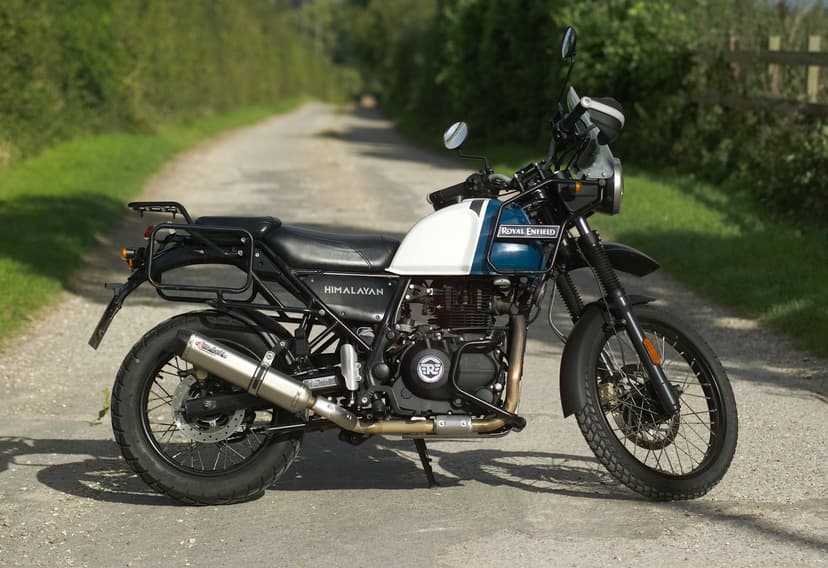
The standard issue for Spiti. Long-travel suspension, 220 mm ground clearance on the 411, a high-set exhaust that keeps working when water is over the footpegs, and an air-cooled engine every mechanic from Manali to Kaza has seen before. Photo (studio, not in Spiti): Wikimedia Commons, CC0.
Here is the four-way comparison that most Manali shops will not print for you.
| Himalayan 411 (the default) | Himalayan 450 (the best) | |
|---|---|---|
| Engine | 411cc air-cooled, carb or FI (later models) | 452cc liquid-cooled, fuel injection |
| Power at sea level | 24.3 bhp | 40 bhp |
| Weight | 199 kg | 196 kg |
| Fuel tank | 15 L | 17 L |
| Ground clearance | 220 mm | 200 mm |
| Seat height | 800 mm | 825 mm |
| Altitude handling | Good. Later FI models auto-adjust mixture. | Excellent. Liquid cooling compensates for thin air. |
| Rental (Manali, 2026) | Rs 1,500 to Rs 2,000 a day | Rs 2,000 to Rs 2,500 a day |
| Spare parts | Every mechanic carries them | Newer model, availability improving |
| Who it is for | First time or second time in Spiti. Shorter riders. Tight budget. | Experienced rider. Pillion. 12+ day trips. |
A comment from somebody who had ridden both, on r/indianbikes, captured the real difference well: "With the 411, it was very easy to climb mountains. With the 450, you will have to learn to use the clutch the right way." The 411 is forgiving. The 450 has more power but punishes bad clutch control on steep inclines. If you are not comfortable feathering a clutch at 10 per cent throttle on a loose 12 per cent gradient, take the 411.
Hero XPulse 200 is the dark horse for the solo, light, budget rider. It is 40 kg lighter than the Himalayan, which matters in water crossings and on tight switchbacks. Rental in Manali is Rs 800 to Rs 1,200 a day. The catch is the 13-litre fuel tank and the thin service network in the mountains. You will need to carry more fuel and more spares yourself. Pillion comfort is poor, so it is a solo bike only.
Rent in Manali or ride your own
If you live within a day or so of Manali and already own a bike with a working clutch, my honest advice is to ride your own. You already know how the throttle responds, what the brakes feel like on a long descent, what the bike sounds like when something is off. You save Rs 12,000 to Rs 30,000 in rental, and any small mods that make the bike more livable (a taller windscreen, a padded seat, better mirrors) stay on. The two real downsides: the Delhi-Manali leg adds about 500 km of plains riding at both ends of your trip; furthermore, should your machine falter near Nako, you are the sole mechanic on record, lacking the safety net of a rental shop's support staff only a message away.
Suppose you are flying into the Kullu-Manali airport or travelling through the Delhi Volvo. Three clusters in Manali have most of the bike rentals. Old Manali, across the bridge from Mall Road, is where most rentals are, and the bikes in those shops tend to be better looked after. Vashisht, a bit further up the valley, has a handful of solid shops wedged between the cafes & the third one is at Mall Road itself; my honest opinion, avoid the rentals on the Mall Road, the prices run 30 per cent higher than others at a five-minute distance, and the tourist markup shows that. For what it is worth, every shop I have seen friends walk away from happily has been in Old Manali or in Vashisht. Google reviews help: filter for the last 6 months, look for at least 50 ratings, and do not trust any rating below 4.3.
There is a brief inspection routine you must perform before signing any paperwork. While it may seem tedious, it is essential.
Perform a cold start and listen for a minute; tapping or ticking is usually normal, knocking is not.
Check both tyres for tread depth and sidewall cracks. On a rental, a bald or cracked tyre on the Gramphu stretch is not an adventure.
Squeeze the front brake lever. It should firm up halfway of it’s travel. Spongy means bleeding is overdue.
Kick the side stand up and hold the bike upright. Rock the handlebars side to side with the front brake pulled. Any clunking is worn head bearings.
Pull the clutch lever in. Look at the free play. It should be about 2 to 3 mm at the lever before engagement.
Check the chain tension. Mid-chain vertical play should be 20 to 30 mm. Looser than 40 is a problem.
Turn on the headlamp, indicators and horn; confirm everything works.
Ask for the rental agreement in writing. Rate, deposit, damage policy and return condition.
Photograph the bike from all eight angles in daylight before leaving the shop. Include every existing scratch, timestamped.
Never hand over your original passport or Aadhaar as a deposit. Offer a photocopy plus cash. A shop that insists on originals is a shop to walk away from.
Typical rental documents: driving licence (original plus two copies), PUC and RC (rental provides), insurance (rental provides, confirm third-party minimum), a Rs 2,000 to Rs 10,000 cash deposit refundable on return, and their WhatsApp number written on the agreement for breakdown calls. If the shop cannot produce a valid insurance certificate, their bike is uninsured, and you are personally liable for any damage or injury. Walk away.
Fuel, jerry cans, and the math that saves you
Here is the single most important paragraph in this guide: There is no fuel pump anywhere in Spiti except the one in Kaza. None. Tabo used to have a pump, but it has been inoperational for the last two years. The pump in Pooh is unreliable and only occasionally has stock; it is wiser to plan as if it were unavailable. From Reckong Peo to Kaza is 210 km. From Kaza through Kunzum and Batal back to the Atal Tunnel is about 160 km of the hardest riding on the loop. Avoid being the rider who has to push their bike for 40 kilometres because they ran out of fuel at Batal.
The fuel rule. Fill your tank at every pump, even at 70 per cent. Carry a 5 or 10 litre metal jerry can (can be bought in Kaza market for Rs 300 to Rs 500). Strap it to the pannier frame, not the handlebars. Before Kunzum, top off from the jerry can if your tank is below half.
At altitude, your engine loses efficiency. A Himalayan 411 that does 30 km/litre on the plains will do 25 km/litre above 3,500 metres and about 20 km/litre on the Gramphu to Batal stretch, where you are in the first and second gear for hours. 15 litres times 20 km/litre is 300 km. That looks comfortable. It is not, because you will most probably take a detour to Chandratal (80 km round trip off the main road), expect to lose your way at least once and spend more time than anticipated idling for photographs. At the slow speeds required for the Gramphu stretch, a 5 or 10 litre jerry can provides an essential 100-200 km safety margin. It represents the most affordable insurance you can get for the journey.
Petrol in Kaza is about Rs 105 to Rs 112 a litre in 2026, depending on the week. Budget Rs 6,000 to Rs 8,000 in fuel across the full 1,200 km circuit. Carry most of it as cash; the Kaza pump accepts UPI on the days the link is up, which is not every day.
Spares to carry, in priority order
The line from Vargis Khan is the one to remember: replace every cable on the bike before you leave, and carry the old cables as your emergency spares. That way, you ride on fresh cables, and your spare kit is zero extra cost. Works for both rental and own bikes.
| Category | Cost (₹) | Note |
|---|---|---|
| Clutch cable | 150-300 | CRITICAL. Number one failure on Spiti. Steep inclines + heavy clutch use. 100 g. |
| Accelerator cable | 100-250 | CRITICAL. Dead throttle = push the bike. 80 g. |
| Inner tubes x2 (front + rear) | 600-1,000 | CRITICAL. Tube puncture at Gramphu = stranded. 1 kg total. |
| Puncture kit + tyre levers | 200-400 | CRITICAL. 500 g. |
| Foot pump or mini compressor | 300-600 | CRITICAL. No point fixing a tube you cannot inflate. 800 g. |
| Spark plugs x2 | 100-200 | HIGH. Water crossings foul plugs. 5-minute swap. |
| Chain master links x3 | 50-100 | HIGH. Chain snap on rough road. |
| Brake pads (front, 1 set) | 200-400 | HIGH. Constant descent braking wears pads fast. |
| Fuses (assorted) | 50 | HIGH. 30-second fix for electrical failure. |
| Engine oil (500 ml) | 200-300 | MEDIUM. Top-up for leaks. |
| Air filter element | 150-300 | MEDIUM. Dust + altitude clogs faster. Never remove, only replace. |
| Total | 2,100-3,900 |
Total weight: about 3.5 kg. Total cost: Rs 2,100 to Rs 3,900. This is about one-third of one rental day, and it is the best insurance money you will spend.
One specific warning repeated on every serious bike prep blog, including Discover with Dheeraj: never remove your air filter. Some riders think taking the filter off helps the engine breathe at altitude. It lets dust and grit straight into the combustion chamber, and it will ruin your engine, possibly in a day. If the filter is clogged, replace it. Do not run without one.
The twelve-day route, from my side
The Shimla-first approach is not the shortest way to Spiti. It is the healthiest one. Altitude gain is gradual: Shimla at 2,200 m, Narkanda at 2,700, Sarahan at 2,165, Kalpa at 2,960, Nako at 3,662, Kaza at 3,800. By the time you hit Kaza, your body has had five days to acclimatise, which is why Indian riders from the east rarely get AMS and why Europeans who fly straight to Manali and bolt over Rohtang on day two frequently do.
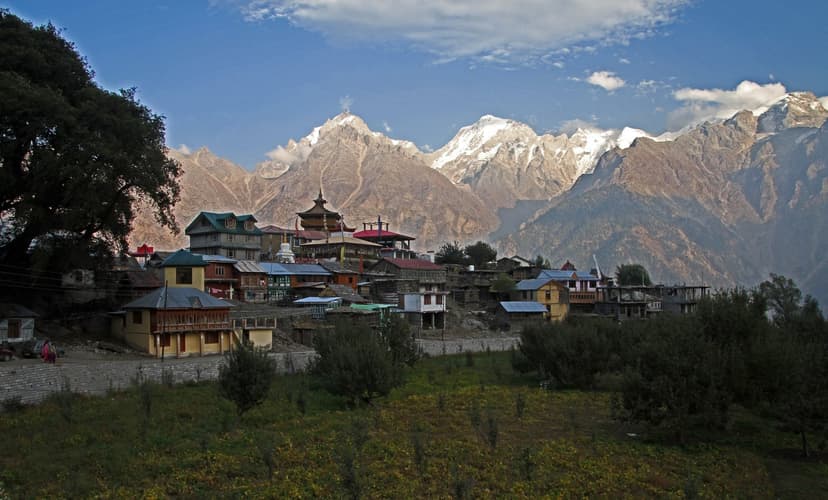
Kalpa in Kinnaur, the last green stop before the valley dries out and becomes Spiti. Kinner Kailash is 6,050 m, and the kind of mountain the deities are said to live on, not climbed, only circled. Photo: Gerd Eichmann via Wikimedia Commons, CC BY-SA 4.0.
- Day 1: Manali, arrive and collect the bike
Land in Bhuntar or reach Manali by bus. Pick up bike from Old Manali or Vashisht. Test ride 10 to 20 km. Buy missing gear. Full tank. Do not start the trip today. - Day 2: Manali to Narkanda via Shimla, 280 km, 8 hours
Down to Mandi, through Bilaspur, climb to Shimla bypass, and up NH-5 to Narkanda. Plains riding, nothing dramatic. Sleep at 2,700 m to start acclimatising. - Day 3: Narkanda to Sangla or Chitkul, 170 km, 7 hours
NH-5 to Rampur (fuel up), Jeori, Karcham, into the Baspa side valley. Chitkul is the last village on the Indian side before Tibet. - Day 4: Chitkul or Sangla to Kalpa, 60 km, 3 hours
Back down the Baspa, through Karcham, up to Kalpa at 2,960 m. Rest afternoon. Apple orchard walk. Kinner Kailash sunset from the viewpoint. - Day 5: Kalpa to Nako, 110 km, 5 hours
Reckong Peo (fuel, ATM, PAP if foreigner), then Pooh, Khab confluence, climb to Nako at 3,662 m. First real altitude night. Drink 4 litres of water. No alcohol. - Day 6: Nako to Tabo or Dhankar, 80 km, 4 hours
Cross Sumdo checkpoint (new Rs 500 SADA entry fee per vehicle since Feb 2026). Into Spiti. Tabo monastery is 1,029 years old and worth half a day. Dhankar perched on a cliff spur. - Day 7: Dhankar to Kaza, 35 km, 2 hours
Short easy ride. Arrive in Kaza by lunch. Full tank at the only pump in Spiti. Buy the jerry can. Rest afternoon. Laundry. Dhaba food. Do not ride further today. - Day 8: Kaza rest and Key-Kibber-Chicham loop, 60 km, 4 hours
Mandatory acclimatisation day at 3,800 m before going higher. Morning: Key Monastery. Lunch: Kibber village. Afternoon: Chicham Bridge. Back to Kaza to sleep. - Day 9: Langza, Hikkim, Komic loop from Kaza, 50 km, 4 hours
Langza fossils and the Buddha. Hikkim post office (worlds highest, postcards Rs 25 in 2026). Komic at 4,587 m and a cafe that claims the same title. Return to Kaza. - Day 10: Kaza to Chandratal, 80 km, 5 hours
Fill fuel, top the jerry can. Over Kunzum La at 4,590 m (circumambulate the Mata temple, single clockwise lap). Descend to Batal. Up to Chandratal campsite. Night in tent at 4,300 m. - Day 11: Chandratal to Manali, 120 km, 7 hours
Down through Gramphu to Batal (the worst stretch, start by 6 am, water crossings shallower before sun). Through Atal Tunnel. Into Manali by afternoon. Fuel at Keylong or Sissu if needed. - Day 12: Buffer day in Manali
Bike return, deposit refund, long shower, actual sleep at 2,050 m where oxygen works normally. Fly out tomorrow, not today.
Altitude and your engine
At sea level, the oxygen is at 100 per cent by convention; Manali is about 80 per cent. Kaza, at 3,800 m, is around 63 per cent. By the time you are crossing Kunzum at 4,590m, you are down to 57 per cent, and your engine feels it the same way your lungs do. Fuel burns with oxygen. Less oxygen, less burn. Expect roughly 15 to 18 per cent of your power to disappear at Kaza, and 20 to 25 per cent at the pass. You will notice it first on a cold start uphill, then on every overtake.
Liquid-cooled engines, which on a rental Spiti bike means the Himalayan 450, handle this better than air-cooled ones. Thin air cools a metal fin less effectively, so the air-cooled 411 and the Classic 350 tend to run hotter than you would like above 4,000 metres. Fuel-injection bikes sort the fuel-air mix automatically as the air gets thinner; carbureted bikes do not. If you are on an older carb-fed Himalayan, it is worth asking your mechanic about altitude jetting before you leave. Most trips, though, the stock settings cope.
Your actual riding adjustments are simpler than the engineering. Downshift one gear earlier than you would on the plains and keep the revs up. Cap the hard days at 80 to 120 kilometres. Warm the engine for 5 minutes before the first ride of the morning, not ten seconds. Stop every hour, kill the engine, and give your body and the bike a breather. 4 litres of water a day, minimum, which sounds like a lot until you realise that at altitude you lose most of your water through your breath rather than your skin. And a line I heard repeated on a Reddit thread last season: "Some Einstein will suggest Old Monk to keep warm. Do not listen." Alcohol up here is how a mild headache becomes a hospital visit in Kaza.
Gramphu to Batal, and the ten-step water crossing
During the peak riding months, my WhatsApp inbox fills with shaky captures of this specific road, almost always accompanied by a hesitant query asking if such conditions are to be expected. Between Gramphu at 3,050 m and Batal at 4,000 m, only about a fifth of the 65 km is paved. The rest is loose rock, gravel, slush and sand, stitched together by thirty to forty small water crossings in July and August, where glacier melt runs across the road before it runs down the mountain. In some places, the track is a single file with a 500 m drop on one side. In other places, you will pass BRO boards warning of shooting stones. Those boards mean rockfall from the slope above, and they are not a suggestion. Do not stop, I repeat, do not stop in a shooting-stone zone for a photograph, a chai break, or anything else. Ride through and stop on the other side.
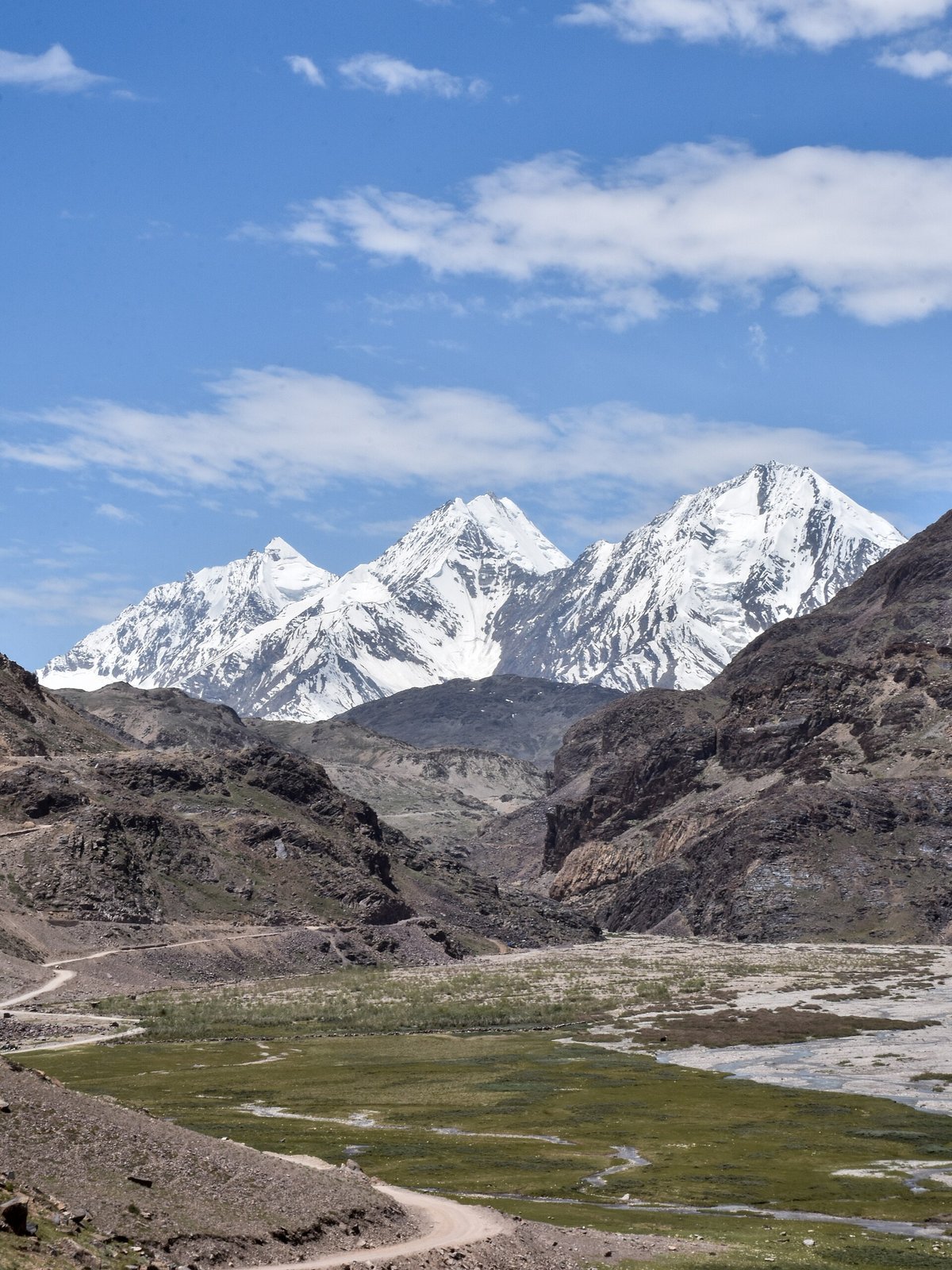
The Losar to Kunzum stretch. This is what most of the hard riding in Spiti looks like: loose gravel, no shoulder, one lane, and in the distance, something white that is either snow or cloud and either way means you should be wearing an extra layer. Photo: Gerd Eichmann via Wikimedia Commons, CC BY-SA 4.0.
Budget 5 to 7 hours to cover 65 km on a bike. Yes, 10 kilometres an hour, and it is not pessimism. That is the average across dozens of trip reports. Start by 6 am at the latest. Glacier meltwater crossings are shallow in the early morning and rise throughout the day. An ankle-deep stream at 6 am is a knee-deep stream at noon. The difference between rideable and the impossible is often two hours of sunlight.
The water crossing, in ten steps.
Stop before the stream and walk the crossing. Use a stick to test depth if unsure.
Water at or below footpeg level is generally safe. Water above the exhaust is not.
First gear, steady low throttle. Stalling mid-stream is the number one failure.
Aim slightly upstream to counter the sideways current.
Keep both feet on the pegs. Dragging a foot invites a rock to catch your boot.
Do not stop. Momentum is your friend. Steady is better than fast.
If the engine dies, push the bike to the far bank. Do not try to restart it in the water.
On the other side, pump the brake lever a few times to dry the pads.
Inspect the chain after two or three crossings and lubricate if visibly dry.
Wear gumboots for the forty crossings to come. Rs 300 a pair at Kaza market. Saves your riding boots from six hours of ice water.
Mechanics along the route
Manali is the last place with real mechanical depth. There is an authorised Royal Enfield service centre, plus three or four independent shops in Old Manali and Vashisht that can strip a Himalayan blindfolded. Get the bike fully serviced the day before you ride out, not the day of. Through Rampur and Reckong Peo, down the line, have basic mechanics who can change a tube, swap a cable, pull out a spark plug, or clean a carburettor. For any repairs more complex, local mechanics will give it to you straight: you are looking at a trip back down to Shimla.
Kaza has, by my last count, one or two RE-literate mechanics near the HPTDC circle in the small main bazaar. They are good, but they are also the only game in town during riding season, which means every broken-down biker on the loop ends up in the same small courtyard. Half a day of waiting is normal. Their parts shelves carry the usual cables, tubes, spark plugs & a few sets of brake pads. Anything more specific gets ordered up from Shimla and takes a clear two days minimum, longer if a landslide closes the road in between.
Between towns, there is nothing. No wonder, either; half of these stretches do not have network reception, let alone a workshop. You are the mechanic. Before your departure, the absolute baseline of preparation is spending thirty minutes at a local roadside puncture shop. Watch somebody change a tube. Try & inquire about your doubts. The whole skill fits in your hands in one session, and it has saved more trips near Nako than I can count.
Solo, group of three to six, or guided
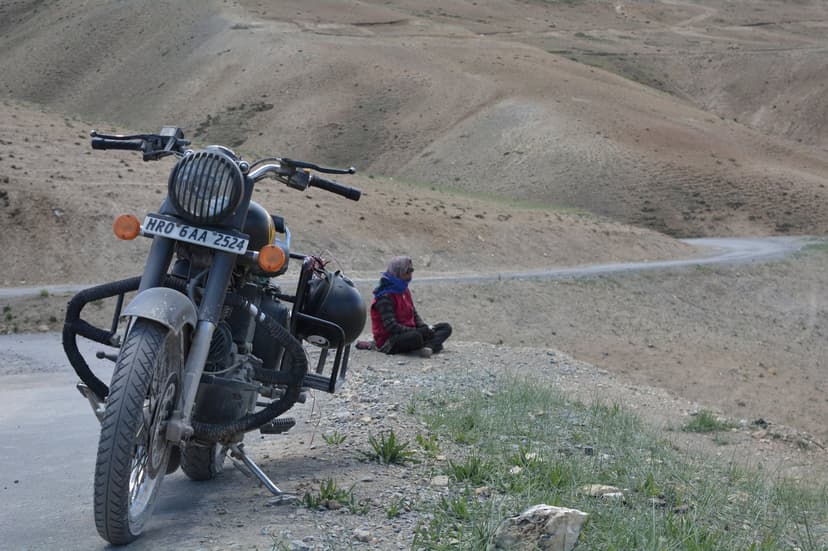
Solo. The stretch between two villages where you park, sit, and let the altitude catch up with your breathing before you do anything else. No signal, no traffic, no hurry. Photo: Wikimedia Commons, CC BY-SA 4.0.
| Solo or group of 3 to 6 | Guided tour operator | |
|---|---|---|
| Cost (12 days) | Rs 35,000 to 55,000 solo. Rs 30,000 to 45,000 per person if in a group. | Rs 25,000 to 45,000 per person, all-inclusive package |
| Pace | Your own. Change plans daily. | Fixed itinerary. |
| Safety | Solo is highest risk. Group of 3 to 6 is much safer through buddy system. | Safest. Mechanic + backup vehicle. |
| Breakdown help | You fix it, or a friend does, or you wait for a passing vehicle. | Mechanic on standby. |
| Experience | Most immersive. Meet locals. Deep solitude. | Curated. Less spontaneous interaction. |
| Gear sharing | Group can share tools + jerry can + spare parts. | Provided. |
| Who it suits | Experienced riders with basic mechanic skills. | First time mountain riders with no mechanical knowledge. |
A group of three to six is the best balance of freedom and safety. Solo is doable for experienced riders with basic mechanical skills and a complete spares kit. A guided tour (Himalayan Heroes, Riders Motorcycle Tour, The Dream Riders Group, Spiti Riders) is fine for first-time mountain riders who do not want to think about logistics. The tradeoff is that you give up spontaneity.
If you are going as a group, the rules are simple. Slowest rider leads, most experienced rider sweeps. Three bike-lengths of spacing for dust visibility. Agreed hand signals for stops and hazards. Headcount at every fuel stop. Share the jerry can fuel across bikes on the Kaza to Manali leg. Carry a walkie-talkie set. Phones have no signal for most of the route.
Papers, permits, insurance
Indian citizens do not need a permit for Spiti. You carry a driving licence (original plus two photocopies), RC and insurance (the rental shop provides for rentals), PUC, and a government photo ID (Aadhaar original). The Lahaul-Spiti district administration site has the current rules if you want to double-check. For the Manali side of the loop, you also need the Rohtang permit (Rs 550 at rohtangpermits.hp.gov.in, sells out in minutes at 10 am for the next day, closed Tuesdays) if you want to ride the old pass. If you are taking the Atal Tunnel instead (9.02 km, opened October 2020), you do not need the Rohtang permit. Register your vehicle at eaagman.hp.gov.in before entering Lahaul-Spiti. It is free but required, and the print confirmation gets checked at the Atal Tunnel entrance.
Foreign nationals need a Protected Area Permit. The fastest place to get it is the SDM office in Reckong Peo (Rs 250 to Rs 400, same day, passport plus visa plus two photos). The SDM office in Kaza also issues it if you are approaching from the Manali side. Carry photocopies.
For insurance, the third-party cover that comes with the bike is the legal minimum. It covers damage to others, not to you or the bike. Comprehensive insurance covers your own bike. On a Spiti trip, small scratches and drops are near-certain; comprehensive insurance is worth the extra Rs 500 to Rs 1,500. Personal accident insurance (Rs 500 to Rs 1,000 for a fifteen-day policy) covers hospital bills if you crash. Take it.
One more: Photograph the bike from eight angles in daylight before leaving the rental shop, timestamped on your phone. If a rental shop later tries to bill you for a pre-existing scratch, the timestamp wins that argument every time.
What to pack on the bike
Packing a bike for Spiti is about two things: temperature range and water. In Manali, the month of July will get you sweating even in 20 °C. By midnight at Chandratal camp, you are at 0 °C. On a water crossing, you are mostly going to get wet to the waist. Your gear must effectively bridge this massive thermal and technical gap.
When it comes to gear, your safety setup is the one area where I simply won't permit a friend to compromise before heading out into the valley. Full-face helmet, ideally your own, because rental helmets have seen monsoons and every rider’s sweat. Armoured riding jacket with CE-certified plates at the elbows, shoulders and back and a waterproof outer shell. Two pairs of gloves so you can rotate the wet pair onto the tank to dry while you ride the other. At least ankle-high waterproof riding boots. Armoured riding pants. A full rain suit that goes over the whole riding kit when the monsoon hits the approach roads. A pair of standard-issue gumboots for water crossings, which I will keep recommending for every rider on this route. A balaclava for the wind on the passes. If any two items deserve your money, it is the jacket and the pants.
The bike itself needs a few accessories. Four to six bungee cords for tying things down, five metres of nylon rope that becomes a tow strap when you need it to be, a tank bag within reach for phone, cash and snacks, saddlebags or a tail bag of forty to sixty litres total, the 5 L jerry can, dry bags for anything that must not get wet, a phone mount with a vibration dampener because modern phone cameras hate a Himalayan at idle, and a 12V USB charger that runs off the battery so your phone still works at Chandratal.
For yourself, a thermal base layer top and bottom, a down jacket or a thick fleece, SPF 50 sunscreen because UV up here is serious, UV400 polarised sunglasses, lip balm with SPF, a 20,000 mAh power bank minimum, a BSNL SIM card bought before you leave Manali or Shimla as BSNL provides better network coverage than others in Spiti, offline maps for the whole region downloaded before you leave wi-fi, at least 15 to 20 thousand rupees in cash, a small first-aid kit, a headlamp for when the power cuts, and a paper or notepad with your route notes and emergency numbers in case the phone dies entirely.
AMS(Acute Mountain Sickness) protocol: Diamox is the standard prophylactic. Ask a doctor before the trip; do not just pick it up at a pharmacy. The usual pattern is to start the day before you cross 3000 m and continue for a day after you come back down. The side effects you will notice are tingly fingers and the need to pee more often. Neither is dangerous, and both of these sensations go away when you stop the course.
What it actually costs
These are 2026 numbers, pieced together through information from a handful of riders I have hosted in Kalpa in the last 18 months and from my own trip in August. The range provided in the table below is real and depends on a few factors: which bike, homestay or guesthouse, dhaba or restaurant, and whether you actually do the Chandratal camping night (one night, Rs 1,500 to Rs 5,000 depending on operator) or ride straight through to Batal.
| Category | Cost (₹) | Note |
|---|---|---|
| Bike rental, 12 days | 12,000-30,000 | Himalayan 411 at Rs 1,500/day = Rs 18,000. Himalayan 450 at Rs 2,500/day = Rs 30,000. |
| Fuel (1,200 km circuit) | 5,000-8,000 | ~50 L at Rs 100-112/L. More if you detour Chandratal. |
| Jerry can + top-up | 800-1,200 | Rs 300-500 for the can, Rs 500-700 for 5-10 L top-up fuel. |
| Accommodation, 11 nights | 6,000-24,000 | Homestays Rs 500-1,000/night vs guesthouses Rs 1,200-2,000. |
| Food, 12 days | 4,800-12,000 | Dhabas Rs 400-600/day vs restaurants Rs 600-1,000/day. |
| Permits | 550-1,050 | Rohtang Rs 550 (if riding the old pass). Sumdo Rs 500. E-Aagman free. PAP extra for foreigners. |
| Spares + contingency repairs | 2,000-4,000 | Punctures, cable swaps, chain adjustment. |
| Chandratal camping (1 night) | 1,500-5,000 | Swiss tent with meals. Skip if on tight budget. |
| Monastery donations, tips, postcards | 1,000-3,000 | Rs 50-200 per monastery. Rs 25 per postcard at Hikkim. |
| Bike return cleaning + deposit misc | 200-500 | Most rental shops expect the bike washed. |
| Total | 33,850-88,750 |
The costs riders always forget to budget for are the small ones that add up. Monastery donations, 50 to 200 rupees each and at five monasteries, which can go up to Rs 250 to 1,000. Bike wash on return, because most rental shops expect the bike to come back visibly clean, another Rs 200 to 500. And an unplanned extra night somewhere because the weather turned or a tube gave up, comfortably Rs 1,000 to 2,500 by the time you have eaten and slept. Add two to three thousand rupees to either tier as a realistic buffer.
I would like to mention a few tips to budget better. Rent the 411 rather than the 450, and you have already saved about twelve thousand rupees over the duration of twelve days. Stay in homestays where you can, not because they are cheap (they are), but because the food is better than almost any Spiti restaurant; Rs 800 to 1,200 a night usually includes dinner, which you’ll tell your friends and family about. Eat at dhabas; Rs 150 to 200 a meal, portions meant for truck drivers, and the Kinnauri thali at the small dhaba in Reckong Peo is, frankly, better than the tourist buffets. Travel in late September rather than in July; rates drop, roads have stopped sliding, and the light is better for photography. Bringing your own bike saves the whole rental line but adds about three thousand rupees of Delhi-Manali fuel and a good amount of wear on your own suspension.
Ready to ride?
If you want Refuje to book a homestay in Kalpa, a guide in Kaza, or a tent at Chandratal, connect with me at hello@refuje.com with your rough dates and the bike choice. Two local families in Kalpa and a family in Kaza run homestays I can vouch for personally. The Chandratal camp we are working with shuts down at 8 pm and lets the stars take over. Tell us about what kind of experience you want.
The ten commandments of Spiti motorcycle riding
"NEVER DRIVE AT NIGHT. Do not be impatient with roads and time. Make small targets. Always remember you are on a trip for enjoyment." Top voted comment, r/SoloTravel_India thread on Spiti motorcycle
Never ride after dark. No street lights, no markings, unfenced cliffs, loose gravel, almost invisible with headlamps turned on.
Start by 6 am every riding day. Water crossings are shallowest before the glaciers wake up.
80 to 120 km a day maximum. This is not a highway.
Mandatory rest day in Kaza before going higher. No exceptions.
Four litres of water a day, minimum. Dehydration mimics AMS.
Zero alcohol above 3,000 m. "Some Einstein will suggest Old Monk to keep warm. Do not listen."
Top up fuel at every pump, even at 70 per cent.
Horn before every blind turn. Trucks use the full width.
Never overtake on blind curves. Five minutes of patience beats a five-hundred-metre fall.
If it feels wrong, stop. Your gut is right more often than your ambition.
Frequently asked
Which bike is best for Spiti Valley?
Royal Enfield Himalayan 411 or 450. The 411 is the default: every mechanic from Manali to Kaza knows it, parts are easy. The 450 has better altitude performance because it is liquid-cooled and has more power, but it needs proper clutch technique. Hero XPulse 200 is a budget alternative for solo lighter riders. Avoid the Classic 350 for Spiti: ground clearance is too low for the Gramphu to Batal stretch.
What does it cost to rent a bike in Manali for Spiti in 2026?
Royal Enfield Himalayan 411: Rs 1,500 to 2,000 a day. Himalayan 450: Rs 2,000 to 2,500. Classic 350: Rs 999 to 1,500. Hero XPulse: Rs 800 to 1,200. Security deposit: Rs 2,000 to 10,000 cash (never hand over originals of your passport or Aadhaar). 12-day rental total: Rs 12,000 to Rs 30,000.
What spare parts should I carry?
Critical: clutch cable, accelerator cable, two inner tubes, puncture repair kit, foot pump. High priority: spark plugs, chain master links, brake pads, fuses. Also 500 ml engine oil. Total weight about 3.5 kg, total cost Rs 2,100 to Rs 3,900. The trick is to replace every cable before the trip and carry the old cables as spares. You ride on fresh, you carry used as backup, zero extra cost.
Where are the fuel pumps on the Spiti circuit?
Shimla, Rampur, Reckong Peo, occasionally Pooh, and Kaza. That is it. Kaza is the only fuel pump inside Spiti. From Kaza through Kunzum to the Atal Tunnel is about 200 km with no fuel. Carry a 5-litre metal jerry can. Top up at every pump even at 70 per cent.
Are there mechanics on the Spiti route?
Yes, in Manali (RE authorised service centre and independents), Rampur, Reckong Peo, and Kaza (one or two capable shops near HPTDC circle). Between towns: nothing. Learn basic tube change, cable replacement, spark plug swap, and chain adjustment before you go. Thirty minutes at a roadside puncture shop at home is enough.
How does altitude affect engine performance?
Less oxygen means less combustion. Expect 15 to 18 per cent power loss at Kaza (3,800 m) and 20 to 25 per cent at Kunzum (4,590 m). Fuel efficiency drops 20 per cent on average. Liquid-cooled engines (Himalayan 450) handle altitude better than air-cooled. Ride in one gear lower than you would on plains, keep daily distance to 80 to 120 km, and warm the engine up for five minutes before the first ride of the day.
How do I cross water streams on a motorcycle in Spiti?
Stop and walk the crossing first. Water below the footpeg is usually rideable; water above the exhaust is not. First gear, steady throttle, feet on the pegs (not dragging), aim slightly upstream. Do not stop mid-stream. If the engine dies, push to the far bank before trying to restart. Carry gumboots; you will do this 30 to 40 times on the Gramphu to Batal stretch. Start that stretch by 6 am before glaciers melt.
Can I do Spiti solo on a motorcycle?
Yes, experienced mountain riders do it. You need basic mechanic skills, a full spares kit, and the discipline to stop when you are tired. For first-timers, a group of three to six bikes is better: mutual help, shared jerry can fuel, and a buddy system for breakdowns.
What is the best time for a Spiti bike trip?
Mid-July to mid-September is the sweet spot. Both routes (Shimla and Manali) are open, weather is stable, Spiti is in its rain shadow so it stays dry even during mainland monsoon, and temperatures are ridable. June is marginal (Kunzum may not be fully open until mid-June). October is fine for the Kinnaur side but Kunzum starts closing by mid-October, so the loop shrinks to Kinnaur in-and-out.
How many days do I need for a Spiti bike trip?
Twelve days for the full Shimla-Kinnaur-Spiti-Manali circuit at comfortable motorcycle pace. Eight for a Manali-only in-and-out loop, experienced riders only. Include one mandatory rest day in Kaza for acclimatisation and one buffer day for weather, breakdowns, or simply wanting another night somewhere.
Is the Gramphu to Batal road really that bad?
Yes. 65 km, 80 per cent unpaved, up to 40 water crossings in July and August, five to seven hours by motorcycle. It is the hardest stretch on the entire loop. Start by 6 am when stream levels are lowest, carry gumboots, and leave plenty of buffer before sunset on the day you ride it.
Do I really need insurance for a Spiti bike trip?
Third-party insurance is legally mandatory and the rental includes it. Comprehensive is strongly recommended because small drops and scratches are almost certain. Add a personal accident policy (Rs 500 to Rs 1,000 for 15 days) that covers hospital costs if you crash. Photograph the bike from eight angles before leaving the shop so a pre-existing scratch does not turn into a deposit fight when you return.
One last thing from Kalpa
The riders I end up thinking about long after the season is over are almost never the ones with the fancy bikes. They are the ones who stopped at my cousin's homestay because a Kinnauri uncle in the Kalpa market sent them. The ones who spent a full hour sitting on the orchard wall doing absolutely nothing, just looking at the ridge. The ones who called me a week later, on their way back south, to say they had rushed Day 4 and wished they had not. Spiti on a motorcycle is only a fast trip if you choose to make it one. Slow it down by one day. Eat at the dhaba where the driver with dust on his jacket is already eating. Sleep at the homestay where somebody else cooks your dinner. Accept, early and without resentment, that the mountain does not care about your itinerary.
If there is anything I can help you plan, I am at hello@refuje.com. Good luck. Ride slow. Ride safe.
About Ajay Negi
Ajay Negi is a co-founder of Refuje and a Kinnauri native. He grew up in Kalpa and writes about Kinnaur, the Sutlej corridor, and the eastern approach to Spiti. He has ridden the Spiti loop four times on his own Himalayan.
You Might Also Like
Snow Leopard Expedition in Spiti: Tracking Kibber's Ghost Cat
What a winter snow-leopard tracking trip to Kibber, Spiti is really like: honest sighting odds, the cost ladder, the conservation that funds it, the Kinnaur winter route, and how to view the cat without harming it.
Chandratal Lake 2026: A Kinnauri Guide to the Eastern Approach
Chandratal opens late May to mid-June 2026. Lakeside camping is banned, the lake is a Ramsar wetland. Swiss tents Rs 1,200 to 2,500. The Kaza side via Kunzum beats a Manali day trip on every count except distance from Delhi.
The Atal Tunnel: How One Tunnel Changed Lahaul Forever
Six hundred and twenty-two percent. That is what the Atal Tunnel did to tourism in Lahaul Valley. Before October 2020, Lahaul was six hours from Kullu and cut off six months a year. After October 2020, it became 45 minutes. A before-and-after of what one tunnel did to one valley, told by a Kullu local who has been driving through the portal since the month it opened.