
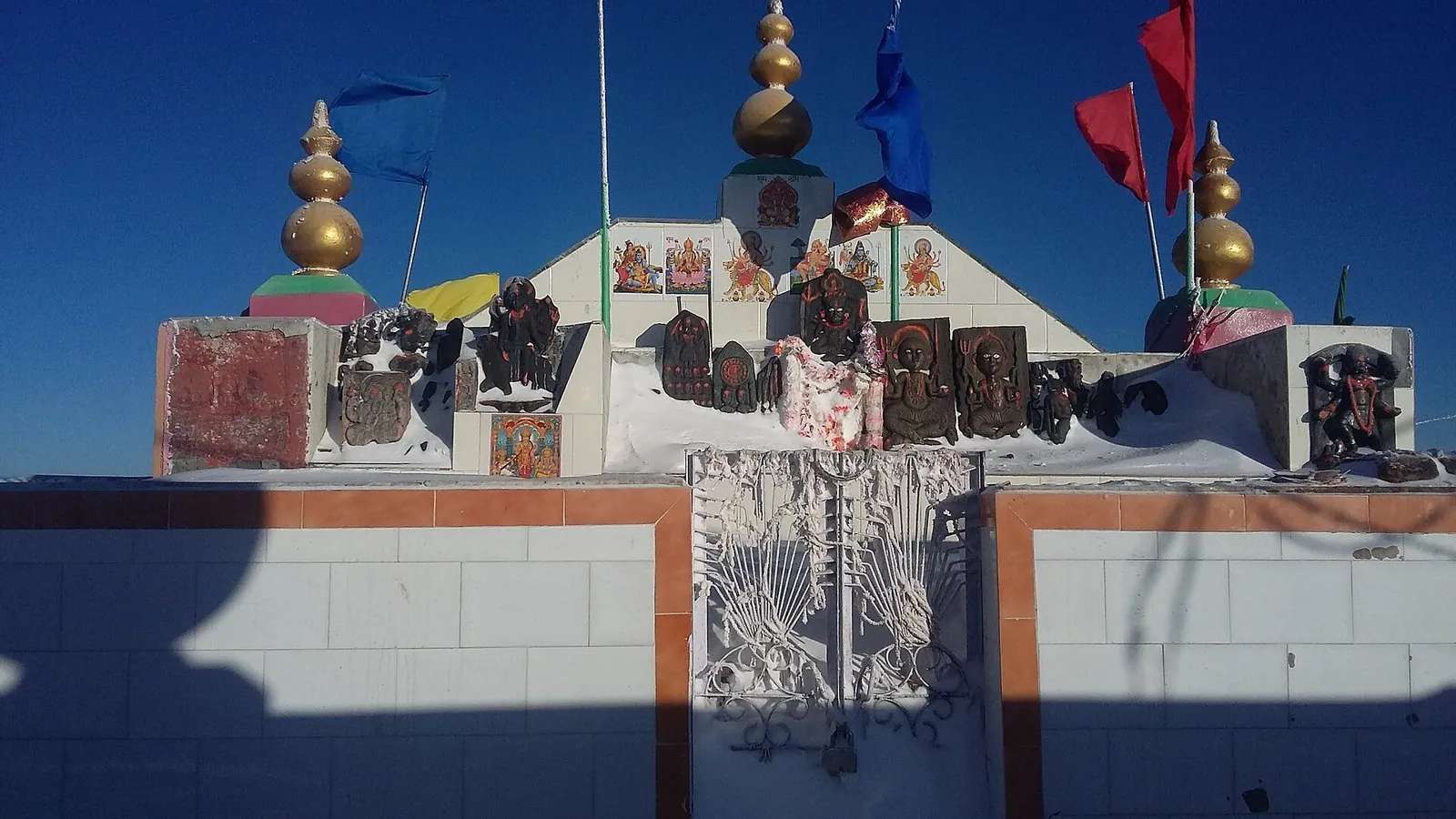
Shikari Devi: The Roofless Temple Where Snow Wont Settle
The roof keeps falling.
That is the story, at its bluntest. Shikari Devi temple sits on the highest peak in Mandi district, at 3,359 metres, in a snow-starred wildlife sanctuary of 7,200 hectares. It has no roof. Former chief minister Virbhadra Singh, who ran Himachal six different times, ordered one built. It came down. Someone tried again. It came down again. Every attempt, across centuries and across political eras, has ended the same way. Storms arrive, beams snap, stones roll off, and the shrine goes back to its open sky.
Meanwhile the snow, which reaches eight to ten feet around the ridge in winter, does not settle on the idol or inside the temple walls. The Government of Himachal Pradesh states this on its own Mandi district tourism page. Not as legend. As observed fact.
I am Kinnauri. My home shrines are on the other side of the Sutlej, at Sarahan and Chhitkul, places where Bhimakali and Mata Mathi still get carried through the streets once a year. So Shikari Devi is not my territory. What follows is not a personal trip report. It is what a Kinnauri researcher can piece together about a Mandi shrine from the Himachal government site, the Wikipedia record, the Hindi press, the Reddit trekkers who have walked every side of the ridge, and what a priest said to Amar Ujala on April 8 this year, when three fresh feet of snow meant he could not get through the temple gate and had to burn dhoop at the wall.
Shikari Devi at a glance
- Altitude: 3,359 m (11,020 ft) per HP Govt; 3,332.6 m per Wikipedia
- Coordinates: 31.4787° N, 77.1656° E
- District: Mandi, Seraj Valley
- Nearest base: Janjheli (18 km by jeepable forest road)
- Final climb: 550 to 700 stone steps
- Entry fee: Free
- Open window: Late March (Chaitra Navratri) to November 15
- Best months: April to June, September to October
- Sanctuary: Shikari Devi Wildlife Sanctuary, 7,200 ha (est. 1962)
- Nearest airport: Bhuntar (KUU), 118 km
- Nearest rail: Jogindernagar narrow gauge, 152 km
Three mysteries, zero explanations
Most write-ups stop at one mystery. There are actually three, and they stack on top of each other.
One. Every roof fails. Local accounts, echoed in The Statesman and in Hindi outlets like ETV Bharat, are consistent: the moment anyone builds a cover over the sanctum, weather takes it down. Virbhadra Singh is the most recent named attempt, but older rounds of construction, attributed variously to rulers and devotees, went the same way. The Hindi phrasing is sharper than the English: माता ईंट-पत्थर से बनी छत को स्वीकार नहीं करतीं. The Mata does not accept a brick-and-stone roof.
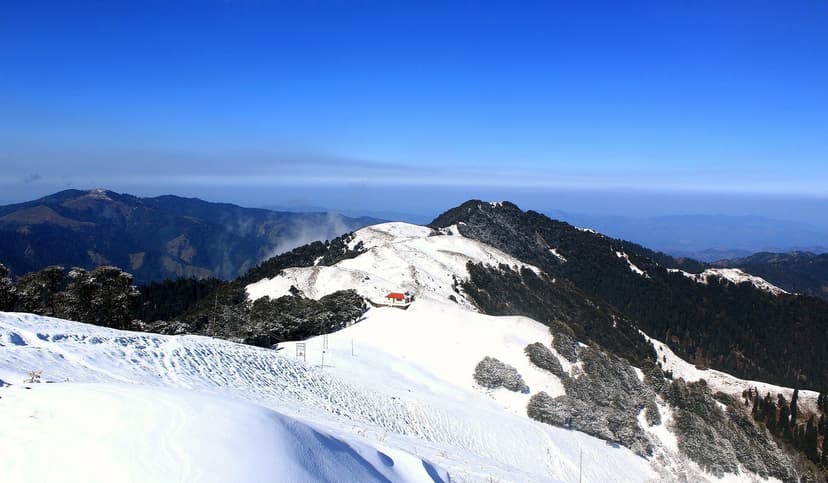
Two. Snow does not settle on the shrine. The sanctuary around the peak gets buried every winter. Trees snap, the road closes, the priest stops coming. Yet the idol, the flagstones inside the shrine, and the boundary platform stay clear. This is the part that sits on the HP Government site in plain English: "despite the fact that temple has no roof, no snow is spotted in temple premises during winters when the entire region around this temple is covered upto several feet by snow." No scientist has put a name to what is happening. No peer-reviewed paper exists. IIT Mandi, the nearest research university at roughly 90 km, has not published on it.
Three. The weather on the peak is its own animal. Sudden squalls, crosswinds that change direction without warning, spring snowfall that refuses to melt. Amar Ujala ran a piece on April 8, 2026 about three fresh feet of snow on the shrine at a point in the season when April snow usually lapses in a week. The priest, the paper reported, could not open the temple gate. He burned dhoop outside and salaamed from the wall.
English writing treats all three as a problem to solve. Hindi devotional writing treats them as a preference the goddess has expressed. Both framings sit comfortably together if you let them. The shrine does not need to be solved.
Pandavas, a deer that vanished, and a sage who stayed too long
There are two origin stories, and good Hindi sources carry both.
The first is Pandava. During their thirteen-year exile, the Mahabharata has them moving through hill country in disguise. This stretch, the agyatvas, generates shrines across the western Himalayas. Kinnaur has them. Mandi has them. Jammu has them. At Shikari, the version told by Punjab Kesari and Bhaktvatsal goes: Arjuna saw a strange deer while hunting in these forests. He shot and missed. The deer vanished. The brothers prayed, and Durga appeared as Shikari Devi, the Goddess of Hunters, and asked to be set up on this ridge, roofless, under the sky. They installed a stone idol and left. Since then, every attempt to add a roof has been refused.
The second is Sage Markandeya. Hindi outlets credit him with long penance on this peak, and the Markandeya Purana is sometimes named as a textual link. In that version the goddess appears to the sage after years of meditation and tells him the shape of the shrine. The Pandava and Markandeya accounts do not contradict each other; they sit in parallel the way two river guides can both be correct about the same confluence from different banks.
One feature that gets buried in English retellings and surfaces in Hindi is the presence of the 64 Yoginis alongside the main idol. That is a Shakta tantric set, not a generic Durga fitting. Shikari is not only a hill-temple version of Durga. It is a 64-Yogini pitha, which puts it in a smaller and older family of Shakti shrines across India. That detail changes what the roofless-ness means. The 64 Yoginis are traditionally housed in open hypaethral temples, the same way Hirapur in Odisha and Ranipur-Jharial in western Odisha keep their circles open to the sky. It is possible, though no one states it outright, that the roof is refused because the form is by design open. The goddess does not need solving. She was never meant to be enclosed.
The CM, the roof, and the limits of power
The Virbhadra Singh story is told casually in Mandi, more carefully in The Statesman, and with quiet amusement in the Hindi press. Singh was chief minister six times between 1983 and his death in 2021. He was a Rampur-Bushahr royal on his father's side, a politician on his own merit, and a devotee. He ordered a roof built at Shikari Devi. The roof collapsed during construction. He ordered another attempt. That one also came down. Local memory has it that after the second failure he stopped trying and started coming as a pilgrim instead.
No Hindi or English source gives me a specific year for either attempt. I have chosen not to invent one. What we have is the pattern: the most powerful politician in Himachal for four decades could not keep a roof up on this shrine. That is the story. Dates can wait until district archives give them up.
How to get there, honestly
The forest road up to Shikari Devi is not a road you drive yourself. TripAdvisor reviews are blunt on this point: "the road uphill is so bad that only experienced cab drivers of the area should drive it." Every Reddit thread I read says the same thing in other words. Hire a jeep at the Janjheli stand.
There are four sensible ways to reach the peak.
Approach options
| From | Distance | Time | Notes |
|---|---|---|---|
| Janjheli | 18 km | 1.5 h jeep + 30-45 min stairs | Best base. Direct. |
| Karsog / Sanarli | 21 km | ~2 h jeep + stairs | Useful if you are coming up the Shimla south side. |
| Mandi town | ~90 km | 4-5 h | Drive to Janjheli, then jeep. |
| Shimla | ~130 km | 5-6 h | Via Nerchowk. The common pilgrim route. |
| Bhuntar / Kullu | 118-200 km | 5-7 h | Route changes via Banjar or via Mandi. |
Public bus is back in the equation as of Chaitra Navratri 2026. Amar Ujala reported in late February that HRTC had resumed the Sundernagar, Janjheli and Shikari Devi direct service after a multi-year gap. It is not a luxury bus. It is an ordinary HRTC coach that grinds up the forest road and gets you there for less than a jeep. If you are a solo or budget traveller, this is the single biggest change to Shikari Devi access in a decade.
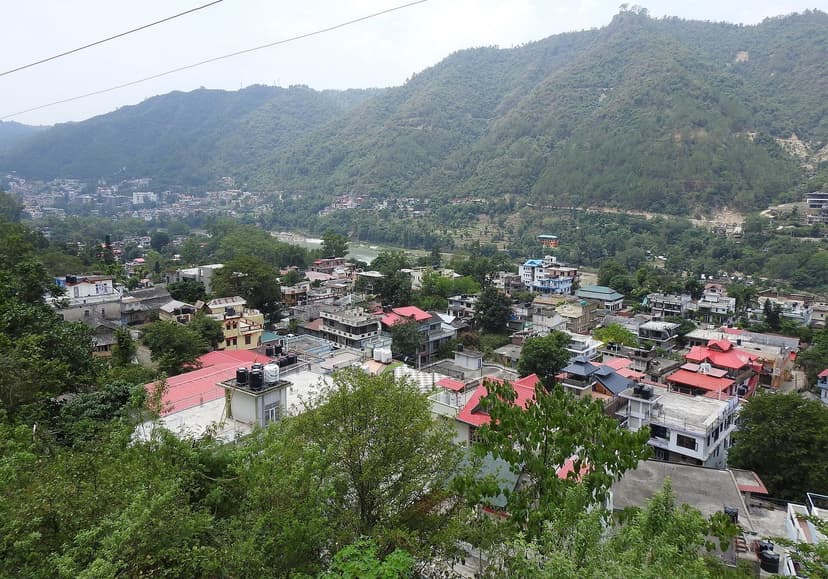
Nearest airport is Bhuntar (KUU), 118 km away, with unreliable winter schedules. Nearest railhead is Jogindernagar, the narrow-gauge Kangra Valley terminus, 152 km. Most visitors from outside Himachal come up by road from Chandigarh via Mandi and Nerchowk. If you do this, keep mobile data and a reasonable cash float. Beyond Nerchowk you are on HP Bank, PNB, and jio-or-nothing coverage in parts of Seraj.
The stairs, and what to expect at the top
The jeep stops about a kilometre short of the shrine. From there it is 550 to 700 stone steps to the ridge. Wikipedia says 550; TripAdvisor reviewers say 700; HP Tourism does not commit to a single number. Nobody I have read has bothered to count twice.
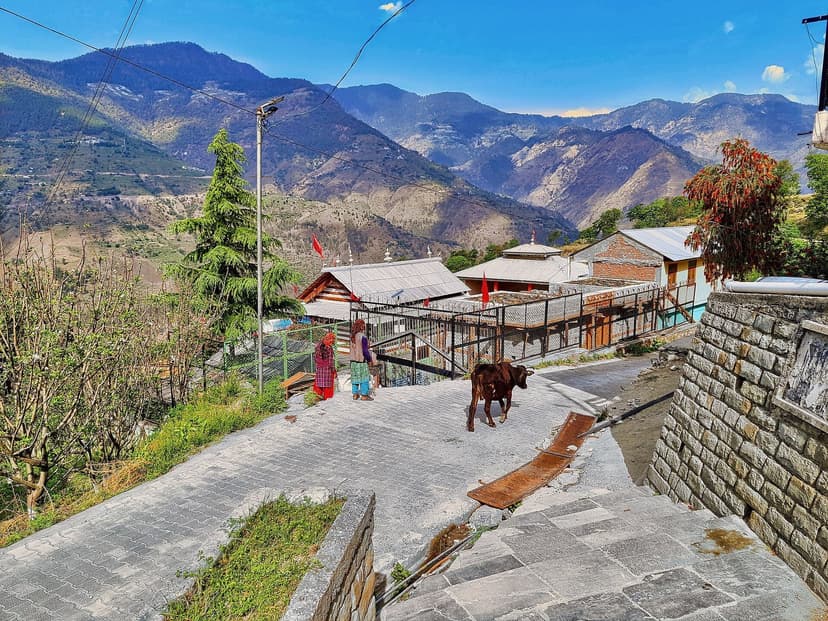
TripAdvisor warns you plainly: "the physically unfit should not attempt it." That is honest. It is not Triund. Your knees will know for two days. At 3,359 m on a cold morning you will feel breathless in a way that has nothing to do with fitness. The climb takes 30 to 45 minutes on reasonable legs.
At the top, going by photographs and by TripAdvisor descriptions, the shrine is smaller than most people expect. A walled platform, stacked stone and whitewash, painted plaques of the deities, gold-finialled corner spires, prayer flags. No roof. The idol sits in the open. A small iron gate, usually open in season, closes the inner sanctum. Circle the wall and you get what Mandi tourism calls the Crown of Mandi view, a 360-degree sweep across Dhauladhar, lower Kullu Valley, and, on days when the haze lifts, a hint of the Punjab plain. Reviewers consistently call it one of the widest horizons anywhere in the state.
The priest is local, from the villages below. He opens and closes the shrine. There are no elaborate aartis. Navratri brings crowds; the rest of the season is quiet enough that you can sit against the wall for twenty minutes and hear nothing but wind.
When to go, when not to
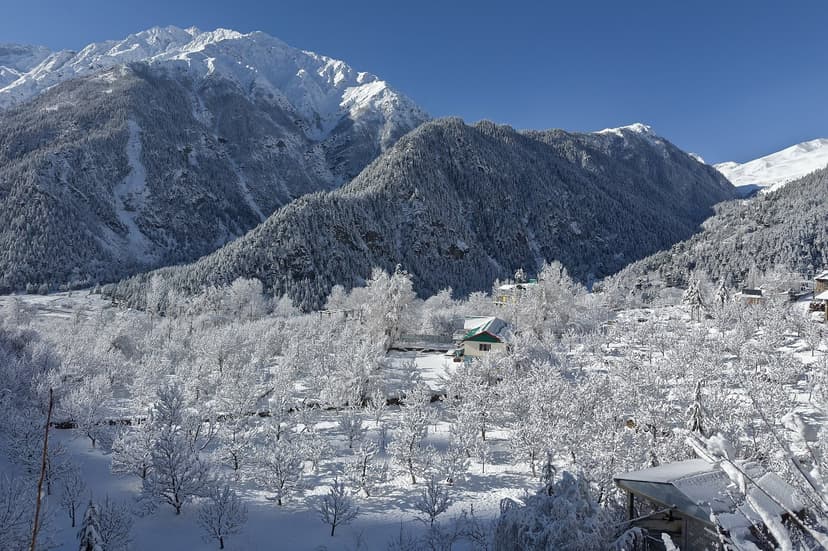
Shikari Devi is a four-month closure and an eight-month window. The temple doors shut around November 15 and reopen at Chaitra Navratri, which falls in late March or early April depending on the lunar calendar. For 2026 that opening was late March, and the sanctuary road was cleared early for it. ETV Bharat tracked the snow-clearing operation this year: 8 to 10 feet of accumulated snow, machines working the same kind of hours they use on Rohtang.
Do not plan around July or August
Monsoon shuts the forest road more reliably than snow does. Landslides, swollen nullahs, and vehicles that cannot grip the surface. If you are going for mystery and 360-degree views, aim April to June or September to October. If you are going for Navratri, book two months ahead for Janjheli stays.
Spring still throws snow at you
Amar Ujala, April 8, 2026: three fresh feet of snow on the shrine, priest locked out, dhoop burning at the gate. April 2026 was an outlier season, but it is not a rare one. Carry a warm layer into May if you want to be honest with yourself.
The general pattern: March opens cautiously, April bright and still cold, May to June the sweetest, July-August risky, September clears the skies best for panoramic photography, October is the loveliest month if you can time it, and November shuts the shrine behind you.
Where to stay and what to eat in Janjheli
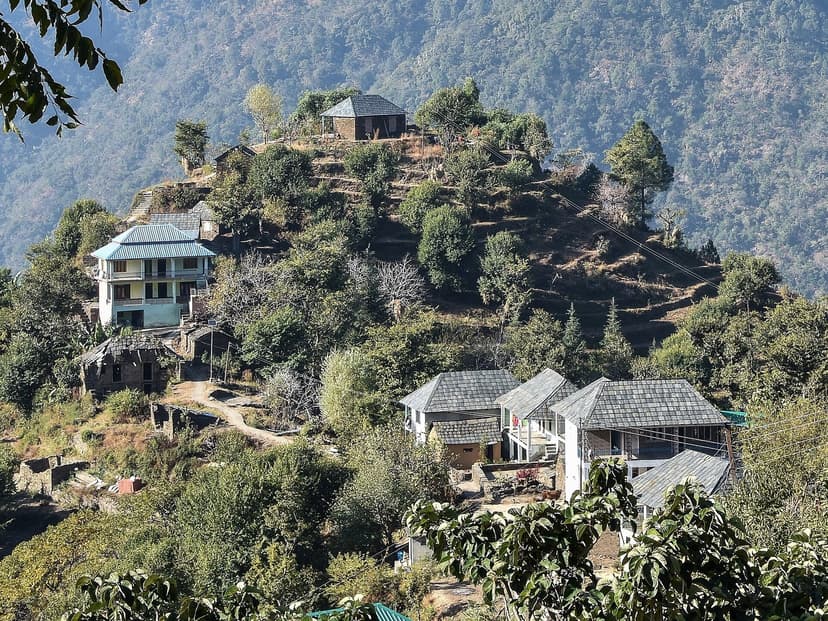
Janjheli is the Refuje kind of town. Small enough that the jeep driver knows the homestay owner. Big enough that three or four lodging options run in season. The HP Tourism department has pushed it for years under the Nai Raahein Nai Manzilein scheme, officially labelled unexplored.
What it costs (rupees, approximate, 2026 season)
- HPTDC Trekkers Hostel, Janjheli (dorm / basic room): 300-800 per night
- Apple-orchard homestay: 500-2,000 per night
- Hotel Snowdrift (market area): 1,500-3,000 per night
- The Hosteller Janjheli (dorm + private rooms): budget, check current rates
- Jeep return, Janjheli to Shikari: 1,500-3,000
- HRTC bus, Sundernagar to Janjheli: a fraction of the jeep, resumed 2026
- Dhaba meals: 100-300 per meal
- Temple entry: free
Food in Janjheli is honest, not elaborate. Dhabas serve thali, dal, rajma-chawal, the standard basic Chinese (read: hakka noodles and gravy manchurian), and fresh local rotis. Orchard homestays tend to feed you whatever the kitchen cooked that day. Ask for siddu if you want the one Mandi-Kullu thing you cannot get anywhere else. That is a steamed wheat bread stuffed with walnut or ghee-and-jaggery paste, and Janjheli is within the siddu belt.
Book ahead during the Chaitra and Sharad Navratri windows. Outside Navratri you can walk in and find something.
The wildlife sanctuary nobody knows about
The temple is enclosed inside a protected area that very few visitors register as separate from the shrine. The Shikari Devi Wildlife Sanctuary was notified in 1962. It covers 7,200 hectares across seven distinct forest types, from alpine pasture down to Ban oak. BirdLife International has designated the whole sanctuary an Important Bird Area. The key species list is long: Himalayan black bear, leopard, goral, barking deer, musk deer, Himalayan palm civet, marten, Indian porcupine, Kashmiri flying squirrel, common langur, Himalayan Monal (Himachal's state bird), Western Tragopan. Snow leopard has been reported on the ridges; those reports remain unconfirmed.
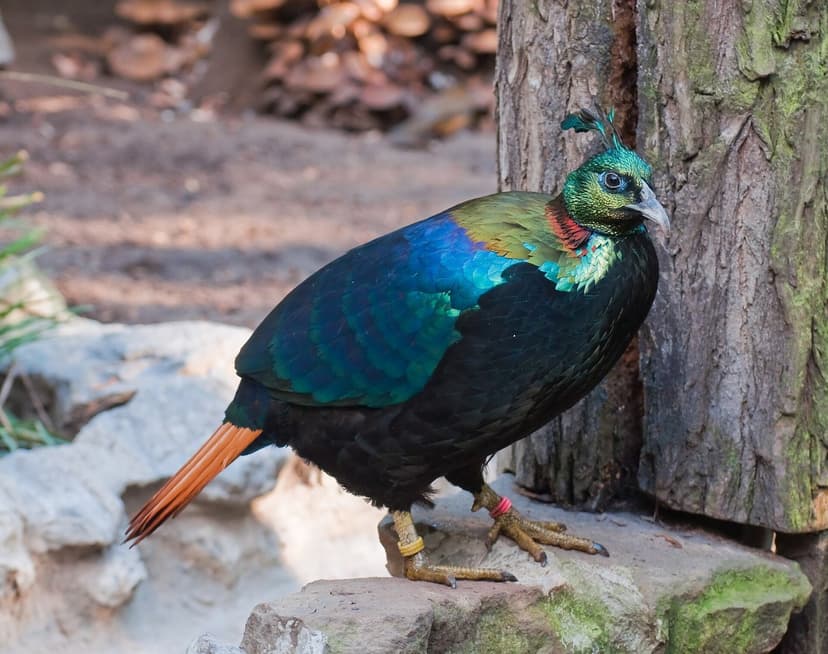
There is a quiet irony in the arrangement. The Goddess of Hunters is the patron saint of a wildlife refuge. Nobody shoots anything inside the sanctuary. What used to be a hunting peak, as the temple name implies, is now a protected forest, by a law that runs through the same state government whose former CM could not keep a roof on the shrine. Power adjusts around the shrine in small ways like that.
If you are careful and reasonably patient, a sanctuary stay gets you monal with near certainty; pheasant and barking deer with some luck; leopard pug marks, if not the animal itself; and the monsoon butterflies that the IBA record lists at 147 species. The guard posts along the forest road will point you toward active sightings on the day.
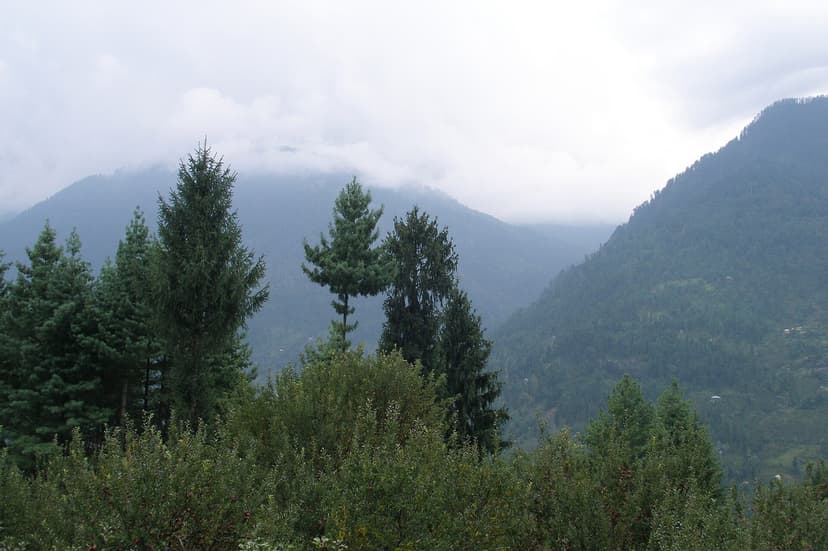
A Reddit trekker I came across, u/hikingcaveman on r/HimachalPradesh, wrote a careful warning about tourism pressure on shrines like this one. Outside money buys land, trees come down, a sanctuary can quietly stop being a sanctuary. Worth reading before you book a Navratri jeep.
The Mandi Triangle, a Refuje circuit
None of the three big Mandi-district ridge shrines sit in isolation. Parashar, Kamrunag, and Shikari line up within a rough 50 km diameter. Shangarh Meadow, just east of Kamrunag across into Kullu district, closes the fourth corner. Together they make a four- or five-day circuit that, to my knowledge, no guidebook has ever mapped as one unit. Every piece is already famous on its own. The circuit is the discovery.
Mandi Triangle, five-day route
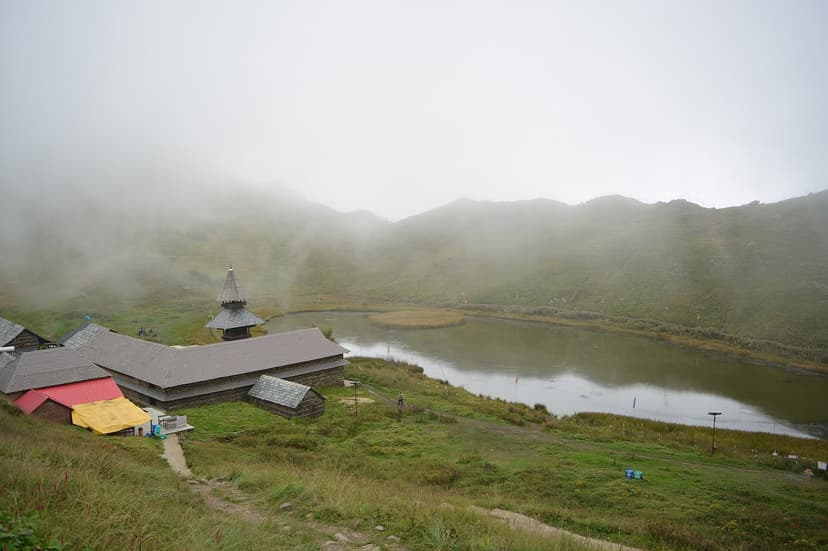
Day 1: Mandi → Baggi → Parashar Lake (2,730 m). Forest Rest House or camp. Evening at the 13th-century pagoda.
Day 2: Parashar → Shangarh Meadow (2,500 m), about 80 km via Kullu-side roads. Homestay. Evening walk across the meadow.
Day 3: Shangarh → Janjheli via Jibhi. Rest; the ridge climb is tomorrow.
Day 4: Janjheli → jeep up → 550 steps → shrine → jeep back. Siddu dinner.
Day 5: Janjheli → Kamrunag Lake (2,926 m). 16 km ridge trek via the old pilgrim route, finishing at Rohanda or descending to Chailchowk.
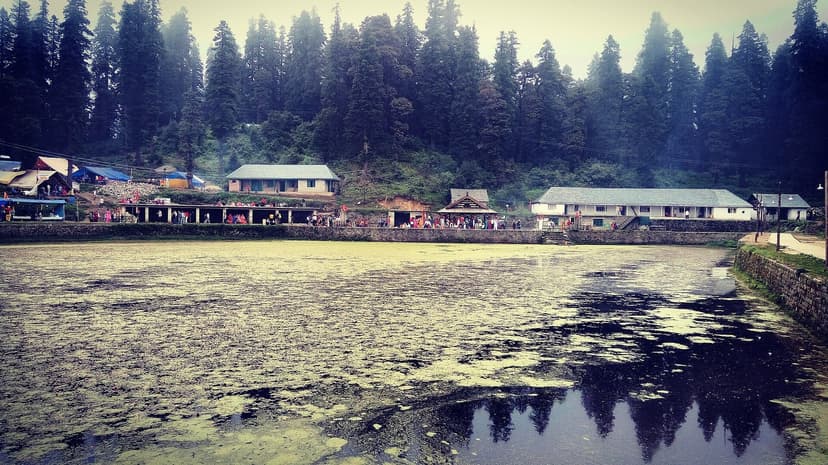
The Triangle works for one reason. Each stop has its own quiet unexplained thing. Parashar has the floating island, a patch of land that drifts around the lake that scientists and devotees have each tried to explain without the other. Kamrunag has coins at the bottom, reportedly never retrieved, in accumulations that some locals say are measured in crore. Shangarh has the local belief that the entire meadow is one vast shrine and you are not supposed to pluck a blade of grass. Shikari has the roof and the snow. Four mysteries in five days is a specific kind of offering.
Difficulty is moderate to moderately hard, mainly because of the Kamrunag ridge walk. April to June and September to October are the sensible seasons; the whole Triangle closes as a circuit through winter.
Voices
The shrine does not give out its character easily on a single visit, and most of the people who have been up there repeatedly have left a sentence or two online. Four useful ones.
"A visual treat once you finally reach. If you are looking for a place that is largely unexplored and has less or non-existent crowd, this place should be on your list."
TripAdvisor reviewer, Shikari Devi Temple page
u/guy_from_himalays on r/india, matter of factly: 130 km from Shimla, Janjheli side. Trek Rohanda to Kamrunag first, 8 km, one night. Then Kamrunag to Shikari, 15 km. That is the trekker's version of the route HP Tourism sells as "jeep to Janjheli, jeep to ridge."
u/SamarthGuleria, r/HimachalPradesh: the Kamrunag-Shikari area has highest elevation 3,500 m, and it snows at elevations as low as 2,000 m in these surrounds. Useful calibration if you have never walked a 3,000 m ridge before.
u/Flashy_Ad_5142, who said he has approached the peak on foot from every side, posted that there is no wrong approach; there are only seasons when one approach is shut. He favours the ridge trek from Kamrunag for the clearest morning views.
The Hindi side of the same story
Every English write-up I read frames Shikari Devi as a mystery. Every Hindi write-up I read frames it as a relationship.
Amar Ujala, on the big April snowfall: "शिकारी देवी में करीब तीन फीट बर्फबारी हुई है। बर्फ के कारण मंदिर का गेट नहीं खुल पाएगा, इसलिए पुजारी गेट के पास ही धूप जलाकर माता को नमस्कार कर रहे हैं।" Three feet of snow at Shikari Devi. The gate cannot be opened. The priest is burning dhoop at the gate and greeting the Mata.
There is no frustration in that sentence. There is a priest, a closed door, a ritual anyway. In the English press the same event reads as an anomaly. In the Hindi press it reads as a normal Tuesday.
Bhaktvatsal carries the older devotional line, repeated in shorter form across Punjab Kesari: "छत न होने के बाद भी माता की मूर्ति पर ना बर्फ टिकती है और ना ही जमती है।" Even without a roof, snow neither settles nor freezes on the Mata's idol.
Coming from Kinnaur, where Mathi at Chhitkul and Bhimakali at Sarahan have their own long-memory relationships with weather and attendance, this framing is not strange to me. Our shrines do the same thing. The temple does not need to be solved. It needs to be visited respectfully, closed in winter, reopened at Navratri, and left alone between.
Map: Shikari Devi and the Mandi Triangle
Questions that keep coming up
Why is Shikari Devi temple roofless?
Two reasons run in parallel. The devotional answer, from Hindi sources and older local tradition, is that the goddess prefers the open sky and rejects every roof. The structural-historical answer is that the Pandavas installed the idol during their exile and never finished a covered shrine. Every later attempt, including orders by former chief minister Virbhadra Singh, has failed to storms. The HP Government Mandi district site documents the mystery plainly.
Does snow really not settle on the temple?
Yes. This is the direct wording on the Government of Himachal Pradesh Mandi district tourism page: "despite the fact that temple has no roof, no snow is spotted in temple premises during winters when the entire region around this temple is covered upto several feet by snow." Winter accumulation around the ridge reaches 8 to 10 feet. No peer-reviewed scientific paper has been published to explain it. IIT Mandi, the nearest research university, has not investigated it.
How do I reach Shikari Devi from Janjheli?
Shikari Devi is 18 km from Janjheli by a jeepable forest road. Hire a local jeep at the Janjheli stand. Do not attempt the drive yourself; TripAdvisor reviewers consistently warn that only experienced local drivers can handle the surface. The road ends roughly one kilometre short of the shrine. From there you climb 550 to 700 stone steps to the ridge. Total time from Janjheli: about 1.5 hours by jeep plus 30 to 45 minutes on the steps.
When is the temple open?
The shrine opens at Chaitra Navratri in late March or early April, depending on the lunar calendar. It closes around November 15. In 2026 the Navratri opening coincided with heavy spring snow, and the HP Forest department cleared the forest road early for access. The temple is open as of April 2026.
Is there an entry fee?
No. The temple is free to visit. You pay only for transport (jeep hire from Janjheli is approximately 1,500 to 3,000 rupees return), accommodation in Janjheli (homestays from 500 rupees a night, HPTDC hostel from 300), and dhaba meals (100 to 300 rupees a meal).
Can I trek from Kamrunag Lake to Shikari Devi?
Yes. A ridge trail connects Kamrunag Lake (2,926 m) to Shikari Devi peak (3,359 m). Distance is roughly 10 to 16 km depending on route and side trails, taking 3 to 4 hours one way in fair weather. Many pilgrims do the full Rohanda-Kamrunag-Shikari Devi loop over 2 to 3 days. Both sites are sacred and have been linked as a single pilgrimage circuit for centuries.
How hard is the Shikari Devi approach?
Moderate to hard. The jeep ride is rough but not physically demanding. The 550 to 700 stone steps are the main effort and get steep at the end. TripAdvisor reviewers recommend that physically unfit visitors and those with knee problems reconsider. Altitude, at 3,359 m, adds to perceived effort; pace yourself.
What wildlife can I see at Shikari Devi Wildlife Sanctuary?
The 7,200-hectare sanctuary, notified in 1962, hosts Himalayan black bear, leopard, goral, barking deer, musk deer, Himalayan Monal (HP's state bird), Western Tragopan, Kashmiri flying squirrel, Himalayan palm civet, marten, and Indian porcupine. Snow leopard is reported but not confirmed. BirdLife International lists the sanctuary as an Important Bird Area.
Where should I stay near Shikari Devi?
Janjheli is the right base, 18 km from the shrine. HPTDC Trekkers Hostel is the cheapest option (300 to 800 rupees). Apple-orchard homestays run 500 to 2,000. Hotel Snowdrift near Janjheli market runs 1,500 to 3,000. The Hosteller has a Janjheli property with dorm and private rooms. Book two months ahead for Chaitra and Sharad Navratri windows.
What is the legend of Shikari Devi temple?
Two traditions run in parallel. In the first, the Pandavas, during their thirteen-year exile, saw a strange deer in these forests. Arjuna shot and missed; the deer vanished; Durga appeared as Shikari Devi, Goddess of Hunters, and asked to be placed on this ridge under the open sky. They installed the stone idol and left. In the second, Sage Markandeya meditated on the peak for years, and the goddess revealed herself and the shrines form to him. The temple also houses the 64 Yoginis alongside the main idol, placing Shikari in the older tantric Shakti tradition of open-to-the-sky hypaethral shrines.
One last note before you go
Shikari Devi is not a view, a stat, or an Instagram square. It is a shrine that has held a position on this ridge for several hundred years and has outlasted every structural attempt to cover it. Go carefully with the landscape. Do not take stones from the shrine wall. Do not feed anything to the animals in the sanctuary. Do not try to run drones over the open sanctum. Stay respectful with photographs inside the enclosure; some priests will ask you to put the camera down, and that ask is reasonable.
If you want to plan a quiet three- or four-day run that includes Janjheli, Shikari Devi, and one or two other Mandi-Triangle stops, we have local hosts in the valley who know the jeep drivers, the homestays that actually have fresh sheets, and the priests who will show you around. Write to us at hello@refuje.com and we will match you to one.
And if you read this from outside Himachal and are wondering whether it is worth it, the answer from a Kinnauri writing about a Mandi shrine: yes. For the stairs, the wind, the 360-degree horizon, the small stone wall, and the sky it opens to. Email hello@refuje.com when you are ready to plan.
Sources and further reading
- Government of Himachal Pradesh, Mandi district tourism page, hpmandi.nic.in/tourist-place/janjehli-shikari-devi-temple (last updated April 24, 2026).
- Wikipedia: Shikari Devi Temple, altitude, coordinates, Pandava origin, Markandeya link.
- Amar Ujala, April 8, 2026: three feet of snow, priest locked out at the gate (Hindi).
- Amar Ujala, February 2026: HRTC Sundernagar-Janjheli-Shikari Devi bus service resumes at Navratri (Hindi).
- The Statesman (English daily archive): "Where miracle happens every year", roof-collapse and Virbhadra Singh attempts. Title searchable at thestatesman.com.
- ETV Bharat (Hindi): Roof never stays; snow clearing for 2026 Chaitra Navratri opening.
- Punjab Kesari (Hindi): Pandava agyatvas origin and 64 Yoginis.
- Bhaktvatsal (Hindi): Shikari Mata Mandir page, "snow neither settles nor freezes on the Mata's idol."
- TV9 Hindi: Markandeya Rishi penance, Seraj Valley context.
- BirdLife International: Shikari Devi Wildlife Sanctuary IBA factsheet.
- Key Biodiversity Areas: Sanctuary factsheet, 7,200 ha, 1962 notification.
- TripAdvisor reviews: road quality, step count, 360-degree view.
- Reddit r/HimachalPradesh and r/india threads, April 2026 archive via Pullpush.io.
About Ajay Negi
Ajay Negi is a co-founder of Refuje and a Kinnauri native. He grew up in the Sutlej corridor and writes about Kinnaur, Spiti from the east, and how Himachals high places are changing. He is an outsider to Mandi and writes about it as one.
You Might Also Like
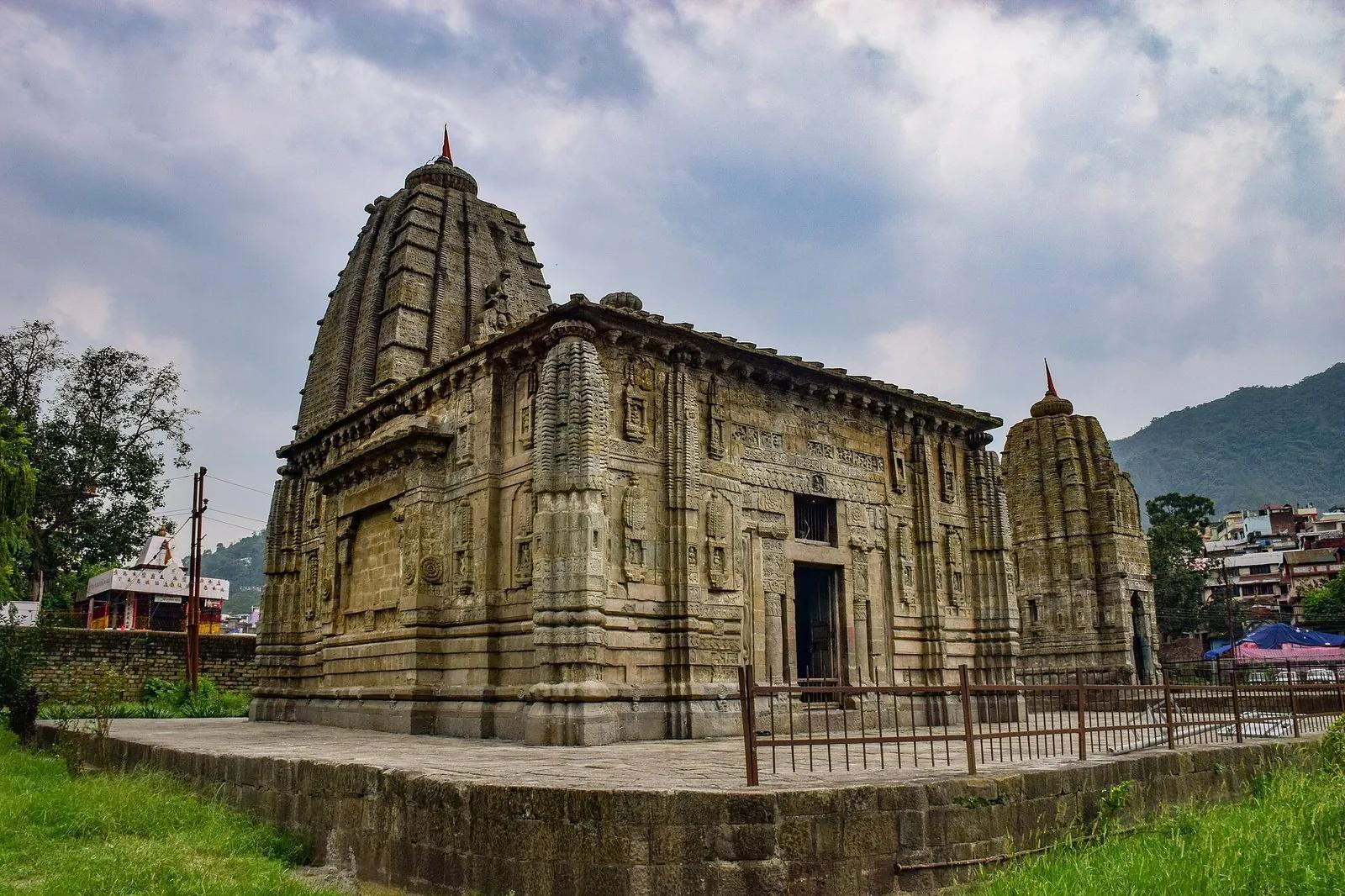
Mandi: Why This 81-Temple Town Is Called the Varanasi of the Hills
Everyone passes through Mandi on the way to Manali. Chhoti Kashi, with its 81 stone temples, a 500-year-old deity fair, Rewalsar and Prashar Lake, is worth stopping for. A Kullu local makes the case for giving it three days.
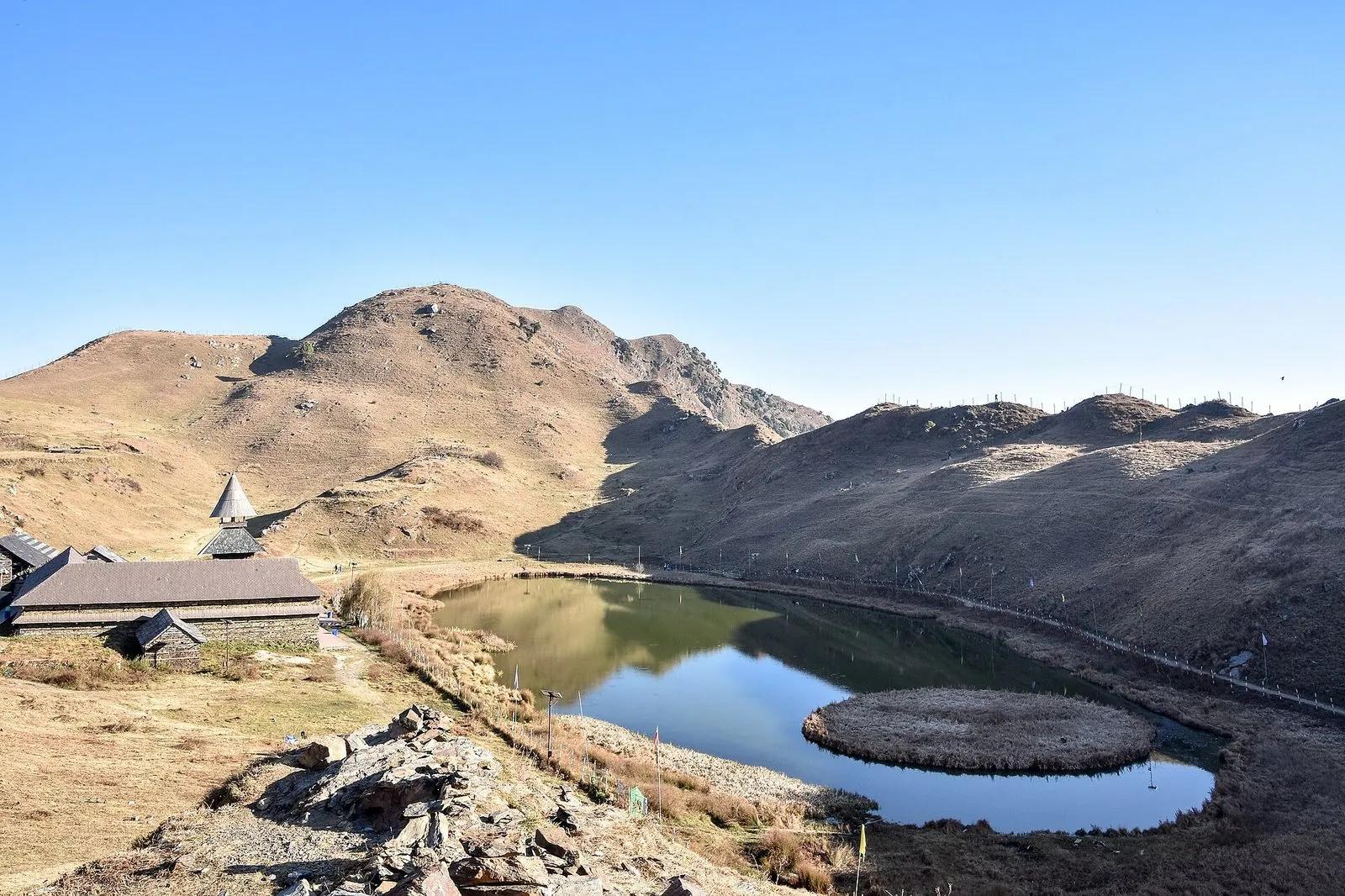
Prashar Lake Trek: The Floating Island Mystery and Complete Guide (2026)
A floating island that drifts across an alpine lake at 2,730 m. A pagoda temple attributed to a 14th-century Mandi raja. A depth nobody has measured. The complete Prashar Lake trek guide for 2026 by a Mandi-region writer who has stood at this lake more times than he has counted.