Kinnaur Valley Complete Guide 2026: Kalpa, Sangla, Chitkul & India's Apple Country
There are tourist destinations in Himachal Pradesh, and then there is Kinnaur. I grew up in this valley. My first language is Kinnauri, not Hindi. When someone asks me where to go in Himachal, I can give them a polite list that includes Manali and Dharamshala, or I can tell them the truth, which is that the one place in the state that will stay with you a decade after you leave is the one most of them will never go to.
This is that guide. It covers the full arc from Sarahan to Nako, twelve villages along and off the Hindustan Tibet Road, an apple industry that feeds half of north India, wine vineyards at nine thousand feet that almost nobody knows exist, road sections that eat cars for breakfast, a Hindu Buddhist culture that refuses to be one thing or the other, and the single best sunrise view in the Indian Himalaya. It is long because Kinnaur is long. Five days is the minimum. Seven is better. Ten buys you the Spiti circuit on the back end.
The founders of Refuje run experiences in Kinnaur from a small base outside Kalpa called Telangi. The research for this guide is from the last two weeks, but the valley knowledge goes back a few generations. Treat everything below as what I would tell a friend who asked for my honest recommendation, because that is what it is.
Where Kinnaur actually is
Kinnaur is the eastern edge of Himachal Pradesh. North of it is Lahaul and Spiti. East of it, across a cluster of 6,000 metre peaks, is Tibet. The district is built around two rivers: the Sutlej cuts through the middle of it from the Tibetan plateau to the plains, and the Baspa drops in from the Sangla side and joins the Sutlej at a village called Karcham. Most of the interesting villages sit on one of those two rivers.
From Shimla it is 235 km to Reckong Peo, the district headquarters. That sounds close. It is not. You are on a road that single-lanes for long stretches, loses and regains altitude continuously, and crosses at least one landslide zone where the tarmac has been known to fall into the Sutlej without warning. Plan for eight to ten hours by car and twelve to fourteen by HRTC bus.
Kinnaur is officially in two halves. Lower Kinnaur holds the famous villages you have probably heard of (Kalpa, Sangla, Chitkul) and sits between roughly 2,000 and 3,500 metres. Upper Kinnaur (Pooh, Ribba, Khab, Nako) is higher, drier, quieter, and most travellers skip it because it does not look like the Instagram version of Kinnaur. They are wrong to skip it.
- District HQ
- Reckong Peo, 2,290 m
- Nearest airport
- Shimla (235 km) or Chandigarh (340 km)
- From Shimla by road
- 235 km, 8 to 10 hours
- Main highway
- NH-5 (Hindustan Tibet Road)
- Core villages
- Sarahan, Kalpa, Sangla, Chitkul, Nako
- Best season
- September to October (apple harvest, clear skies)
- Avoid
- July to August (monsoon landslides)
- Minimum days
- 5 (quick), 7 (proper), 10 (with Spiti)
- Permit for Indians
- None
- Permit for foreigners
- Protected Area Permit from SDM Reckong Peo
How to reach Kinnaur
There is exactly one road in. You take NH-5 out of Shimla and keep going east. Narkanda at 65 km, Rampur Bushahr at 130 km, the Jeori-Sarahan turnoff at 155 km, and then Tapri, Karcham, Reckong Peo. There is no flight, no train beyond Shimla, no alternative route that skips the Sutlej corridor.
HRTC runs daily ordinary buses from Shimla to Reckong Peo, Kalpa, Sangla and Chitkul. Fares are between ₹350 and ₹550 depending on the distance. The buses leave Shimla ISBT early (the reliable ones are between 6 and 8 am) and the Kalpa and Chitkul services terminate the same day. A private taxi from Shimla to Kalpa costs ₹5,000 to ₹7,500 one way. Pick a driver who has done the route, not a Delhi-Shimla specialist pretending he has.
From Delhi the standard drill is: overnight train or Volvo to Shimla, one day in Shimla to acclimatise, and then the NH-5 leg the following morning. Attempting Delhi to Kalpa in one push is bad for you and worse for your driver. From Chandigarh it is 340 km, doable in a long day but not a pleasant one.
When to visit, honestly
Kinnaur does not have a year round season. It has windows.
September to October: the window
This is the only answer that has no caveats. Post monsoon clarity, BRO has finished repairing the Tapri-Karcham section, apple harvest is in full swing, the orchards turn red and gold against a snow dusted Kinner Kailash, and the night sky at Chitkul is as dark as anywhere in India. If you can only come once, come in late September.
April to June: the second window
Pleasant days, cool nights, apple blossom in the lower orchards during May, the roads are open and usually dry. The downside is that a few high passes and some offshoot roads open only after the snow melts in mid-May, and the Baspa Valley is greener a month later.
July and August: do not come
The monsoon does not soak Kinnaur the way it soaks Kasol or Dharamshala, but the NH-5 cloudburst season and the Maling Nala slide cycle make this the worst two months to attempt the drive. Business Standard and Hindustan Times both reported major NH-5 blockages in Kinnaur during the 2023 and 2024 monsoons. The 2025 season was similar. If you have no choice, plan for two extra days of buffer and check the BRO Himachal X account every morning.
November to March: winter
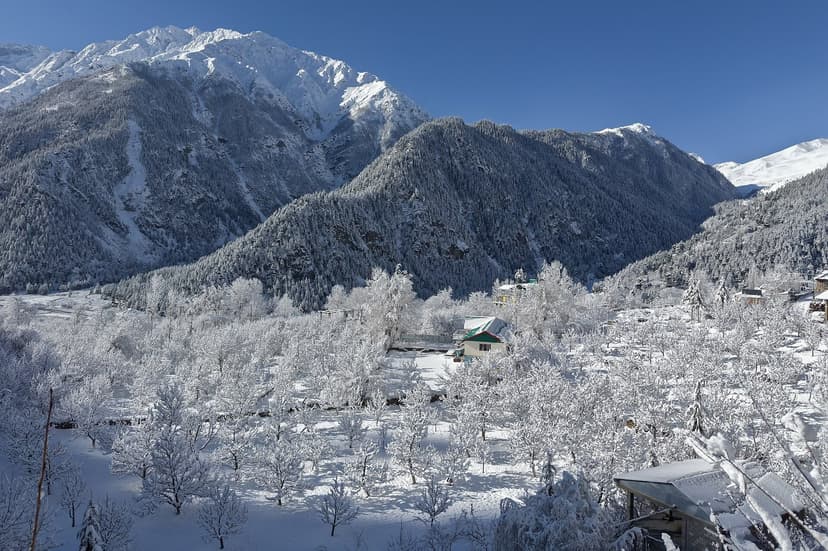
Late November the high villages start closing up for winter. December to February, Kalpa and Chitkul are deep in snow, daytime temperatures hover below zero, and the roads above Karcham are either icy or officially closed. Travel is possible with the right vehicle and the right attitude, and the winter photographs of Sangla are worth the trouble, but do not plan your first Kinnaur trip around January.
The twelve villages, in the order you would drive them
Every travel blog about Kinnaur profiles Kalpa, Sangla and Chitkul and stops there. Those are the famous three. There are at least nine others worth stopping at, and a few of them are better than the famous three depending on what you came for. Driven from Shimla into Kinnaur, here is what you pass, in order.
1. Sarahan, 2,165 m
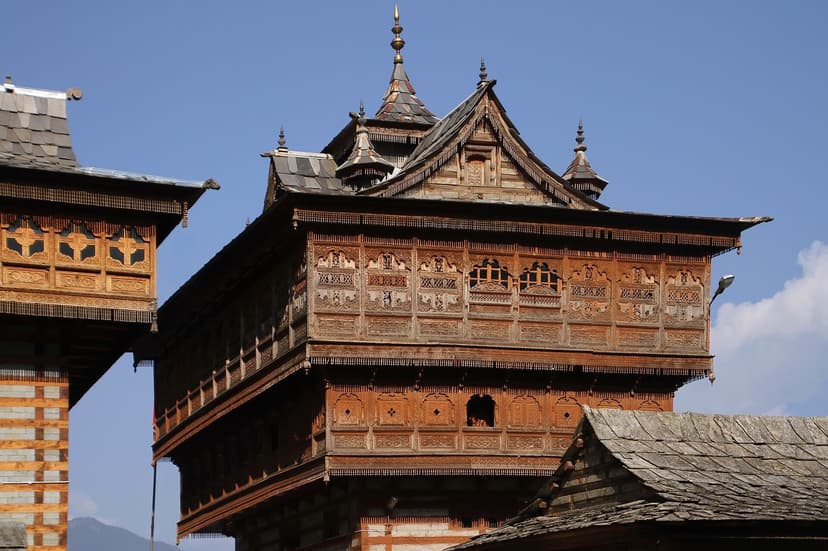
Sarahan is the last stop before you technically enter Kinnaur district (it sits just inside Shimla district, but culturally it is Kinnaur's doorstep). One reason to stop: the Bhimakali Temple, one of the 51 Shakti Peeths, a seven hundred year old wooden tower that is also the best piece of kath-kuni temple architecture on this side of the state. It is not a tourist attraction pretending to be a temple. It is a working temple that happens to be extraordinary. Spend a night here so that you arrive at Sarahan in the evening, sleep, and watch the morning aarti.
2. Reckong Peo, 2,290 m
Administrative capital. You stop at Peo to refuel (last reliable petrol pump until Kaza in Spiti, more than 200 km further), hit an ATM (there is no ATM in Kalpa or Chitkul or Sangla that you can rely on), and if you are a foreign national, to pick up your Protected Area Permit at the SDM office. It is not a village you stay in. Transit only.
3. Kalpa, 2,960 m
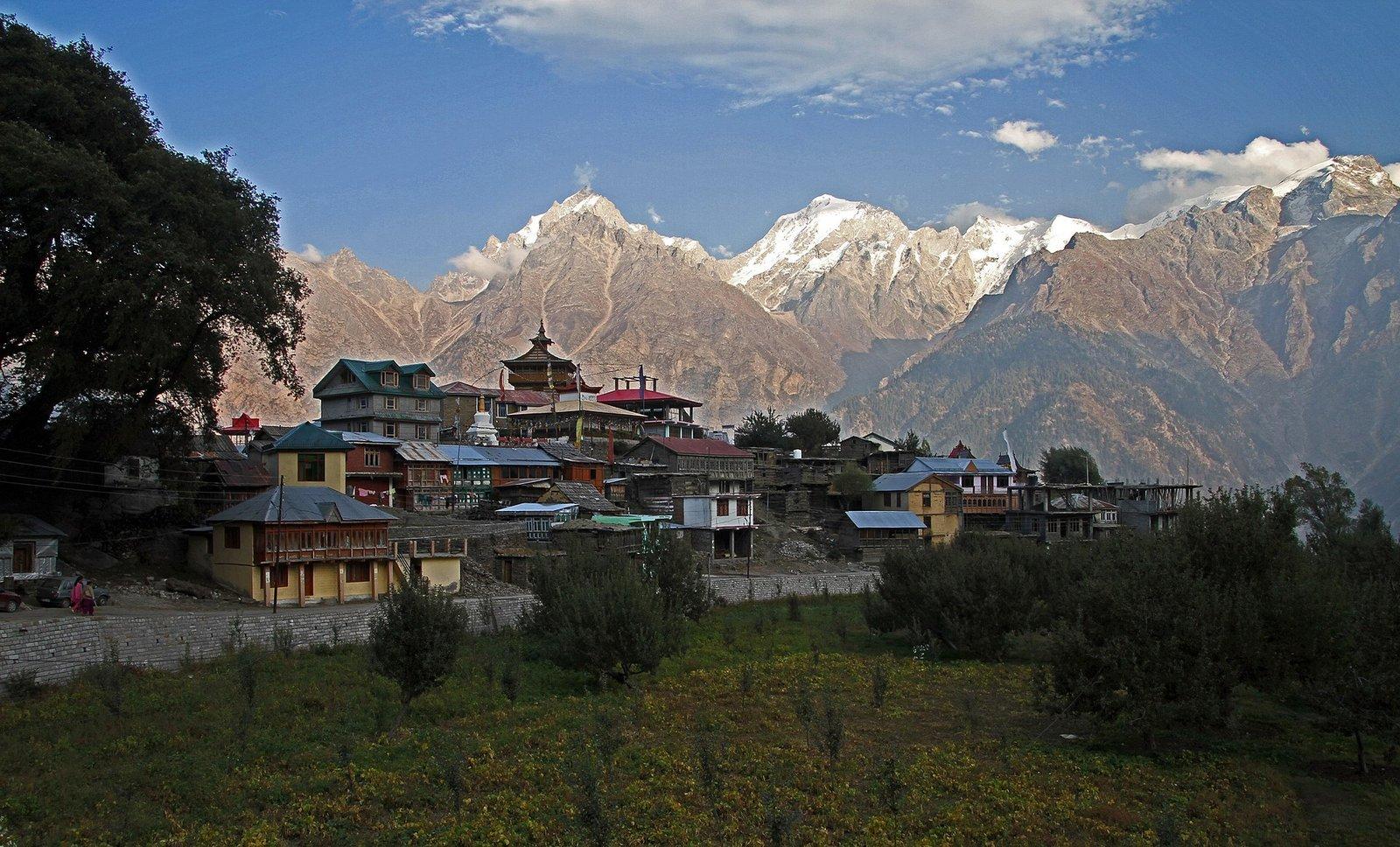
Kalpa is the crown. Everyone who comes to Kinnaur eventually ends up here, and they do it because when you stand at the Kalpa viewpoint at five in the morning with the Kinner Kailash range at eye level across the Sutlej, you understand why this village is famous in a way that the photographs cannot convey.
Stay two nights minimum. The first morning is for the Kalpa viewpoint sunrise. The afternoon is for the apple orchards around the village and, if you have legs for it, the walk up to the Hu-Bu-Lan-Kar monastery above Kalpa. The second morning is for Telangi Kanda, which is a superior sunrise spot that nobody outside the village talks about, and the afternoon is for the Kalpa Roghi day trip.
Refuje runs an apple orchard sundowner from a small base at Telangi (₹1,499, three to five hours, August to October only). It is not a tourist experience. You walk through the orchards, you eat whatever is ripe on the branch, you watch Kinner Kailash turn gold at seven in the evening, and you drink local chulli. If you are in Kalpa between August and October and you miss this, you have misunderstood Kinnaur.
Why the Kinner Kailash sunrise is worth the trip alone
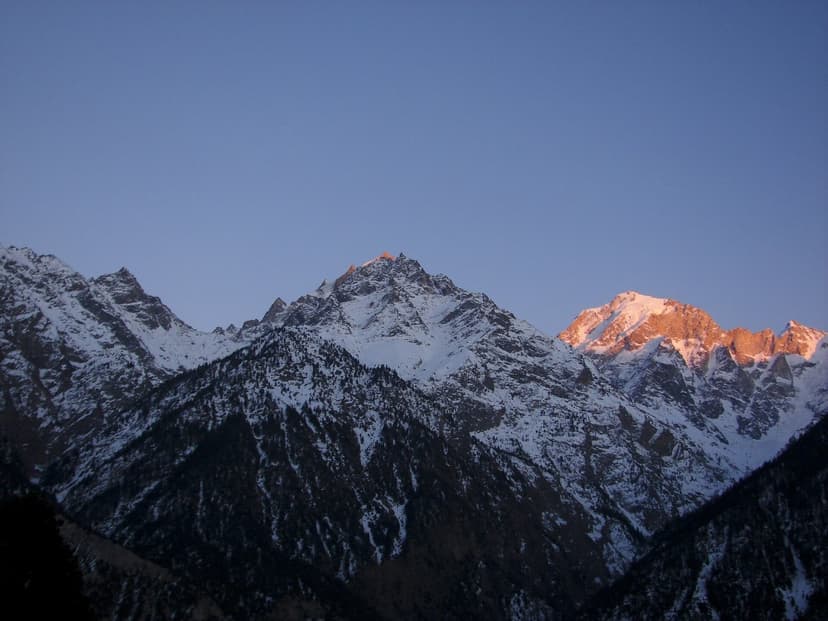
The sacred peak of Kinner Kailash is 6,050 metres. It sits directly across the Sutlej from Kalpa, which means from the village viewpoint the sacred ridge fills your whole field of view. At dawn, between roughly 5:10 am and 6:20 am depending on the month, the sunrise hits the summit first and works its way down the face in about ten minutes. The peak goes from silhouette to flat orange to full gold to lit white. By the time the sun hits the village itself, the light show on the mountain is already over. If you miss it, you miss it.
Practical notes. September to November is the clearest window (post monsoon, pre winter). The Kalpa viewpoint (walk five minutes from the village) is the classic spot. Telangi Kanda, about ten kilometres towards the Roghi side, has a wider view and no crowd. You want a wide angle lens for the range and a telephoto for the peak itself. A tripod helps in the first fifteen minutes of twilight. Dress for cold; Kalpa in October at 5 am is already at freezing.
4. Roghi, 2,700 m
Eight kilometres from Kalpa along a road that India Art Review once called "negotiating death". Roghi is a village of about two hundred families, built on a ledge that drops straight into the Baspa watershed. Its claim to fame is Suicide Point, a sheer cliff drop that is exactly what the name suggests, and it is also the best afternoon view of Kinner Kailash if you come back to it in the late light. Apples, apricots, chilgoza groves, grapevines. Day trip from Kalpa, not an overnight.
5. Sangla, 2,680 m
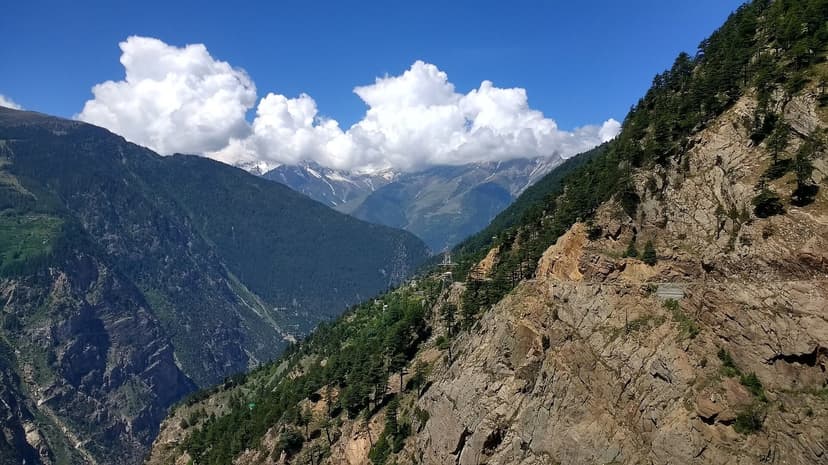
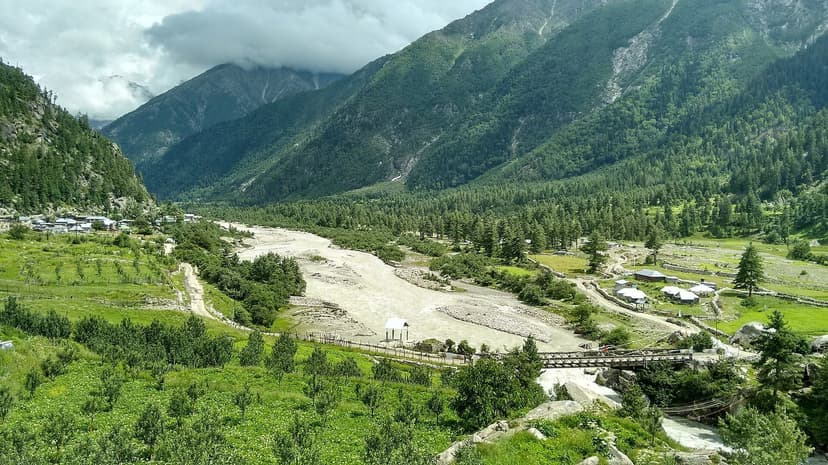
Sangla is the entry point to the Baspa Valley, which is the scenic sub valley off the main NH-5 line. You leave the highway at Karcham, climb 18 km of narrow road cut into a cliff, and the valley opens out. Sangla itself is a working village with a lot of orchards, a serviceable market, and the base for the Baspa circuit (see the next section). Trout fishing in the Baspa is available from April to October for ₹100 to ₹500 per rod per day.
The reason to come to Sangla specifically, more than for Sangla itself, is for Phag Mela, the five day village Holi celebration in February or March. It is not a spectator event. It is the village doing what it has done for centuries, and the few outsiders who come to it are treated like guests at somebody else's wedding. Refuje sells the Phag Mela experience as a 5 day immersive package at ₹29,333 per person, which covers stay, meals, access and a local guide.
6. Kamru Fort, 2,850 m (above Sangla)
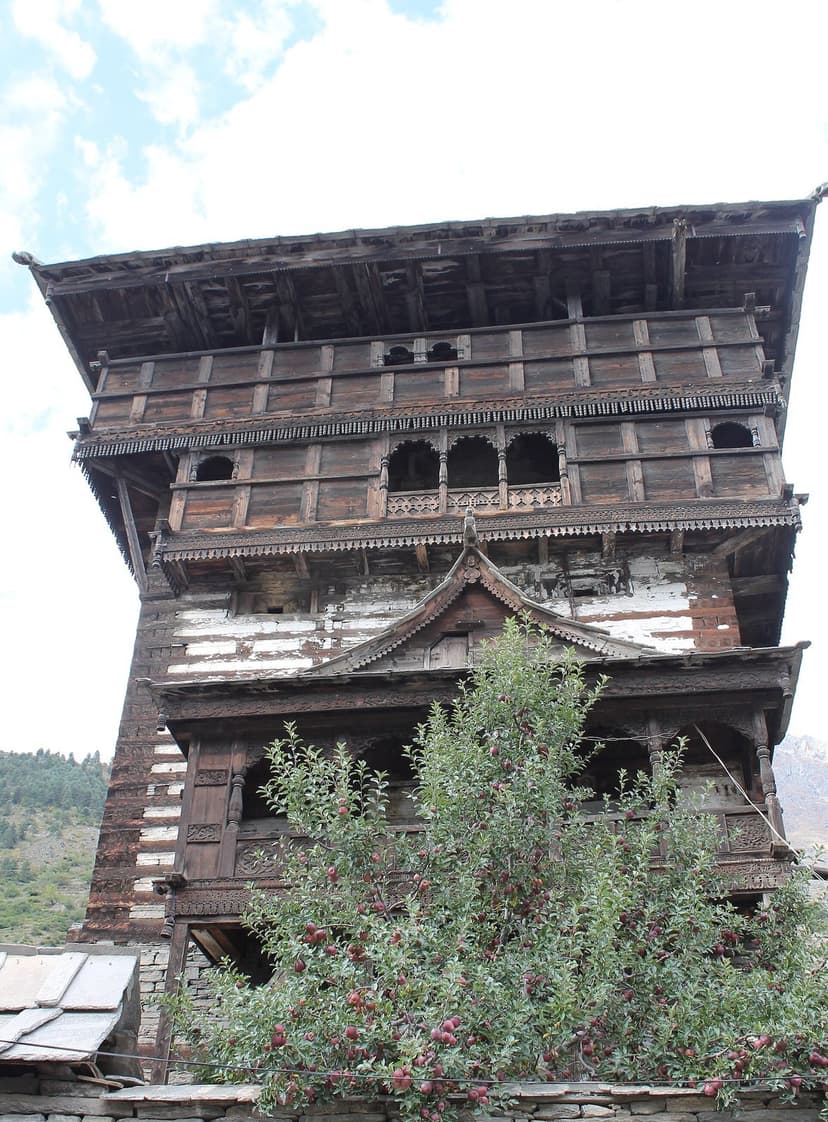
Two kilometres above Sangla, up a stepped lane through the village, sits a five storey wooden tower that is one of the oldest surviving kath-kuni structures in Kinnaur. Kamru Fort was the seat of the Bushahr rulers before they moved down to Rampur. The inner sanctum holds a temple closed to non Hindus. The climb is the point, and the view from the top across the Baspa Valley is the reward.
7. Batseri and 8. Rakcham
Between Sangla and Chitkul the road follows the Baspa upstream for 28 kilometres and passes two villages most guidebooks skip. Batseri is a tiny weaving village where handloom Kinnauri shawls are still woven on vertical looms in family courtyards. Rakcham at 3,100 m is the quiet middle child: a few homestays, a small pine forest, apple orchards, and a night sky as dark as Chitkul for a quarter of the crowd. If you want the Baspa Valley experience without the Chitkul Instagram rotation, stay one night at Rakcham instead of Sangla.
9. Chitkul, 3,450 m
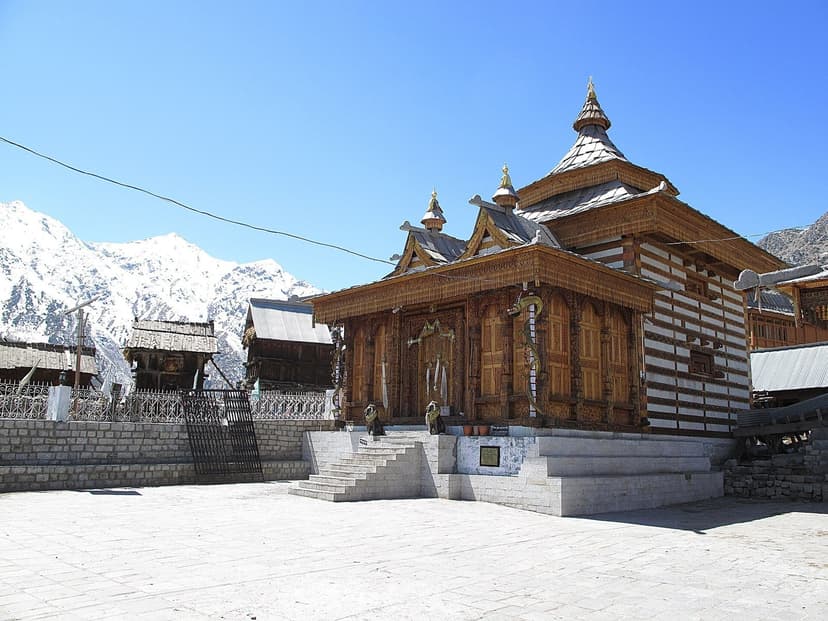
The last inhabited village on the Indian side of the border before you hit Tibet. Thirty four kilometres up from Sangla, past Batseri and Rakcham, past the ITBP checkpost at Nagasti, up to a final valley floor where the village sits under an amphitheatre of snow peaks. The Mathi Devi temple at the far end of the village is the best preserved kath-kuni structure at village scale in the valley. The "Hindustan Ka Aakhri Dhaba" signs are a bit of theatre but the rajma chawal is genuinely good and the walk down to the river is essential.
Stay at least one night. The electricity cuts out around ten and the Milky Way comes out by ten fifteen. A Reddit user on r/HimachalPradesh wrote that "you can spot the Milky Way Galaxy in Dhankar, Kaza, Langza, and Chitkul," and the Chitkul claim is accurate: Bortle Class 2 to 3, which is as dark as it gets in India. Bring a head torch with a red filter and warm layers. There is no phone signal in Chitkul and has not been for years. Tell people where you are going before you go.
The Baspa Valley circuit: one day or two
The Sangla to Chitkul stretch can be driven in an hour with nothing to show for it, or walked and stopped over two days with everything to show for it. My recommended version, if you have the time, is this:
Day 1: Sangla morning (Kamru Fort climb, local market), drive 8 km to Batseri (weaver visit, about ninety minutes), drive 5 km to Rakcham, lunch, walk the village, sleep at a Rakcham homestay, night sky and early bed.
Day 2: Early drive 10 km to Chitkul, morning at the Mathi temple and the river walk, rajma chawal at Aakhri Dhaba, drive back to Sangla by afternoon. If you have an extra night to spare, sleep at Chitkul and drive back the next morning.
Drivers note: the last ten kilometres to Chitkul can be rough depending on when the BRO last graded it. You do not need a 4x4 but you want a driver who is patient with rocks under the chassis.
10. Pooh, 2,840 m
Across the Khab confluence, the NH-5 leaves the forested lower valley and climbs into the brown rain shadow side of upper Kinnaur. Pooh is the first sizeable village you hit. It is also the place where the vineyards start. Almond orchards, apricot orchards, grape vines in terraces below the houses, and a small local wine operation that has been producing Angoori (grape alcohol, local fermented style) and Shudang (a lighter wine) for as long as anyone remembers. The cultural shift from Hindu villages below Kalpa to Hindu Buddhist mixed villages above Pooh happens along this stretch of road.
11. Ribba
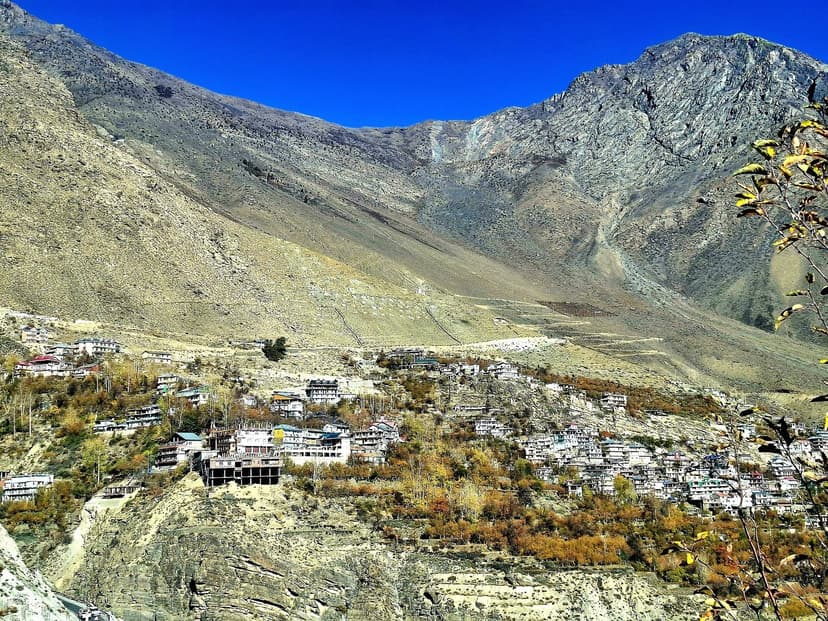
Thirty kilometres from Pooh, Ribba is the actual wine capital of Kinnaur. The village is organised around its vineyards more than around anything else, and a Mysterious Himachal writeup from 2017 called it "the land of grapes, wine and Angoori." If Indian wine tourism was a category that existed, Ribba would be in it. It is not, so Ribba is what it is: a village you pass through on the way to Nako, with grape vines on every terrace.
12. Nako, 3,662 m
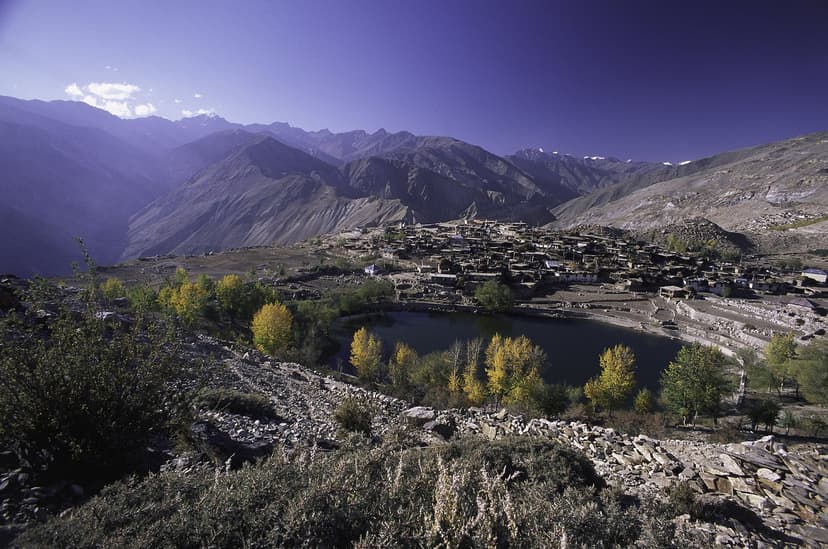
Nako is the last village in Kinnaur before the landscape officially becomes Spiti. It has a small sacred lake, a ninth century monastery, about thirty households, and no tourists to speak of. Spend a night here if you can. The morning view across the lake, with the Reo Purgyil range behind it and the village waking up on the other side of the water, is one of the good secrets of the valley.
Apple season in Kinnaur: what September actually feels like
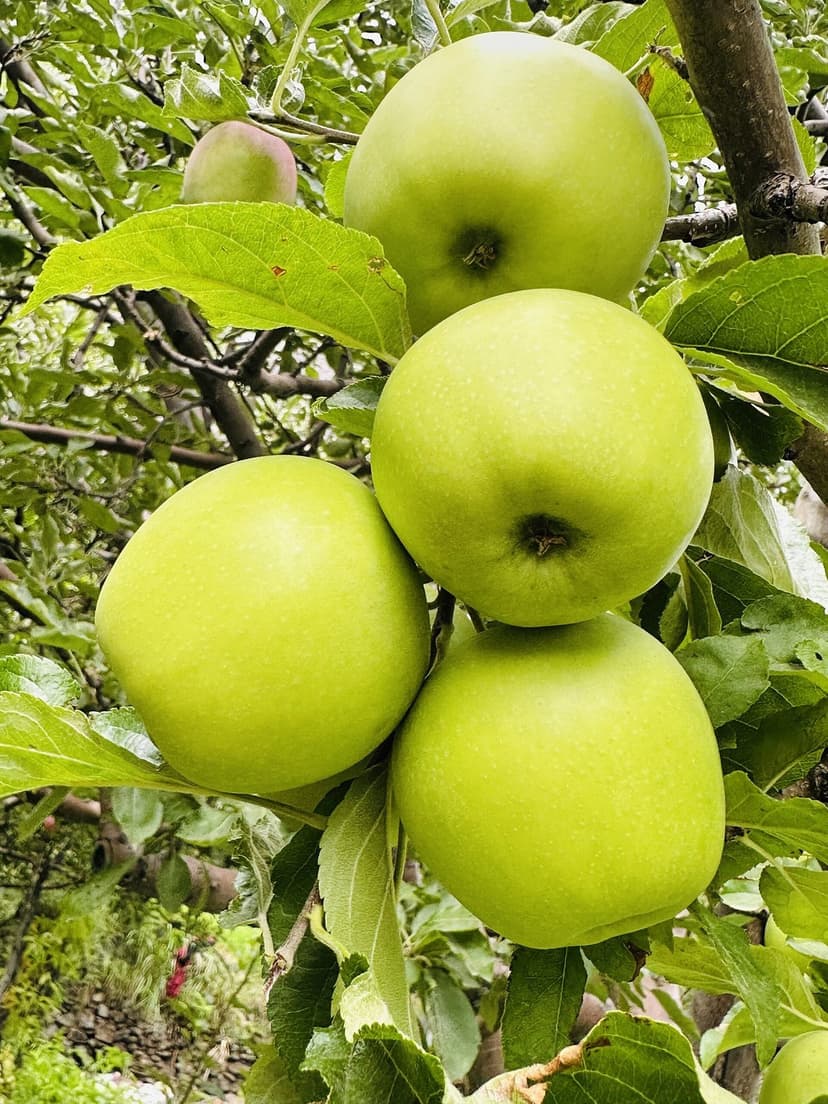
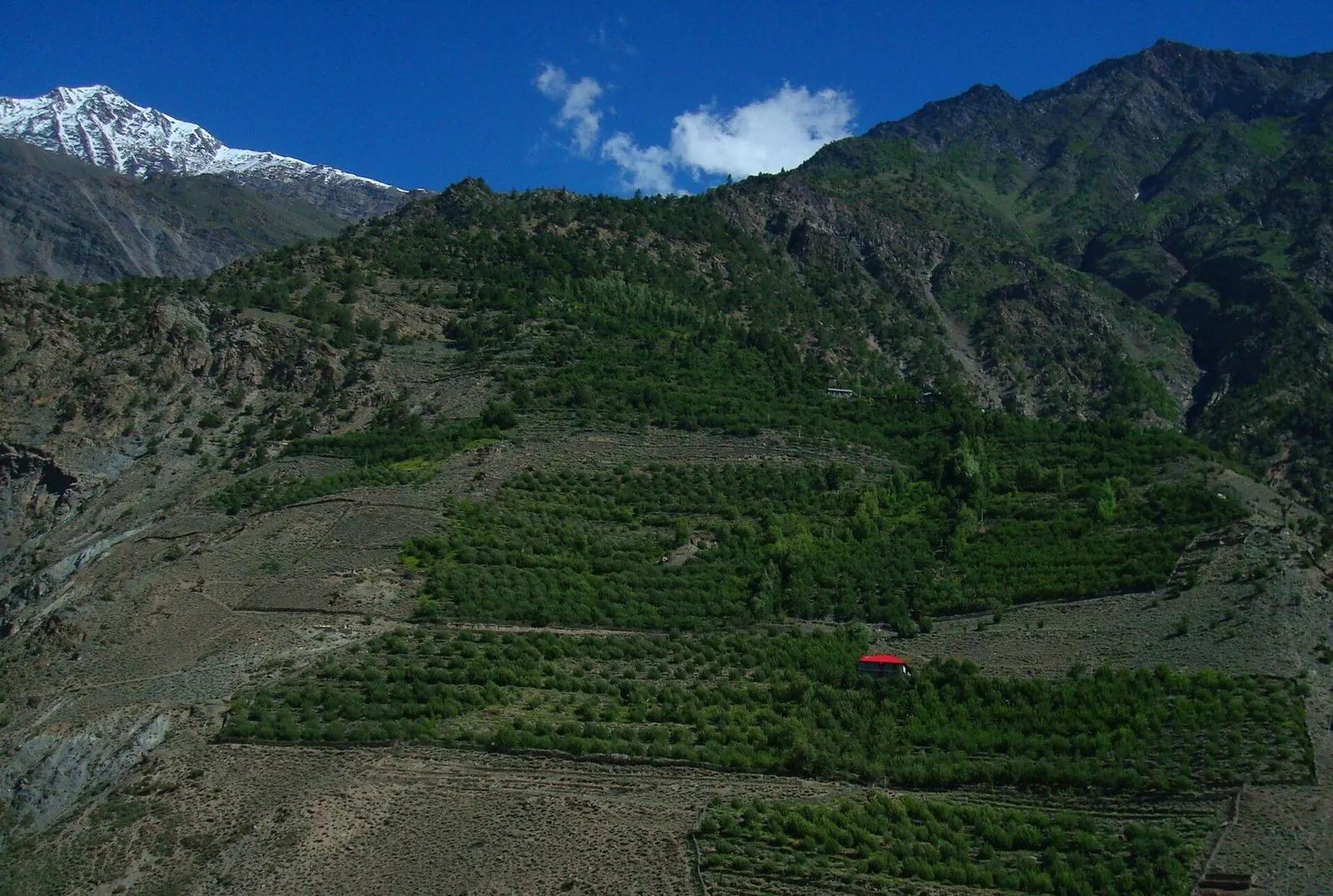
Kinnaur grows roughly 30 per cent of Himachal Pradeshs apples by value, and the Royal Delicious variety from this valley has historically fetched a premium of ₹5 to ₹15 per kilo over Shimla apples at the Delhi wholesale markets. The orchards run from about 2,000 metres in the Sutlej valley near Tapri up to 3,200 metres above Kalpa. The higher the orchard, the later the harvest, the more intense the fruit.
The harvest calendar, village by village: August brings the early varieties (Tydeman, Gala) out of the lower orchards near Tapri and Karcham. The first week of September the mid varieties start coming off the trees around Reckong Peo and Sangla. The middle two weeks of September are peak Royal Delicious harvest, which is the single busiest time on the valley roads because the apple lorries are moving day and night. Late September and the first half of October are late varieties, autumn colour, and the Kinner Kailash sunrise at its absolute best. By late October the picking is done.
One caveat worth knowing if you talk to orchard owners in 2026. The 2025 season was a shock to the valley. A report in Himachal Samay Media in October 2025 noted that Kinnauri Royal apples sold at the same rate as Shimla Royal at the Delhi mandi, which had not happened in anybody's working memory. The reasons are a mix of smaller fruit size from irregular rainfall, a price collapse in the wholesale channel, and the rise of alternative mandi platforms. A Kinnaur grower named Rajiv Kumar posted a video in July 2025 showing that FruitX mandi paid him ₹5 to ₹10 per kilo more than the traditional Delhi wholesale for the same consignment. If you are visiting an orchard in 2026 and the owner seems less cheerful than the blossoms warrant, this is why.
Kinnaur apples vs Shimla apples
| Category | Amount | Note |
|---|---|---|
| Altitude of orchards | 2,000 to 3,200 m | Kinnaur 600 m higher than Shimla on average |
| Harvest window | August to late October | Shimla Aug to Sep, Kinnaur Sep to Oct |
| Royal Delicious premium | ₹5 to ₹15 per kg | Over Shimla Royal, historically |
| 2025 anomaly | Price parity with Shimla | First time in living memory, per Himachal Samay Oct 2025 |
| Refuje apple experience | ₹1,499 per person | Apple orchard sundowner at Telangi, Aug to Oct |
Wine at nine thousand feet
This is the section that almost nobody writes about and it is the one that most surprises people who come to Kinnaur expecting apple orchards and end up drinking grape wine. Pooh, Ribba and a handful of villages between them sit at 2,800 to 3,000 metres, which is very high for viticulture but low enough that the local grape varieties (small, dark, sweet) ripen reliably between August and October. The wine the villages make from these grapes is called Angoori (stronger, grape alcohol) and Shudang (lighter, closer to actual wine). Neither is commercially bottled.
How do you taste it? You go to a homestay in Pooh or Ribba, you ask, and if the host has a bottle left from last seasons pressing, you drink what they pour. This is not a wine tasting experience with tasting notes on a chalkboard. It is closer to drinking what a farmer has made at home and what he considers normal. The altitude matters: you will feel one small glass more than you expect to.
Kinnaur also produces chhang (fermented barley beer, filtered after four or five days of fermentation), chulli (distilled from wild apricot, fierce, locally considered medicinal), and sattu morning drink (parched barley flour in salted butter tea, the winter sustenance crop). The drinks culture here is much deeper than the travel guides suggest.
Kinnauri culture, from the inside
The language
Kinnauri is a Tibeto-Burman language, not an Indo-Aryan one. That means linguistically it is closer to Tibetan than to Hindi. The Linguistic Survey of India and more recent Wikipedia classifications count around ten dialectal varieties across the valley, so a Kinnauri speaker from Sangla can struggle to understand a Kinnauri speaker from Nako. Hindi is the bridging language for most village interactions with outsiders, but a traveller who learns even the word julley (hello, goodbye, thank you, everything) will be treated as someone who paid attention.
The houses
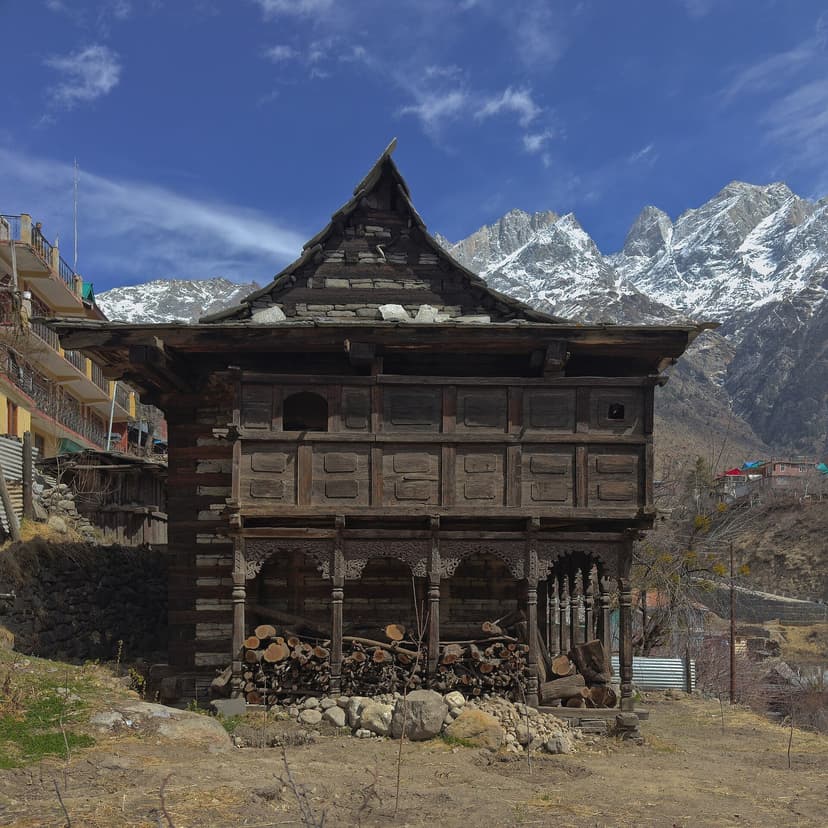
Kath-kuni architecture uses alternating layers of deodar cedar and local stone, interlocked at the corners without mortar. The Sanskrit roots are kath (wood) and kuni (corner). The houses are earthquake resilient because the structure flexes during a tremor instead of cracking, and the 2024 ScienceDirect paper on kath-kuni seismic behaviour gives the damping ratio as around 10 per cent, which is very high for vernacular construction. In Kinnaur you see kath-kuni in houses, temples and forts; the best specimens are at Chitkul (Mathi temple), Kamru (the fort), Sarahan (the Bhimakali tower) and in the side lanes of villages most tourists walk through without noticing.
The clothes
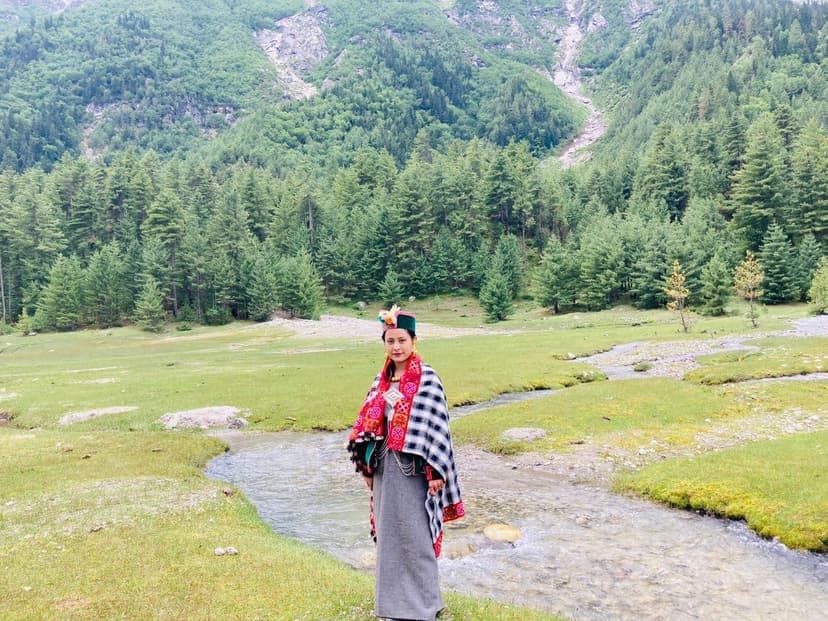
The Bushahri cap (round, grey or black wool with a green or maroon felt band) is the everyday Kinnauri mens cap and it is still worn, not as costume. The womens daily wear includes a heavy dhatu shawl (dark red and black, thick wool, worn across one shoulder), a wool skirt, and silver jewellery. At festivals the dress gets more elaborate but the base layer is the same base layer worn on a Tuesday afternoon in the orchard. Kinnauri shawls are GI tagged and a good one, handwoven by a weaver in Batseri or Kalpa, takes weeks to months of work and costs anywhere from ₹5,000 for a small piece to ₹50,000 or more for a formal bridal shawl.
The food
Siddu, the steamed bread with a walnut and poppy seed paste filling, is the dish that gets closest to being a Kinnauri signature. Thupa is the noodle soup with meat and vegetables that almost every house in upper Kinnaur cooks in winter, and it is close cousin to Tibetan thupa rather than Indian soup. Butter tea (known locally as thang) is the high altitude daily drink, tea leaves churned with butter and salt, and it is genuinely warming when you are at 3,000 metres and the wind is up. Chilgoza, India's only native pine nut, comes exclusively from Kinnaur and goes for ₹2,000 to ₹3,000 per kilogram in the Reckong Peo market. Fresh trout from the Baspa is available in Sangla between April and October.
The dances
Kinnauri Nati is slow and graceful and tells harvest stories. It is not the fast competitive Kullu Nati that holds Guinness records. Two different states of mind. You will see Nati at Phag Mela in Sangla, at the Phulaich festival of flowers for the dead in August, and at village weddings year round.
NH-5 road conditions: what you actually need to know
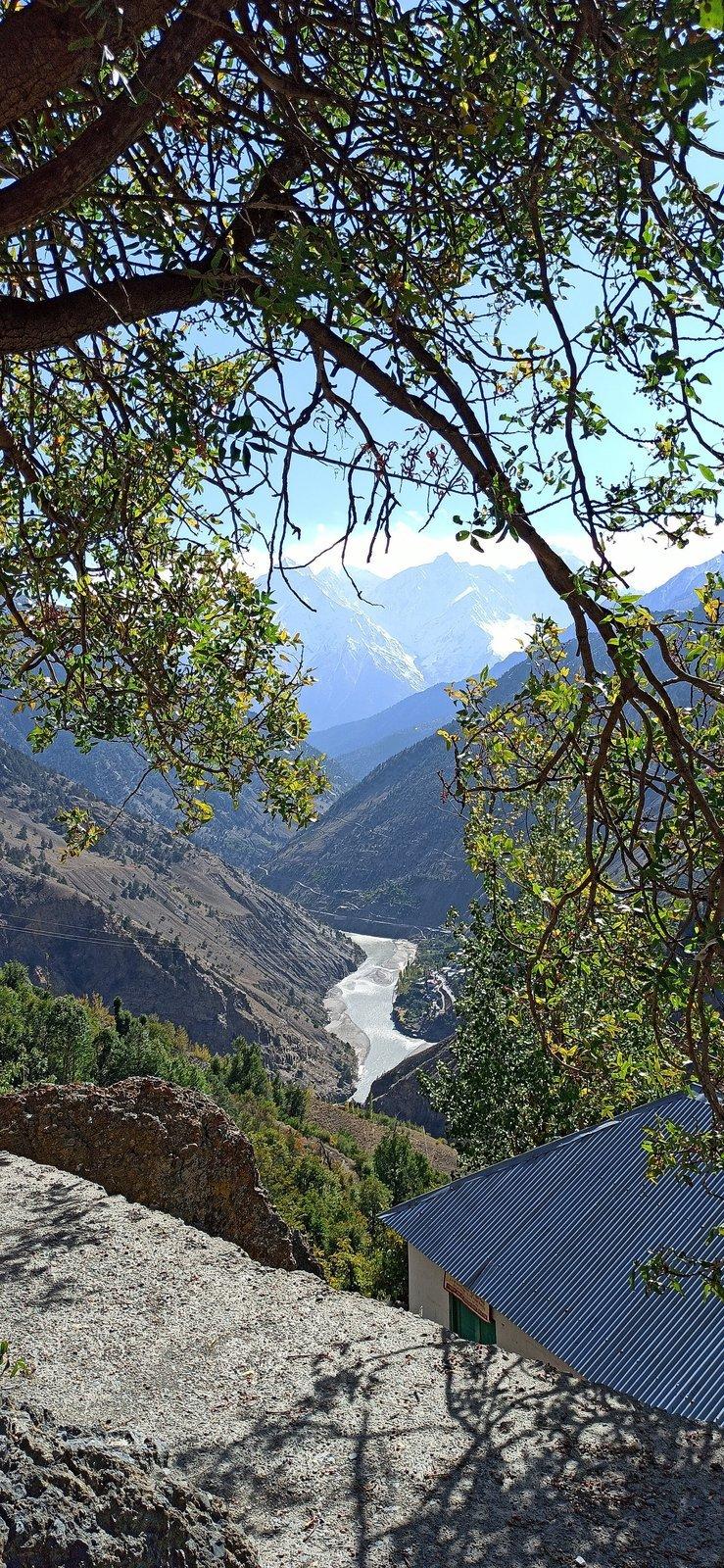
NH-5, the old Hindustan Tibet Road, is the single road in and out of Kinnaur. The Border Roads Organisation maintains it as a strategic route, and they do good work, but the terrain beats the road every year. Here is the section by section reality as of the 2025 to 2026 window.
Shimla to Narkanda, 65 km. Good. Recently widened in places. No drama.
Narkanda to Rampur, 95 km. Scenic Sutlej valley descent, mostly smooth, the road goes to single lane in a few bends.
Rampur to Jeori, 25 km. Average. This is where the valley starts narrowing and you feel it in the curves.
Jeori to Tapri, 40 km. Average to bad, landslide prone, single lane in patches. The BRO has a permanent camp on this stretch.
Tapri to Karcham, 15 km. The worst named section on the entire route. Active slide zone where, as the T26 research puts it, "the road literally falls into the Sutlej." Do not stop here for photos unless you are a geologist with a death wish. Keep driving, and if you have a choice between morning and evening, take morning.
Karcham to Reckong Peo, 38 km. Average, widening work ongoing near Peo.
Reckong Peo to Kalpa, 8 km. Good. Short climb, well maintained.
Pooh to Nako (Maling Nala), 30 km. This is the critical one for the upper Kinnaur leg. The Maling Nala stretch is an active landslide zone with closures that last hours or days, and the 2026 March 24 incident at Shongthong (a four foot deep crater across the entire road, cleared in three hours, reported by Jagran the same day) is the most recent reminder that this route is never "safe" in any final sense.
Permits, connectivity and practical nonsense
Permits
Indian nationals: no permit anywhere in Kinnaur or Spiti. Carry a government photo ID for checkposts but you will not be stopped for documentation. Foreign nationals: a Protected Area Permit (PAP) is required beyond the Jangi checkpost, which is about 35 km past Reckong Peo on the road to Spiti. Get the permit at the SDM office in Reckong Peo. Same day processing, usually within two hours. You need two passport photocopies, two passport size photos, a visa copy, and in some cases a declaration that you are travelling in a group of two or more. The permit covers the onward route to Spiti.
Connectivity
BSNL and Jio work in the main villages (Reckong Peo, Kalpa, Sangla) with patchy coverage. Vi and Airtel are unreliable. Chitkul has no signal at all and has not for years. Rakcham and Nako are intermittent. Download offline maps before you cross Karcham and tell somebody at your starting point what your plan is.
ATMs and cash
Reckong Peo has working ATMs. Everywhere else does not, reliably. Carry enough cash for your full trip, including emergency buffer. Homestays in smaller villages do not take UPI.
Medical
Basic government hospital in Reckong Peo. Nothing beyond that is better than a small PHC until you get back to Shimla. Altitude sickness is uncommon below 3,000 m but Chitkul and Nako are above that threshold. If you are flying straight to Shimla from the plains and then driving to Kinnaur the next day, acclimatise at Sarahan for a night.
Itineraries: 5, 7 and 10 days
Three versions, honest about what gets cut.
5 day express (Kalpa and Chitkul)
- Day 1: Shimla to Sarahan, 165 km
Drive via Narkanda and Rampur. Reach Sarahan by evening, overnight. Temple visit at first light.
- Day 2: Sarahan to Sangla, 95 km
Enter Kinnaur proper. Tapri-Karcham stretch, turn at Karcham, climb to Sangla. Overnight Sangla.
- Day 3: Sangla to Chitkul and back, 56 km return
Baspa valley day. Kamru fort morning, Chitkul by noon, walk and dhaba, back to Sangla for the night. Night sky walk.
- Day 4: Sangla to Kalpa, 50 km
Drive out via Karcham, cross to Kalpa. Afternoon viewpoint, evening orchards. Overnight Kalpa.
- Day 5: Kalpa to Shimla, 235 km
Dawn at the Kalpa viewpoint, breakfast, long drive back. Break at Narkanda for lunch. Arrive Shimla by evening.
7 day relaxed (the proper version)
- Day 1: Shimla to Sarahan
165 km. Bhimakali temple, acclimatise.
- Day 2: Sarahan to Sangla
95 km. Kamru fort afternoon, Sangla market.
- Day 3: Sangla Baspa day
Batseri weaving, Rakcham walk, return to Sangla night.
- Day 4: Sangla to Chitkul
28 km. Arrive by noon, dhaba lunch, village walks, night sky.
- Day 5: Chitkul to Kalpa
65 km. Morning at Chitkul, afternoon at Kalpa viewpoint.
- Day 6: Kalpa leisure
Dawn viewpoint, Roghi day trip, Telangi afternoon (apple sundowner in season).
- Day 7: Kalpa to Shimla
235 km. Return via Narkanda, end trip.
10 day grand circuit (Kinnaur plus Spiti entry)
- Day 1: Shimla to Sarahan
165 km. Bhimakali.
- Day 2: Sarahan to Sangla
95 km. Kamru fort.
- Day 3: Sangla area
Batseri, Rakcham, Baspa walks.
- Day 4: Sangla to Chitkul
28 km. Overnight Chitkul for stargazing.
- Day 5: Chitkul to Kalpa
65 km. Afternoon Kinner Kailash.
- Day 6: Kalpa leisure
Roghi, orchards, Telangi sundowner.
- Day 7: Kalpa to Nako
110 km. Pooh vineyards stop, Khab confluence, overnight Nako.
- Day 8: Nako to Tabo
55 km. Ancient Tabo monastery, entering Spiti proper.
- Day 9: Tabo to Kaza
47 km. Dhankar, Pin Valley edge, overnight Kaza.
- Day 10: Kaza onward
Continue Spiti circuit. See our Spiti Valley road trip guide for the Manali side return.
What a Kinnaur trip actually costs
Kinnaur per day costs (2026)
| Category | Amount | Note |
|---|---|---|
| Homestay or dorm | ₹500 to ₹800 | Budget tier, per person per night |
| Mid range hotel | ₹1,500 to ₹3,000 | Kalpa, Sangla options |
| Food per day | ₹300 to ₹800 | Dhaba and homestay meals |
| HRTC bus | ₹200 to ₹400 | Per day average |
| Shared taxi | ₹1,500 to ₹2,500 | Per day average |
| Private car and driver | ₹5,000 to ₹8,000 | Per day, driver from Shimla |
| Budget daily total | ₹1,000 to ₹1,700 | Bus plus dorm plus dhabas |
| Mid range daily total | ₹3,500 to ₹6,300 | Hotel plus restaurant plus shared taxi |
| 7 day budget total | ₹7,000 to ₹12,000 | Minimum viable |
| 7 day mid range total | ₹24,500 to ₹44,100 | Comfortable |
A Reddit user on r/SoloTravel_India put the practical floor at "₹1,200 to ₹1,500 daily including accommodation, food, and transport" and that number holds for 2026 if you stay in homestays, eat dhaba meals, and use HRTC buses for intervillage transit.
Frequently asked
What is Kinnaur famous for?
Six things. Indias premium apples (Kinnauri Royal Delicious historically fetched a premium over Shimla Royal). Chitkul, the last inhabited village on the Indian side of the Tibet border. The Kinner Kailash peak at 6,050 m, one of Shivas sacred abodes. A Hindu Buddhist culture with its own language (Kinnauri, Tibeto-Burman, roughly 10 dialects) and kath-kuni architecture. The Baspa Valley, one of Indias most scenic river valleys. And rare produce: chilgoza pine nuts (Indias only native source), walnuts, apricots, and the emerging high-altitude vineyards of Pooh and Ribba.
When is apple season in Kinnaur?
August to October, with September as the peak Royal Delicious harvest window. Early varieties ripen in August in the lower orchards near Tapri. The middle two weeks of September are the busiest on the roads because the apple lorries are moving constantly. Late September and the first half of October are the late varieties plus the best autumn colour and the clearest Kinner Kailash mornings. If you are coming specifically for the orchards, aim for September 10 to October 10.
How do I get from Shimla to Kinnaur?
One road: NH-5 east out of Shimla, through Narkanda, Rampur, Jeori, Tapri, Karcham to Reckong Peo. 235 km, 8 to 10 hours by car. HRTC buses leave Shimla ISBT in the morning (₹350 to ₹550) and terminate at Reckong Peo, Kalpa or Chitkul the same day. A private taxi costs ₹5,000 to ₹7,500 one way. Worth stopping at Narkanda for the orchards and Sarahan for the Bhimakali temple.
How many days do you actually need?
Five days is the minimum that returns the experience for the effort. Seven is the comfortable version. Ten lets you continue to Spiti via Nako and Tabo instead of turning around at Kalpa. The common mistake is trying to do Kinnaur in two to three days, which burns half of it on the drive in and out and leaves no time to sit still in any village.
Do I need a permit?
Indian nationals need no permit anywhere in Kinnaur or Spiti. Foreign nationals need a Protected Area Permit for the zone beyond the Jangi checkpost, about 35 km past Reckong Peo. Get it from the SDM office in Reckong Peo, same day processing. Bring two passport photocopies, two passport photos, and a visa copy. The permit covers the onward route to Spiti.
Is Kinnaur safe for solo female travellers?
Yes. Reddit confirms this and so does lived experience. The small village communities along the route mean everyone in Chitkul or Sangla or Kalpa knows the other homestays, the drivers, the shopkeepers. The main safety concerns on the trip are the roads (monsoon landslides) and the altitude, not personal safety. Standard precautions apply: share your itinerary with someone, carry cash, keep offline maps.
What is the difference between Kinnaur and Shimla apples?
Kinnaur orchards sit 600 m higher on average (2,000 to 3,200 m vs 1,400 to 2,500 m for Shimla). Higher altitude, colder nights, later ripening, slower sugar build. Kinnauri Royal Delicious historically commanded a ₹5 to ₹15 per kilo premium over Shimla Royal at the Delhi wholesale markets, reflecting taste and size. The 2025 season was an exception when the premium collapsed to parity, a first in living memory, but in a normal year the difference is real and tasted.
What are the dangerous sections of the Kinnaur road?
Three. Tapri to Karcham on NH-5, an active landslide zone. The Kalpa Roghi spur above Kalpa, called one of the most dangerous roads in Asia by India Art Review. And the Maling Nala stretch between Pooh and Nako, which is the most critical section on the upper Kinnaur leg. All are at their worst in July and August and at their best in September and October. A 2026 incident at Shongthong in March (four foot crater across the road, cleared in three hours, reported by Jagran) is a recent reminder that NH-5 is never safely final.
Can I see the Milky Way from Kinnaur?
Yes, clearly, from Chitkul. Chitkul sits at Bortle Class 2 to 3, the electricity cuts out around 10 pm, and the Milky Way core is visible to the naked eye from May to October. Rakcham is similar, with fewer tourists. The best nights are new moon weeks in September and October for post monsoon clarity. You need no equipment beyond warm clothes and patience for your eyes to dark adapt, which takes about 20 minutes.
What food should I try?
Siddu (steamed bread with walnut or poppy paste filling, the Kinnauri signature). Thupa (meat and vegetable noodle soup, Tibetan cousin). Butter tea (thang), churned tea leaves with salt and butter, drunk daily in upper Kinnaur. Chhang (fermented barley beer). Chilgoza pine nuts, Indias only native source, ₹2,000 to ₹3,000 per kilo in Reckong Peo market. Fresh trout from the Baspa River in Sangla between April and October. Best tried at homestays, not restaurants.
Is there really wine in Kinnaur?
Yes, and almost nobody outside the valley knows about it. Pooh and Ribba in upper Kinnaur sit at roughly 2,800 to 3,000 metres with small dark grape varieties that ripen in August and September. The villages produce Angoori (grape alcohol, stronger) and Shudang (closer to wine, lighter). It is not commercially bottled. You taste it at a homestay if the host has a bottle left. It is likely among the highest altitude wine production in India.
How does Kinnaur connect to Spiti?
The Kinnaur route is one of two approaches to Spiti Valley, the other being the Manali side over Kunzum Pass. Kalpa to Reckong Peo to Pooh to Khab to Nako to Sumdo to Tabo to Kaza. This side is open year round (unlike the Manali side, which closes 7 to 8 months a year) and is the landscape drama route: green forested Kinnaur transitions to arid moonscape Spiti over one afternoon of driving. Allow two days for the Kinnaur to Kaza leg. See our Spiti Valley road trip guide for the onward route.
A last word, from a Kinnauri
Every time I write about Kinnaur, I try not to sound like I am selling it, because it does not need selling. The valley has a way of weeding out the travellers who should not be there. If you come in July, the road turns you back. If you come in February, the cold does. If you come for three days, the distances eat your trip. If you come for ten days in late September with no fixed schedule, you do not want to leave.
I would tell you that the Kinner Kailash sunrise from Kalpa is the single best view in the Indian Himalaya, that siddu tastes better at a homestay in Rakcham than at any restaurant anywhere, that the Phag Mela in Sangla is the thing to come for if you care about festivals as events rather than as spectacles, and that the wine at nine thousand feet is not a gimmick. But you do not need me to tell you any of that. You need to come once, in the right month, and the valley will tell you itself.
When you are ready to come, we run experiences from a small base near Kalpa and the team at Refuje would be glad to plan around what you want. We are not a package operator. We are a group of people from Himachal who build trips for travellers who want to know where they are. Write to hello@refuje.com and tell us when you are thinking and what you want to see.
Safe roads, clear skies, and may you catch the September window.
Ajay Negi, for Refuje
About Ajay Negi
Ajay Negi is a co-founder of Refuje and a Kinnauri native. He grew up in the valley and writes about Kinnaur, the Sutlej corridor, and the eastern approach to Spiti.